Story Highlights
- Trump nominated Lance Schroyer, a 29-year Oklahoma law enforcement veteran, to become ICE’s first Senate-confirmed director since the Obama administration
- ICE arrests have climbed to approximately 2,000 per day over the past week, according to a source familiar with the numbers
- If confirmed, Schroyer would oversee a workforce of roughly 22,000 employees and a multibillion-dollar enforcement budget
What Happened
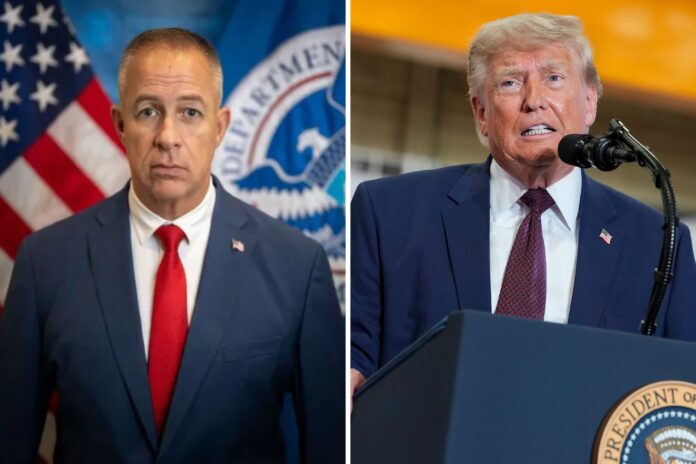
President Trump announced on Truth Social that he is nominating Lance Schroyer, a former Oklahoma State Trooper and U.S. Marine with 29 years of law enforcement experience, to serve as the permanent director of Immigration and Customs Enforcement. “Lance has firsthand experience getting Illegal Aliens OFF our streets and, just like ME and our Secretary of Homeland Security Markwayne Mullin, he LOVES the men and women of ICE,” Trump wrote, calling Schroyer “a PATRIOT with real operational experience” and urging the Senate to confirm him “IMMEDIATELY.”
Schroyer currently serves as a senior adviser to Homeland Security Secretary Markwayne Mullin, where he has helped coordinate between federal immigration authorities and local law enforcement agencies through the 287(g) program, which authorizes trained state and local officers to carry out certain federal immigration enforcement duties under ICE supervision. Mullin, who took over the Department of Homeland Security in March, praised the selection as a “great pick,” saying Schroyer’s operational background running large-scale enforcement efforts in Oklahoma positions him well to lead the agency. Republican Senator James Lankford of Oklahoma, Schroyer’s home state, also voiced strong support, calling him committed to “enforcing our immigration laws and keeping our communities safe.”
If confirmed, Schroyer would become the first Senate-confirmed ICE director since the Obama administration, ending nearly a decade of leadership by acting officials. He would replace acting director David Venturella, who took over after Todd Lyons stepped down from the role at the end of May. Trump’s first-term ICE nominee, Tom Homan, never secured Senate confirmation and instead went on to serve as the administration’s border czar shaping immigration policy from the White House. The permanent director role carries substantial authority over interior enforcement, detention operations, deportation logistics, and homeland security investigations tied to cross-border criminal activity.
The nomination arrives as ICE’s enforcement operations have intensified significantly. According to a source familiar with agency operations, arrests have climbed to approximately 2,000 per day over the past five days, a sharp increase that a second source described as part of a “new normal” the agency intends to sustain. A Department of Homeland Security spokesperson emphasized the administration’s enforcement posture, stating, “Our message is clear: if you come to our country illegally, we will find you, we will arrest you, and we will deport you.”
Why It Matters
The Schroyer nomination represents a significant institutional milestone for an agency that has operated without permanent, Senate-vetted leadership for the better part of a decade, spanning multiple administrations. Supporters argue that installing a confirmed director, subject to congressional oversight and accountability, brings needed stability and legitimacy to an agency at the center of the administration’s signature immigration enforcement agenda. Schroyer’s background at the state and local level, rather than within the federal bureaucracy, is seen by some officials as an advantage that could help him avoid the political baggage associated with prior federal appointees.
For the millions of Americans who support stronger immigration enforcement, the surge in daily arrests represents tangible progress toward the mass deportation campaign Trump promised throughout his 2024 campaign and has pursued aggressively since returning to office. The administration has repeatedly emphasized that enforcement priorities include violent criminals, gang members, and repeat immigration violators, framing the increased pace of arrests as evidence the policy is delivering results the American public demanded.
At the same time, the enforcement surge has coincided with rising scrutiny of ICE’s operational practices. Twenty individuals have died in ICE detention this year, and the Department of Homeland Security’s internal watchdog recently announced two separate reviews examining detainee deaths and whether facilities are complying with proper use-of-force standards. Confirmation hearings for Schroyer are likely to become a venue for both parties to litigate these broader questions about agency accountability, oversight, and operational tactics.
Economic and Global Context
ICE’s expanded enforcement operations carry substantial budgetary implications. Congress approved a $70 billion funding package earlier this year to support ICE and Customs and Border Protection operations through the remainder of Trump’s term, reflecting the scale of resources the administration has committed to its enforcement agenda. That funding has enabled significant expansion of detention capacity, personnel, and operational tempo, supporting the kind of sustained daily arrest numbers now being reported.
The broader immigration enforcement push also intersects with labor market dynamics in industries that have historically relied heavily on immigrant labor, including agriculture, construction, and hospitality. Business groups in several states have expressed concern about workforce disruptions as enforcement activity intensifies, even as administration officials maintain that prioritizing criminal offenders limits the impact on law-abiding workers and employers.
Internationally, the enforcement surge has drawn attention from origin countries whose nationals make up significant shares of ICE’s detained and deported populations, with several governments raising diplomatic concerns about detention conditions and deportation procedures. The administration has largely maintained its enforcement posture despite this international attention, framing immigration policy as a matter of domestic sovereignty rather than subject to foreign government input.
Implications
The Senate is expected to schedule confirmation hearings for Schroyer in the coming weeks, though the process could extend over several months given the scrutiny likely to accompany the nomination of a leader for such a consequential and controversial agency. Democratic senators are expected to press Schroyer on detainee treatment, use-of-force policies, and his vision for balancing aggressive enforcement with due process protections, while Republican senators will likely focus on his operational credentials and commitment to the administration’s enforcement priorities.
For ICE personnel, a confirmed director could provide greater organizational stability after years of leadership turnover, potentially improving morale and operational continuity within the agency’s roughly 22,000-person workforce. For communities across the country experiencing heightened enforcement activity, the elevated arrest pace is likely to continue regardless of the confirmation timeline, given Secretary Mullin’s explicit framing of the current tempo as a lasting operational baseline rather than a temporary surge.
Heading into the midterms, immigration enforcement will remain a defining issue for both parties, with Republicans likely to campaign on enforcement results and border security gains while Democrats highlight detention deaths and enforcement tactics as evidence of executive overreach.
Sources
“Trump nominates Oklahoma law enforcement veteran Lance Schroyer to lead ICE as permanent director”

