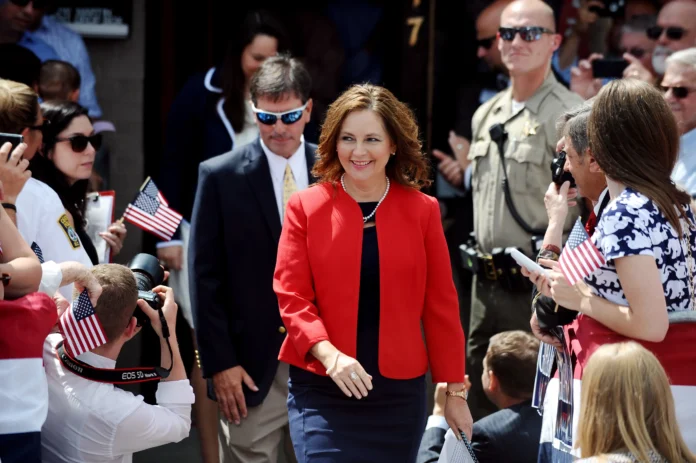
South Carolina swore in Darline Graham Nordone as the state’s first female U.S. senator just three days after the sudden death of her brother, longtime Senator Lindsey Graham, following a direct recommendation from President Trump. Governor Henry McMaster made the appointment official on Monday, calling it a fitting tribute to one of Trump’s closest Senate allies. The swift transition ensures South Carolina retains uninterrupted Republican representation as the state prepares for a special primary election next month.
Story Highlights
- Darline Graham Nordone was sworn in Tuesday, becoming South Carolina’s first female U.S. senator
- President Trump publicly recommended Nordone for the seat, calling it a “fabulous tribute” to his late ally
- Lindsey Graham died Saturday at 71 from an aortic dissection; a special primary election will be held August 11
What Happened
President Donald Trump moved quickly to shape the succession following the unexpected death of Senator Lindsey Graham, a South Carolina Republican who died Saturday at age 71. The Medical Examiner of the District of Columbia identified the preliminary cause of death as an aortic dissection resulting from arteriosclerotic cardiovascular disease. Within hours of the announcement, Trump took to Truth Social to recommend that South Carolina Governor Henry McMaster appoint Graham’s sister, Darline Graham Nordone, to serve out the remainder of his term. “This would be a fabulous tribute to Lindsey, who loved her dearly!” Trump wrote.
McMaster formally announced the appointment on Monday during an emotional news conference, saying Graham had cared for his sister throughout their lives and that it was now his honor to ask her to “finish his work for him.” Nordone, who had never previously held elected office, accepted the position after speaking with McMaster in the early morning hours following her brother’s death. “Lindsey has always been there for me. And now I will be there for him,” she said. Nordone was sworn in Tuesday afternoon on the Senate floor, with Senate Majority Leader John Thune presiding over the brief ceremony, making her the first woman to represent South Carolina in the United States Senate.
Nordone brings a background in public service to the role, having worked for years as director of public information for the South Carolina Vocational Rehabilitation Department and serving since 2019 as commissioner of the South Carolina Commission for the Blind, an agency focused on expanding employment opportunities for South Carolinians who are blind or have low vision. She also sits on the South Carolina State Workforce Development Board and is president-elect of the National Council of State Agencies for the Blind. The bond between the siblings dates back decades: after their parents died within roughly fifteen months of each other, a 22-year-old Lindsey Graham took legal guardianship of his then 13-year-old sister and later formally adopted her, ensuring she would be eligible for his military benefits and, notably, eligible to serve as first lady had he ever been elected president.
Senator Tim Scott of South Carolina publicly endorsed Nordone for the seat shortly after Trump’s recommendation, writing on social media that she “would be a fantastic pick to serve out the remainder of the senate term.” Nordone’s appointment is separate from the question of who will hold the seat long-term. Because Graham had been actively campaigning for a fifth term after defeating a wealthy primary challenger last month, South Carolina law requires a special primary election, scheduled for August 11, to determine the Republican nominee who will appear on the November ballot. Candidates have a one-week filing window beginning July 21. South Carolina businessman Mark Lynch, who lost to Graham in the earlier primary and is committing $5 million of his own money to the race, has already confirmed his candidacy, and Rep. Nancy Mace has been mentioned as a potential contender as well.
Why It Matters
Lindsey Graham was among the most influential Republicans in the Senate, wielding significant power on foreign policy and serving as one of Trump’s most consistent allies after a famously rocky relationship during the 2016 campaign. His sudden death removes a key voice from ongoing debates over foreign policy, judicial nominations, and the administration’s broader legislative agenda at a moment when Republicans hold narrow margins in the chamber. The rapid, orderly transition to his sister ensures continuity in South Carolina’s representation without a prolonged vacancy that could complicate close votes.
For Trump, the episode underscores his continued influence over state-level Republican politics, with his public endorsement effectively settling the question of interim succession within a single day. That kind of rapid coalescing around a single choice, with prominent state Republicans like Scott immediately falling in line, illustrates the president’s continued command over the party’s machinery even in a moment of personal loss for many of his closest allies.
The coming special primary will be closely watched as a test of Trump’s continued sway in down-ballot Republican primaries, particularly given that a well-funded challenger has already entered the race. How the party manages this transition, and whether Nordone herself ultimately seeks the seat beyond January, will shape South Carolina’s political landscape heading into a competitive midterm cycle in which Republicans are working to protect their Senate majority.
For voters, the succession illustrates the practical mechanics of American governance when a sitting senator dies in office, a process that varies significantly from state to state and carries real consequences for which party controls key committee votes in the interim.
Economic and Global Context
While Graham’s death and the succession process are primarily domestic political matters, the loss of his voice on the Senate Armed Services and Judiciary Committees carries real implications for ongoing national security debates, including active congressional oversight of the administration’s military operations in the Middle East and its broader foreign policy posture. Graham had long been one of the Senate’s most hawkish voices and a key advocate for robust American engagement abroad, and his absence changes the internal dynamics of committees central to war powers and defense appropriations debates.
The special election itself carries modest but real economic implications for South Carolina, as competitive primary and general election campaigns typically inject millions of dollars into state and local economies through advertising, staffing, and campaign infrastructure. Mark Lynch’s early $5 million self-funding commitment signals that the special primary will be a well-resourced affair even in its compressed timeline.
Nationally, the succession adds another data point to a broader pattern of family members and close allies stepping into vacated seats, a dynamic increasingly common in American politics and one that raises ongoing questions about political dynasties and continuity within state party establishments.
Implications
In the near term, Nordone will need to quickly acclimate to Senate procedures and committee assignments despite having no prior legislative experience, relying heavily on Graham’s former staff to maintain continuity in constituent services and policy positions. Her voting record in the coming months will be closely watched by both Republican leadership and South Carolina voters as an early indicator of how she intends to approach the role.
For the special primary, candidates now have a compressed one-week filing window followed by just weeks of campaigning before the August 11 vote, favoring candidates with existing name recognition and fundraising infrastructure, advantages that likely benefit contenders like Mark Lynch, who already ran a statewide primary campaign earlier this year.
For Senate Republican leadership, maintaining a fully seated caucus during ongoing legislative battles over defense appropriations, judicial confirmations, and the administration’s broader agenda remains a priority, and Nordone’s swift swearing-in ensures no gap in South Carolina’s Senate representation during this critical period heading into the 2026 midterms.
Sources
“South Carolina governor picks Lindsey Graham’s sister to finish his Senate term”

