President Trump declared Wednesday that Immigration and Customs Enforcement will not abandon vehicle stops as an enforcement tool, one day after the agency temporarily suspended most such stops following two fatal officer-involved shootings within a week. The reversal highlights the administration’s continued commitment to aggressive immigration enforcement even as questions mount over agent training and safety protocols. Trump’s stance sets up a direct contrast with critics who argue the recent incidents demand deeper scrutiny before enforcement resumes at full capacity.
Story Highlights
- ICE briefly suspended most vehicle stops nationwide after fatal shootings of drivers in Houston and Biddeford, Maine within a six-day span
- Trump declared on Truth Social that ending vehicle stops would only benefit criminals, calling the tactic one of ICE’s “most important” tools
- Border czar Tom Homan described the pause as temporary, aimed at reviewing training rather than a permanent policy shift
What Happened
Donald Trump said Wednesday that federal immigration agents would not discontinue vehicle stops as an enforcement method, declaring on Truth Social that “we cannot give up one of I.C.E.’s most important and effective Crime Fighting tools, THE TRAFFIC STOP!” His statement came one day after Trump administration officials confirmed that Immigration and Customs Enforcement had ordered officers to suspend most vehicle stops nationwide following two fatal shootings of drivers within the span of a week.
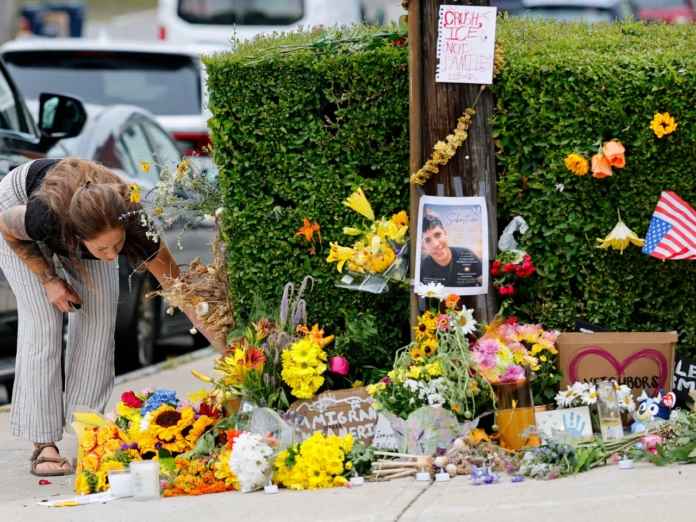
The pause followed the death of Johan Sebastián Guerrero, a 25-year-old Colombian national fatally shot by an ICE agent in Biddeford, Maine on Monday after agents attempted to stop the vehicle he was driving. According to Maine Senator Angus King, Guerrero was not the target of the operation; agents had been pursuing a different individual with a final removal order. A week earlier, an ICE officer in Houston fatally shot Lorenzo Salgado Araujo, a Mexican national who had lived in the United States for more than three decades, during a separate traffic stop while he was driving to work with three passengers.
Border czar Tom Homan characterized the suspension as a short-term review rather than a permanent policy change. “It’s not a policy change, it’s a temporary pause,” Homan told Fox News, adding that ICE agents would receive updated training on vehicle stop procedures and that officers would rely on alternative enforcement methods during the review period. According to sources familiar with the internal directive, some vehicle stops could still occur during the pause if conducted alongside local law enforcement partners trained under the agency’s 287(g) program.
ICE has characterized both men killed in the recent shootings as “illegal aliens” but acknowledged that neither was the specific target of the operations that led to their deaths. The Department of Homeland Security has faced mounting pressure from lawmakers, including Republican Senator Susan Collins of Maine, who said the Biddeford shooting “raised important questions” and pressed Homeland Security Secretary Markwayne Mullin for further explanation. According to reporting, at least 22 people have been fired upon by federal immigration agents since January 2025, with six fatalities, including three U.S. citizens, in incidents that have overwhelmingly involved officers firing into vehicles.
Why It Matters
Trump’s swift reversal of the ICE pause underscores the administration’s prioritization of maintaining aggressive enforcement numbers even amid safety concerns raised by lawmakers within his own party. The tension between operational tempo and officer training standards has become a recurring theme as the administration pursues record-level arrest and deportation figures central to its immigration policy agenda.
The back-to-back fatal shootings have intensified scrutiny of ICE’s operational procedures, including the agency’s continued lack of standardized body camera requirements for field agents, a gap that has complicated independent verification of officer accounts in high-profile incidents. This absence of consistent documentation has fueled distrust among affected communities and additional political pressure from both parties.
For Republican lawmakers facing competitive midterm races, including Collins in Maine, the incidents present a delicate balancing act between supporting the administration’s enforcement priorities and responding to constituent concerns about agent conduct following fatal encounters involving individuals who were not the intended targets of enforcement operations.
The episode also highlights broader questions about training adequacy as ICE has rapidly scaled up staffing and operational tempo to meet the administration’s deportation targets, a expansion that critics argue has occurred faster than corresponding investments in de-escalation training and oversight mechanisms.
Economic and Global Context
The shootings and subsequent policy reversal arrive amid a broader national debate over the economic and labor market effects of intensified immigration enforcement. Communities in Houston and coastal Maine, both sites of recent fatal incidents, have seen visible protest activity, with demonstrations reported in Boston as well, reflecting how localized enforcement actions can generate broader regional political consequences.
Immigration enforcement operations carry direct economic implications for industries that rely heavily on immigrant labor, including agriculture, construction, and food service. Disruptions tied to visible enforcement actions, including community protests and shifting operational tactics, can create uncertainty for employers navigating workforce planning in affected regions.
The administration has emphasized that arrests and deportations remain at record levels despite the temporary vehicle stop pause, according to Homan’s public statements, suggesting officials view the review period as compatible with maintaining aggressive enforcement metrics that have become a central administration talking point.
Implications
In the near term, ICE’s training review is expected to conclude within a short timeframe, according to officials familiar with the process, after which vehicle stops are likely to resume at or near previous operational levels given Trump’s explicit public commitment to preserving the tactic.
For congressional Republicans in competitive districts, continued scrutiny of ICE shooting incidents may require careful messaging that supports enforcement priorities while acknowledging legitimate safety and training concerns raised by constituents and local officials.
Civil liberties advocates and some Democratic lawmakers are likely to continue pushing for mandatory body camera requirements and independent oversight mechanisms for ICE field operations, a policy debate that could gain renewed traction given the pattern of fatal incidents involving unintended targets.
State and local officials in areas with active ICE enforcement operations, including Texas and Maine, will likely continue monitoring the situation closely, particularly regarding coordination protocols between federal agents and local law enforcement partners under programs like 287(g).
Sources
Trump says ‘we cannot give up’ on ICE vehicle stops after temporary halt

