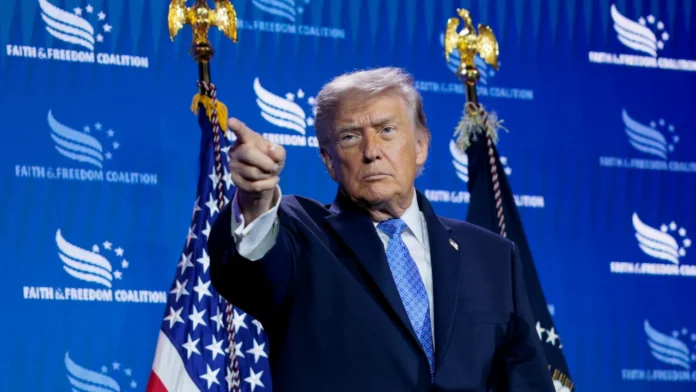
President Trump has abandoned his proposal to charge a 20 percent fee on cargo transiting the Strait of Hormuz, announcing instead that Gulf nations will pursue major trade and investment agreements with the United States. The reversal, delivered on Truth Social following what Trump described as productive conversations with Middle East leadership, comes as the administration simultaneously reinforces a naval blockade targeting Iranian shipping through the strategically vital waterway. The shift underscores the administration’s evolving strategy for managing both the economic and military dimensions of the ongoing confrontation with Iran.
Story Highlights
- Trump has dropped the proposed 20 percent United States Reimbursement Fee on cargo passing through the Strait of Hormuz
- The president says Gulf states will instead make large-scale trade and investment commitments into the United States
- The announcement came alongside confirmation that the U.S. will maintain a full naval blockade targeting Iranian-linked shipping through the strait
What Happened
President Donald Trump announced on Truth Social that he had decided to scrap a previously floated 20 percent fee on commercial cargo passing through the Strait of Hormuz, one of the world’s most critical maritime chokepoints for global oil and natural gas shipments. The fee, which Trump had proposed as a way to help the United States recoup the costs of protecting the waterway, was replaced instead with a commitment to pursue trade and investment deals with Gulf nations. “Based on highly productive conversations with Middle East leadership, I have decided to replace the 20% United States Reimbursement Fee with Trade and Investment Deals that the various Gulf States will be making into the United States,” Trump wrote, adding that the investments “will be MASSIVE” and “extraordinarily good” for the participating countries’ futures.
The reversal came just one day after Trump had initially floated the fee proposal, and followed direct conversations with regional leaders during a meeting with Iraqi Prime Minister Ali al-Zaidi in the Oval Office. Trump told reporters that Gulf state leaders had expressed strong interest in investing in the United States “at record amounts,” and framed the shift away from a formal fee structure as a mutually beneficial arrangement. “I don’t like the concept of a fee, but at the same time, it’s not fair that we’re protecting this strait for the entire world, for China and everyone,” Trump said, underscoring his continued frustration with what he views as free-riding by other nations that benefit from secure shipping lanes without contributing to their protection.
Alongside the announcement, Trump confirmed that the United States would maintain a full naval blockade targeting vessels traveling to and from Iranian ports or carrying Iranian-linked cargo, distinguishing this measure from the broader commercial shipping fee that had applied more generally to all cargo transiting the strait. The blockade reflects the administration’s continued effort to apply economic pressure on Tehran even as it pursues warmer economic relationships with other Gulf nations in the region.
The episode unfolded against the backdrop of Iran’s own competing claims over the strait. Tehran has separately pushed to assert a form of sovereign control over passage through the waterway, including reported efforts to draft a permitting protocol with Oman that would require ships to obtain licenses before transiting, despite the strait’s long-standing status as a free international waterway under international maritime law. Iranian officials have also floated their own transit fees on select vessels, a move Washington and its Gulf allies have firmly opposed.
Why It Matters
The reversal highlights the administration’s preference for negotiated economic arrangements over unilateral fee structures when managing relationships with strategically important Gulf partners. For an administration that has placed significant emphasis on attracting foreign investment into the United States, framing the Hormuz policy shift around inbound Gulf capital rather than a shipping toll aligns with the broader “America First” investment strategy that has characterized much of Trump’s economic approach to the region.
For global energy markets, the decision to drop the fee removes a potential source of shipping cost volatility that had worried industry analysts. A formal 20 percent cargo fee could have significantly increased transportation costs for the roughly one-fifth of the world’s oil and gas that flows through the strait, with downstream effects on global energy prices and inflation. Avoiding that outcome reduces near-term uncertainty for shipping companies and energy traders navigating an already volatile regional security environment.
For Gulf nations, the pivot to investment deals offers a face-saving alternative to a fee structure that many allied governments had reportedly opposed, while still delivering tangible economic benefits to the United States. The arrangement allows Gulf states to demonstrate continued alignment with Washington without absorbing the reputational or financial costs associated with a formal shipping toll.
Economic and Global Context
The Strait of Hormuz carries approximately 20 percent of the world’s oil and gas shipments, making any disruption or additional cost imposed on transit through the waterway a matter of significant global economic concern. Oil prices have fluctuated considerably throughout the year amid the broader Iran conflict, at one point falling below 100 dollars per barrel following an earlier ceasefire announcement, only to face renewed upward pressure as tensions have resurfaced in recent weeks.
The scale of the promised Gulf investment deals remains unspecified, with the administration declining to release specific details about the size or sectors targeted by the new agreements. However, Gulf sovereign wealth funds, including those of Qatar, Saudi Arabia, and the United Arab Emirates, have collectively committed hundreds of billions of dollars toward U.S. investments in recent years, suggesting the new commitments could build on an already substantial existing base of Gulf capital flowing into American markets.
The continued naval blockade targeting Iranian shipping adds another layer of complexity to global energy logistics, as shipping companies and insurers must continue navigating a bifurcated system in which some cargo faces restrictions while general commercial traffic through the strait proceeds without the previously proposed fee.
Implications
In the near term, expect the administration to begin releasing additional details about the specific trade and investment agreements being negotiated with individual Gulf nations, which will likely become a focal point of ongoing diplomatic engagement between Washington and the region. The scale and sector focus of these deals will be closely watched by American businesses in energy, infrastructure, and defense sectors that stand to benefit from expanded Gulf capital inflows.
For the shipping and energy industries, the removal of the proposed cargo fee provides welcome near-term cost certainty, though the continued blockade on Iranian-linked shipping means the broader security situation in the strait remains far from fully resolved. Companies operating in the region will need to continue closely monitoring developments given the fluid nature of both the fee policy and the underlying conflict with Iran.
For Gulf allies, the investment-based approach offers an opportunity to deepen economic ties with Washington at a moment of heightened regional instability, potentially strengthening diplomatic relationships that could prove valuable as the broader Iran conflict continues to evolve in unpredictable ways.
Sources
“Trump scraps proposed Strait of Hormuz shipping fee for Gulf states’ investment deals”

