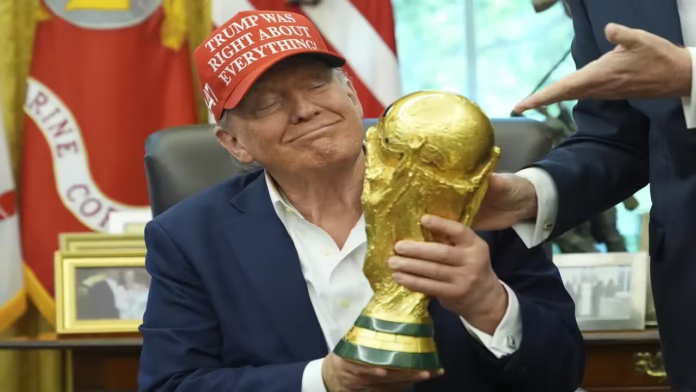
President Trump will take center stage at MetLife Stadium this Sunday, July 19, joining FIFA President Gianni Infantino to jointly present the World Cup trophy to the tournament’s winning captain, a striking departure from decades of FIFA protocol that has typically reserved that honor for the organization’s president alone. The moment caps a tournament the White House is calling the most watched, most secure, and most successful World Cup in American history. Trump’s role underscores the close working relationship he has built with FIFA leadership throughout preparations for the historic first World Cup jointly hosted by the United States, Mexico, and Canada.
Story Highlights
- Trump will jointly present the World Cup trophy alongside FIFA President Gianni Infantino following Sunday’s final between Argentina and Spain
- The move breaks with recent FIFA tradition, where the organization’s president alone has presented the trophy at the last two tournaments
- White House Press Secretary Karoline Leavitt called the tournament the most watched, secure, and successful World Cup in American history
What Happened
The White House confirmed this week that President Trump will attend the 2026 FIFA World Cup final between Argentina and Spain on Sunday, July 19, at MetLife Stadium in East Rutherford, New Jersey, capping a six-week tournament that marked the first World Cup jointly hosted across the United States, Mexico, and Canada. FIFA President Gianni Infantino confirmed weeks in advance that Trump would join him in handing the trophy to the winning team’s captain, a decision Infantino described directly during an interview on Fox and Friends, saying “we will be together with the president enjoying the final and handing the trophy to the winner, of course, together.”
The arrangement marks a significant break from recent tournament tradition. At both the 2018 World Cup in Russia and the 2022 tournament in Qatar, Infantino alone handled the trophy presentation to the champions. Heads of state have participated in the ceremony only occasionally in past decades, with Spain’s King Juan Carlos presenting the trophy to Italy’s captain in 1982 and Queen Elizabeth II handing it to England’s captain following the 1966 tournament, making Trump’s inclusion a notable and relatively rare honor extended to a sitting head of state.
Trump’s relationship with Infantino and FIFA has been closely cultivated throughout the tournament’s build-up. In December 2025, Trump received FIFA’s inaugural Peace Prize from Infantino during the World Cup draw ceremony held at the Kennedy Center in Washington, and the two have appeared together at numerous events since. Trump also attended last year’s FIFA Club World Cup final at the same MetLife Stadium venue, where Chelsea defeated Paris Saint-Germain, giving him a preview of his role at this year’s championship match. According to the White House, Trump will additionally attend a reception for FIFA officials at Trump Tower in New York ahead of Sunday’s final.
White House Press Secretary Karoline Leavitt characterized the tournament’s conclusion as a signature achievement of the administration, telling reporters, “We look forward to the final match on Sunday, and I know the president looks forward to attending. His attendance will cap what has been the most watched, most secure, and most successful World Cup in American history.” The 48-team tournament, expanded from the 32-nation format used in Qatar, represented the largest World Cup ever staged and unfolded against the backdrop of America’s approaching 250th anniversary celebrations, a connection the administration has emphasized throughout the tournament’s promotion.
Why It Matters
The trophy presentation, however brief in the broader scope of the tournament, carries outsized symbolic weight for an administration that has consistently sought to position major international events as showcases for American strength, security, and organizational competence. Hosting the largest World Cup in history across three North American nations, without major security incidents disrupting the tournament, represents a substantial logistical achievement that the administration is positioning as evidence of its broader governing capability heading into a competitive midterm election cycle.
For Republicans, high-profile presidential appearances at globally watched sporting events like the World Cup final offer a rare opportunity to project a unifying, celebratory image distinct from the more contentious policy battles dominating daily headlines. Trump has strategically built a pattern of attending marquee sporting events throughout his second term, including the U.S. Open men’s final, the Ryder Cup, and the NBA Finals, cultivating a visible connection to popular culture and national celebration that carries political value independent of any specific policy achievement.
The security dimension also carries genuine substantive weight. Coordinating security for a 48-team, multi-nation tournament spanning dozens of matches across three countries represented an unprecedented logistical undertaking for federal, state, and local law enforcement agencies, and the tournament’s conclusion without major incident offers the administration a concrete talking point regarding its broader approach to homeland security and event protection heading into the 250th anniversary celebrations this year.
For America’s standing on the global sporting stage, successfully co-hosting the expanded tournament also carries long-term economic and diplomatic implications, reinforcing the country’s position as a premier host for future international sporting events and strengthening ties with FIFA leadership ahead of future bidding cycles for other major tournaments.
Economic and Global Context
The economic scale of hosting the World Cup final at MetLife Stadium extends well beyond the single match. Economic impact studies of prior World Cup host cities have typically estimated hundreds of millions of dollars in direct spending on hospitality, transportation, and tourism during tournament host weeks, with the New York metropolitan region hosting eight matches total, including the championship final, representing one of the most economically significant stops on the tournament’s North American circuit.
The expanded 48-team format itself represents a substantial commercial evolution for FIFA and its broadcast and sponsorship partners, with the larger tournament structure generating additional matches, extended broadcast windows, and expanded sponsorship inventory compared to the 32-team format used in prior tournaments. FIFA’s dynamic ticket pricing structure for the tournament drew criticism from supporters’ groups concerned about affordability, though the approach also reflected the substantial global demand for tickets to marquee matches throughout the expanded field.
Internationally, the trophy presentation ceremony will be watched by what is expected to be one of the largest global television audiences in sporting history, given the World Cup final’s traditional status as among the most-watched annual sporting events worldwide. Trump’s prominent role in the ceremony ensures his image will be broadcast to a global audience spanning billions of viewers across dozens of countries, a level of international visibility matched by few other events available to any sitting American president.
Notably, not every allied head of state chose to attend the final. Argentine President Javier Milei, despite his close alliance with Trump, confirmed he would skip the event to watch from Argentina’s presidential residence instead, illustrating that even close political allies did not uniformly prioritize attendance at the ceremony despite Trump’s prominent role in it.
Implications
In the immediate term, Sunday’s ceremony will generate substantial global media coverage regardless of which nation, Argentina or Spain, ultimately claims the championship, with Trump’s participation ensuring the moment receives outsized attention in American political and sports media coverage alike.
For FIFA and Infantino, the decision to include Trump in the trophy ceremony reflects the organization’s calculated effort to maintain strong relations with the United States government ahead of future events, including potential future World Cup hosting bids and other major FIFA competitions likely to include American venues in coming tournament cycles.
For American security and event planning agencies, the successful conclusion of the tournament will likely serve as a case study and template for coordinating security at future large-scale international events on American soil, including preparations already underway for the Los Angeles 2028 Summer Olympics.
For voters, the imagery from Sunday’s ceremony will likely feature prominently in Republican messaging heading into the fall midterms, offering a visual centerpiece for an administration eager to highlight successful execution of a major national moment alongside its broader policy agenda.
Sources

