Story Highlights
- Trump warned Iran it would be hit “VERY HARD TONIGHT” if it declines to sign a peace agreement, posting the threat publicly on social media
- Iran’s IRGC launched retaliatory strikes against U.S. military bases in Kuwait, Bahrain, and Jordan, according to Iranian state media
- Iran has shut the Strait of Hormuz to all marine traffic, blocking a waterway that previously carried roughly 20 percent of global oil supply
What Happened
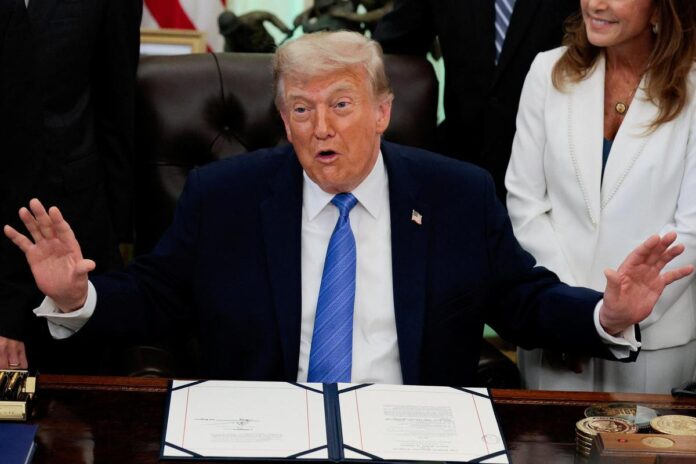
President Donald Trump vowed on Thursday morning that the United States would launch “bigger” and “more powerful” military action on Iran that night, in what would represent a third round of strikes since the two nations began trading blows earlier in the week. The president delivered the warning both through social media and in a blunt Fox News interview, telling the network that U.S. forces would bomb Iran if Tehran declined to sign a peace agreement.
Trump said the United States would hit Iran “VERY HARD TONIGHT” and stated that Washington intended to take “total control” of the country’s oil and gas industry at some future point. The threat followed what administration officials described as Iran’s failure to negotiate in good faith after a ceasefire announced earlier this spring broke down. Trump also framed the renewed offensive as a direct response to the downing of an American military helicopter and his stated frustration with stalled peace talks.
Iran’s Islamic Revolutionary Guard Corps responded by claiming it had launched retaliatory strikes against U.S. forces in the region, with attacks reported on American military installations in Kuwait, Bahrain, and Jordan. The exchange marked the most direct and geographically wide confrontation between U.S. and Iranian forces since the war began in February. Iran also announced the closure of the Strait of Hormuz to all marine traffic, cutting off a key waterway that previously carried approximately 20 percent of the world’s oil supply.
Trump announced the beginning of major combat operations against Iran on February 28, with massive joint U.S.-Israeli strikes targeting military, government, and infrastructure sites. Following an announced two-week ceasefire, initial U.S.-Iran negotiations in Pakistan in April failed to produce a peace deal. Trump later announced an open-ended extension of the ceasefire paired with a continued U.S. naval blockade until negotiations were concluded. That fragile arrangement has now fully collapsed.
Trump told Fox News that he did not believe the American public had the appetite for ground troops in Iran, but said seizing Kharg Island — the country’s primary oil export hub — remained his preference. Iranian officials reportedly contacted Trump to seek an end to the latest strikes, a development the president acknowledged while continuing to threaten further military action.
Why It Matters
The renewed hostilities represent a major inflection point in a conflict that has already reshaped global energy markets, strained alliance relationships, and tested the limits of presidential war powers. For the Trump administration, the decision to escalate rather than de-escalate signals a commitment to achieving decisive military and economic leverage over Iran before accepting any negotiated settlement. Whether that strategy produces a favorable deal or a deeper quagmire remains the defining question of Trump’s second term.
For American military families and service members deployed throughout the region, the expanded Iranian retaliatory strikes against bases in Kuwait, Bahrain, and Jordan represent a direct and immediate personal danger. The administration has not disclosed casualty figures from any of the exchanges this week, and the Pentagon has continued to describe operations in broad terms without confirming specific losses.
The political ramifications at home are also significant. Trump ran in 2024 on a platform of keeping the United States out of foreign wars and prioritizing domestic prosperity. The Iran conflict — now spanning more than three months of active military operations — has forced a fundamental reassessment of that brand. Republicans in Congress who fear the political fallout heading into the November midterm elections are watching the situation carefully, particularly as rising energy costs and inflation strain household budgets.
Congressional Democrats have seized on the escalation to argue that Trump’s foreign policy is both reckless and strategically incoherent. They contend that the absence of a clear endgame, combined with closed-door decision-making on military operations, represents a dangerous concentration of war-making authority in the executive branch.
Economic and Global Context
The closure of the Strait of Hormuz has sent immediate shockwaves through global energy markets. The strait is the single most important chokepoint for global oil trade, and its blockade has driven energy prices to levels not seen in years. According to Bureau of Labor Statistics data released Wednesday, energy costs account for more than 60 percent of the most recent increase in the Consumer Price Index, with energy prices rising 3.9 percent in May following a 10.9 percent jump in March when the war resumed in full force.
Oil analysts and multinational corporations with supply chains dependent on Middle Eastern energy have begun contingency planning for a prolonged closure scenario. Several tanker operators have suspended Gulf operations entirely, triggering spot market price surges. The broader economic cost of the conflict is being measured not just in military expenditure but in the compounding inflationary pressure that constrained consumer purchasing power creates for millions of American households.
Globally, U.S. allies in Europe and Asia are watching the situation with growing alarm. The United Kingdom, which allowed American forces to use British bases in Cyprus for defensive missile operations, has been pulled further into the conflict than it anticipated. Gulf Cooperation Council members, including Saudi Arabia and the UAE, have backed the U.S.-led coalition but are simultaneously calculating the cost of an extended war against a neighbor across a shared waterway.
Iran’s decision to close the Strait of Hormuz is arguably its most powerful economic counterpunch, one that inflicts pain not just on the United States but on the entire global economy. Trump has referenced ongoing efforts to secretly route oil shipments through the strait, but the scale of that operation has not been publicly confirmed and its effectiveness remains unclear under wartime conditions.
Implications
The night of June 11 will be a defining moment. If Trump follows through on his threat and the United States launches its largest strike package yet, Iran faces a decision about whether to escalate further or signal a willingness to return to the negotiating table. A continued Iranian counter-escalation could draw additional regional actors into the conflict and pose serious risks to the roughly 50,000 American military personnel currently stationed across the Middle East.
For Republican lawmakers, the Iran war is becoming an increasingly uncomfortable political liability. With midterm elections approaching, constituents who were promised lower prices and domestic focus are instead confronted with a wartime economy, rising gas prices, and an ongoing military commitment with no declared end date. The administration will need to demonstrate measurable progress — either through a negotiated deal or a decisive military outcome — to sustain political support.
For global energy markets, the next 30 to 60 days are critical. If the Strait of Hormuz remains closed, alternative supply routes and emergency strategic reserve releases will come under enormous pressure. The International Energy Agency and individual governments are already coordinating emergency responses, but there is no adequate short-term substitute for the volume of oil that previously transited that waterway.
Ultimately, the outcome of this conflict will define not just Trump’s legacy but the broader shape of American foreign policy for a generation. The combination of direct military confrontation with Iran, a contested intelligence apparatus at home, and a domestic economy absorbing the shocks of war creates a strategic environment with very little margin for error.
Sources

