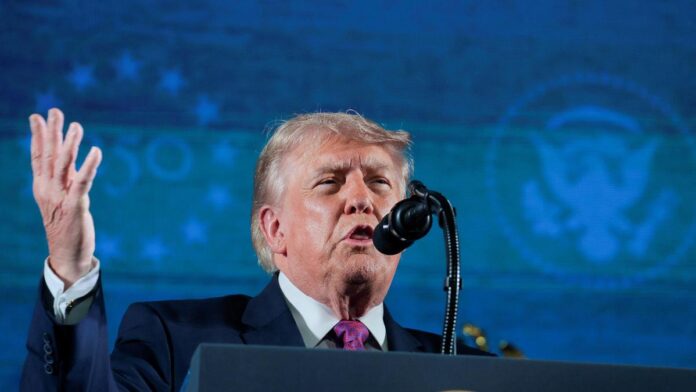
President Trump ushered in the nation’s 250th anniversary weekend with a stark warning about what he called a resurgent communist threat within American borders, delivering the message beneath the iconic granite faces at Mount Rushmore. The speech blended sweeping patriotic tributes to American exceptionalism with pointed political attacks on the rising wave of democratic socialist candidates who have won recent primary elections. Republican officials in attendance, including Senate Majority Leader John Thune and Florida Governor Ron DeSantis, joined Trump for the address as fireworks capped the evening.
Story Highlights
- Trump declared “a resurgence of the communist menace in our land” during his July 3 address at Mount Rushmore National Memorial in South Dakota.
- The president said communism poses a greater threat to America than World War I, World War II, Pearl Harbor, or the September 11 attacks.
- The speech followed a string of recent primary victories by democratic socialist candidates in New York, Colorado, and Texas.
What Happened
President Donald Trump traveled to Mount Rushmore National Memorial in Keystone, South Dakota, on July 3 to deliver a widely anticipated address kicking off the weekend celebrations marking the 250th anniversary of American independence. Speaking beneath the carved faces of Presidents Washington, Jefferson, Roosevelt, and Lincoln, Trump combined soaring rhetoric about American exceptionalism with a dark warning about what he described as a resurgent communist threat within the country. “There is now a resurgence of the communist menace in our land, including from newcomers to our country who embrace ideas totally opposed to our way of life,” Trump told the crowd, calling communism “the enemy of the Constitution.”
In some of his most pointed language, Trump declared communism “a mortal threat to American liberty,” stating it represents “the greatest threat to our country, including World War I, World War II, Pearl Harbor or even 9/11.” He continued with a stark binary framing, telling the audience, “You can be loyal to Karl Marx or you can be loyal to America. You can be a communist or you can be a patriot. You cannot be both.” Trump did not name specific political figures in connection with the communist threat, but the remarks followed a recent wave of primary victories by democratic socialist candidates across multiple states, including New York, Colorado, and Texas.
The president also used the occasion to promote his signature legislative priority, the SAVE America Act, telling the crowd that the only way to ensure Republican success in the midterm elections was to abolish the Senate filibuster and pass the voting overhaul legislation, which would require documentary proof of citizenship to register to vote and photo identification to cast a ballot. Trump celebrated American military achievements throughout the speech, referencing victories in both World Wars and claiming recent successes against Venezuela and Iran, stating the U.S. “beat Venezuela in one day” and “knocked the hell out of Iran.”
Several prominent Republican officials attended the event, including Senate Majority Leader John Thune, South Dakota Senator Mike Rounds, South Dakota Governor Larry Rhoden, Lieutenant Governor Tony Venhuizen, Interior Secretary Doug Burgum, and Florida Governor Ron DeSantis. The event marked the first Mount Rushmore fireworks display since 2020, after the National Park Service under the Biden administration had discontinued the tradition. Trump’s Department of the Interior approved the display’s return this year through his Freedom 250 planning initiative, a group the president created by executive order to help orchestrate the nation’s semiquincentennial celebrations.
Republican strategist Eli Bremer, speaking to Al Jazeera about the address, noted that portions of the speech carried a unifying tone reminiscent of past Republican presidents, saying parts “could have been delivered by Ronald Reagan.” The speech notably coincided with a starkly different Fourth of July message delivered separately by New York City Mayor Zohran Mamdani, a self-described democratic socialist, whose own address focused heavily on criticizing American institutions and immigration enforcement.
Why It Matters
Trump’s decision to frame the electoral rise of democratic socialist candidates in explicitly Cold War-era terms represents a significant escalation in the rhetorical battle lines being drawn ahead of the 2026 midterm elections. By connecting recent primary wins by self-described democratic socialists to a broader narrative about communist infiltration, Trump is signaling that Republican midterm messaging will likely center heavily on ideological contrasts with the Democratic Party’s leftward-shifting base.
For Republican candidates running in competitive districts this fall, the speech provides a clear thematic framework that national party leadership may encourage down-ballot candidates to adopt, particularly in districts where Democratic socialist primary winners have unseated more moderate incumbents. This strategy carries both opportunities and risks: it may energize the conservative base while simultaneously providing Democrats ammunition to characterize Republican rhetoric as overheated or disconnected from kitchen-table economic concerns.
The setting itself, a national monument dedicated to four of America’s most consequential presidents, added symbolic weight to Trump’s message, situating his political attacks within a broader narrative of American historical continuity and exceptionalism. Supporters in attendance echoed these concerns directly, with one attendee who traveled 28 hours from Texas telling reporters he worried about “the spread of socialist and communist ideas” in the country.
The renewed push for the SAVE America Act within the speech also underscores how central that legislation remains to Trump’s midterm strategy, despite its continued inability to secure sufficient Senate votes, suggesting Republican messaging will continue tying voting law changes directly to broader ideological battles over the nation’s political direction.
Economic and Global Context
The speech arrived against a backdrop of persistent voter concerns over inflation and elevated energy prices, driven in part by the ongoing U.S. conflict involving Iran, factors that have weighed on Trump’s approval ratings heading into the midterm cycle. Economic anxiety among voters remains a significant variable that could shape how effectively ideological messaging about communism and socialism resonates compared to more direct economic appeals.
The broader political context includes a wave of democratic socialist primary victories that has unsettled establishment figures in both parties, with House Minority Leader Hakeem Jeffries facing his own internal party tensions as a growing left flank gains influence within the Democratic caucus, a dynamic Trump’s rhetoric appears designed to exploit by portraying the entire Democratic Party as increasingly radicalized.
Globally, Trump’s characterization of communism as a top-tier national security threat, ranked alongside world wars and terrorist attacks, reflects a broader ideological framing that the administration has applied across multiple policy areas, from foreign policy toward China and Venezuela to domestic immigration enforcement, suggesting a cohesive messaging strategy extending beyond the midterm election cycle alone.
Implications
For Republican strategists, the speech offers a template for midterm messaging that leans heavily into ideological contrasts rather than purely economic arguments, a strategic choice that will be tested in competitive House and Senate races where independent and moderate voters may respond differently than the president’s core base.
For Democratic candidates, particularly moderates seeking to distance themselves from the party’s more progressive wing, Trump’s rhetoric may create pressure to explicitly reject socialist and communist labels, potentially complicating intra-party dynamics as Democratic leadership navigates its own internal tensions between establishment and insurgent progressive factions.
For voters nationwide, the speech signals that the coming months of campaign messaging will likely feature intensified ideological rhetoric from the president and his allies, with the practical question remaining whether such messaging proves more effective at mobilizing the Republican base than addressing the economic concerns that polling suggests are foremost on voters’ minds heading into November.
Sources

