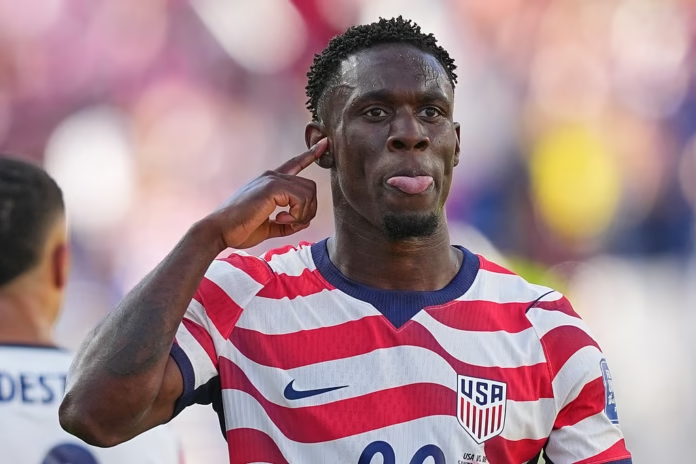
President Trump personally intervened with FIFA President Gianni Infantino to seek a review of a red card issued to U.S. striker Folarin Balogun, resulting in an unprecedented suspension of the automatic one-game ban just before a critical World Cup knockout match. The reversal, the first of its kind at a World Cup since 1962, has triggered accusations that soccer’s global governing body bent its own rules under political pressure. The episode has become a flashpoint over the intersection of presidential influence and international sports governance during a tournament co-hosted by the United States.
Story Highlights
- Trump called FIFA President Gianni Infantino to seek review of striker Folarin Balogun’s red card suspension
- FIFA suspended the automatic one-game ban under Article 27 of its disciplinary code, allowing Balogun to play against Belgium
- The reversal marks the first time since 1962 that a World Cup red card did not result in a suspension
- Belgium’s football association and European soccer body UEFA both criticized the decision as unprecedented and unjustified
What Happened
President Donald Trump called FIFA President Gianni Infantino last Wednesday to request a review of a red card issued to U.S. Men’s National Team striker Folarin Balogun during the team’s 2-0 victory over Bosnia and Herzegovina in the World Cup’s Round of 32. Balogun received the red card after stepping on the ankle of Bosnian defender Tarik Muharemović during the 64th minute of the match, triggering an automatic one-game suspension that would have kept him out of Monday’s knockout match against Belgium in Seattle.
According to a U.S. official who spoke to Axios, Trump wanted to understand why the red card was issued and why it carried a suspension, telling associates he “didn’t know what the hell a red card was” and wasn’t “a soccer guy.” Commerce Secretary Howard Lutnick and Andrew Giuliani, executive director of the White House Task Force for the World Cup, subsequently helped recruit lawyers and coordinate with U.S. Soccer officials to present additional evidence to FIFA’s disciplinary committee, according to reporting from Yahoo Sports. On Sunday, FIFA announced that Balogun’s suspension would be paused for a one-year probationary period under Article 27 of its disciplinary code, a provision that allows the “full or partial suspension of a disciplinary measure.”
The decision marked only the second time in the tournament’s history that a red card did not result in an immediate suspension, following a similar case involving Brazil’s Garrincha in 1962. FIFA had previously used the same provision earlier this year to defer suspensions for Portuguese star Cristiano Ronaldo, Argentina’s Nicolás Otamendi, and Ecuador’s Moisés Caicedo, allowing all three to remain eligible during the tournament. Trump celebrated the outcome on Truth Social, writing, “Thank you to FIFA for doing what was right, and reversing a great injustice!” U.S. head coach Mauricio Pochettino also welcomed the reversal, telling reporters the team had been “punished enough” playing a man down for 30 minutes against Bosnia.
The decision immediately drew sharp criticism from outside the United States. Belgium’s football association, the RBFA, said it was “astonished” by the reversal and argued the ruling directly conflicted with FIFA’s own written disciplinary rules regarding automatic suspensions following red cards. UEFA, European soccer’s governing body, said in a Monday statement that FIFA had “crossed a red line,” calling the decision “unprecedented, incomprehensible and unjustifiable.” Trump addressed the controversy directly at a White House event on Monday, telling reporters, “I asked for a review because I didn’t think it was a foul,” while insisting, “I didn’t tell him what to do. I can’t tell him what to do.”
Why It Matters
The episode represents a highly unusual instance of direct presidential involvement in an international sports governing body’s disciplinary process, raising questions about the appropriate boundaries between political power and independent athletic institutions. While American presidents have long engaged symbolically with major sporting events, direct intervention seeking to reverse a specific disciplinary ruling affecting an active competition is without clear precedent.
The controversy also highlights the close personal relationship between Trump and Infantino, who awarded the president FIFA’s inaugural Peace Prize in December and has appeared alongside Trump at multiple high-profile events, including a Gaza peace summit last year. Critics argue this dynamic creates the appearance, if not necessarily the reality, of an international sports body catering to a head of state’s preferences, a perception that carries reputational risk for FIFA regardless of the technical justification it cited for the reversal.
For American soccer fans and the broader U.S. Soccer Federation, the episode complicates what had otherwise been a largely apolitical and successful World Cup run for the co-host nation, injecting political controversy into a tournament that organizers had hoped would showcase the sport’s growing popularity in the United States without becoming entangled in partisan politics.
The dispute also underscores broader questions about consistency in FIFA’s disciplinary process, since the organization has now invoked the same rule to benefit multiple star players from different countries in the same tournament, raising questions about whether the provision is being applied evenly or selectively based on a player’s profile and the political pressure applied on their behalf.
Economic and Global Context
The World Cup represents an enormous economic undertaking for co-host nations, and the United States has invested heavily in infrastructure, security, and promotion for the tournament, positioning it as a signature cultural and economic moment of Trump’s second term. Trump has previously compared the scale of the tournament to hosting “multiple simultaneous Super Bowls,” reflecting the administration’s view of the event’s economic and symbolic significance.
Internationally, the controversy adds to existing scrutiny of Infantino’s leadership at FIFA, which has faced criticism in recent years over decisions including labor conditions tied to World Cup infrastructure in Qatar and the awarding of the 2034 tournament to Saudi Arabia. The Balogun reversal adds a new dimension to that scrutiny, this time centered on the appearance of favoritism toward a co-host nation’s political leadership rather than commercial or diplomatic considerations.
The dispute also has diplomatic undertones given Belgium and the broader European football establishment’s public objections, potentially straining relations between U.S. and European sporting federations at a moment when the tournament itself is meant to showcase international cooperation and goodwill.
Implications
In the immediate term, Balogun will play in Monday’s knockout match against Belgium under a probationary suspension, meaning any future disciplinary infraction during the tournament could result in the original suspension being reinstated alongside additional penalties, a heightened-stakes situation that will be closely watched by officials and broadcasters throughout the remainder of the tournament.
For FIFA, the episode is likely to generate continued scrutiny of Infantino’s leadership and the organization’s disciplinary consistency, particularly if similar reversals occur for other national teams as the tournament progresses toward its July 19 final, an event at which Trump is expected to participate in the trophy ceremony.
For the Trump administration, the episode adds another data point to a pattern of direct engagement in high-visibility cultural and sporting moments, reinforcing both supporters’ view of an assertive, hands-on presidency and critics’ concerns about the blurring of political authority into traditionally independent institutions.
Sources
“Why FIFA’s Balogun red card suspension after Trump call is so controversial”

