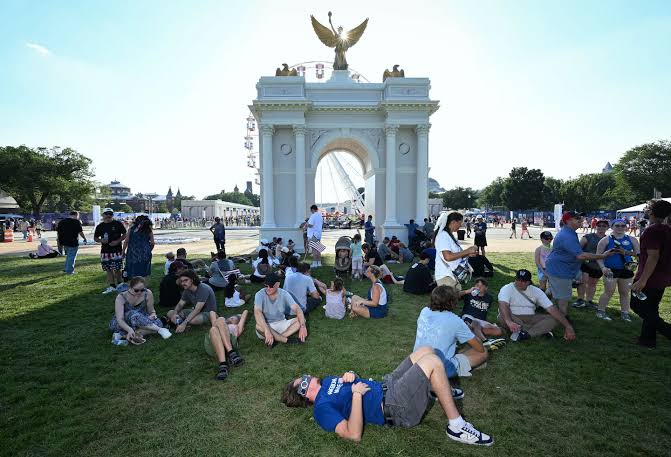
President Trump’s plan to build a towering triumphal arch near Arlington National Cemetery took a significant step forward Thursday after the National Capital Planning Commission granted preliminary approval to the project despite hours of public testimony against it. The 250-foot structure, intended to commemorate America’s 250th anniversary of independence, would become one of the tallest monuments in Washington and reshape a historic sightline linking the Lincoln Memorial to Arlington. Commissioners deferred a final decision on whether a century-old height law applies to the project, setting up further debate before construction can begin.
Story Highlights
- The National Capital Planning Commission voted to approve preliminary site and building plans for Trump’s 250-foot arch
- The structure would stand more than twice as tall as the 99-foot Lincoln Memorial and taller than France’s Arc de Triomphe
- Commissioners postponed a final ruling on whether the Height of Buildings Act applies to the project
What Happened
The National Capital Planning Commission, chaired by White House staff secretary Will Scharf, voted Thursday to grant preliminary approval to site and building plans for a 250-foot triumphal arch that President Donald Trump wants constructed at Memorial Circle, on the Virginia end of the Memorial Bridge facing Arlington National Cemetery. The vote came after nearly three hours of public testimony, much of it in opposition, and marks one of several projects Trump is pursuing to reshape the nation’s capital during his second term.
Commission staff recommended preliminary approval but also proposed a series of design revisions intended to bring the structure into compliance with the Height of Buildings Act, a 116-year-old federal law that restricts building heights in Washington to preserve the city’s historic skyline. The suggested changes involved redistributing height among the main archway, a habitable roof planned as an observation deck, and statues intended to top the structure. Rather than resolve the question of whether the century-old law applies to the arch at all, commissioners voted to continue deliberating that issue, with a final vote expected at the panel’s next meeting in September.
Trump has framed the arch as a fitting tribute to 250 years of American independence. Scharf, who leads the commission as one of Trump’s appointees, echoed that sentiment during Thursday’s proceedings, saying he believes commemorating the anniversary is important and that the arch represents a fitting way to do so. The proposed structure would stand more than twice as tall as the 99-foot Lincoln Memorial and would exceed the height of France’s famous Arc de Triomphe, while remaining well below the 555-foot Washington Monument.
Opposition to the project was substantial and emotionally charged. Speakers at Thursday’s hearing included Gold Star family members and veterans who argued the arch would disrupt a carefully designed sightline between the Lincoln Memorial and Arlington National Cemetery, a view intended to symbolize national reunification following the Civil War. One speaker, a Gold Star mother from North Carolina, described the site as sacred ground tied to memories of her son, who later died in military service, and argued the arch would distract from the solemnity of the cemetery. Others noted that major memorials honoring Vietnam veterans, World War II veterans, and the Rev. Martin Luther King Jr. underwent years of deliberation before approval, and urged the commission to slow its process rather than fast-track Trump’s project.
The U.S. Commission of Fine Arts, a separate federal body, had already approved the arch’s design in May, and the National Capital Planning Commission began its own review in June. The White House has not released a cost estimate for the arch, though Trump has previously suggested it could be funded using leftover donations originally raised for a separate $400 million White House ballroom project, a structure currently under construction that is also drawing on some public funds.
Why It Matters
The arch project represents one of the most visible examples of Trump’s efforts to leave a physical, lasting mark on the nation’s capital during his time in office. Unlike policy initiatives that can be reversed by future administrations, permanent structures on federal land carry a symbolic and physical permanence that shapes how the capital is experienced by millions of visitors for generations. Supporters view the arch as a fitting tribute to the nation’s 250th birthday and an opportunity to add a bold new landmark to the city’s skyline.
Critics, however, see the project as emblematic of a broader pattern of the president using federal commissions largely staffed with his own appointees to advance personal legacy projects, sometimes over strong public objection. The debate over whether the Height of Buildings Act applies to the arch also raises broader questions about how strictly long-standing federal preservation laws will be enforced when they intersect with presidential priorities, a precedent that could affect future development proposals in the capital regardless of who occupies the White House.
For veterans’ groups and Gold Star families specifically, the location adjacent to Arlington National Cemetery adds a layer of significance beyond ordinary zoning disputes. The sightline between the Lincoln Memorial and the cemetery was deliberately designed decades ago to convey themes of sacrifice, reunification, and remembrance, and altering that view touches on how the nation visually commemorates its military dead.
Economic and Global Context
While the White House has not released an official cost estimate, comparable monumental construction projects in Washington have historically run into the hundreds of millions of dollars once land preparation, structural engineering, and traffic reconfiguration are factored in. The arch’s location on a traffic circle also raises practical questions about pedestrian and vehicle safety during both construction and long-term operation, concerns that were raised repeatedly during Thursday’s hearing.
The project sits alongside other Trump-era construction efforts in the capital, including the ongoing $400 million White House ballroom, which is being funded through a mix of private donations and public money despite earlier assurances that it would rely solely on donor contributions. Together, these projects reflect a broader pattern of federally funded architectural initiatives moving forward during a period when other domestic spending priorities, including infrastructure and housing, continue to compete for congressional attention and public funding.
Internationally, monumental arches have long served as symbols of national power and historical commemoration, from the Arc de Triomphe in Paris to similar structures found in capitals around the world. A structure of this scale in Washington would place the United States among nations with prominent triumphal arches honoring military and national history, though the comparison to explicitly nationalist European monuments has itself become part of the debate among critics.
Implications
For the Trump administration, securing final approval in September would represent a significant symbolic win ahead of the nation’s 250th anniversary celebrations, allowing construction to proceed on a highly visible legacy project before the end of Trump’s term. Administration officials have signaled they intend to pursue an intensive, year-round construction schedule once approvals are finalized.
For preservationists and veterans’ advocacy groups, the coming months will likely bring continued organized opposition, including further public testimony and potential legal challenges centered on the applicability of the Height of Buildings Act. Whether the commission ultimately rules that the law constrains the project could set an important precedent for future federal construction in the capital.
For Washington residents and visitors, the debate over the arch adds to a broader conversation about how the nation’s capital is being reshaped during Trump’s second term, alongside other renaming and construction initiatives across the country. The commission’s September vote will be closely watched as the next major milestone in determining whether the arch ultimately becomes a permanent fixture near one of the nation’s most solemn memorial sites.
Sources

