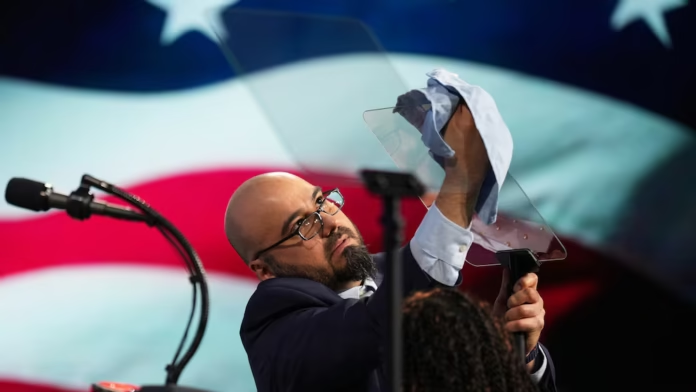
A longtime White House teleprompter operator has been placed on unpaid administrative leave after federal regulators found he allegedly used advance knowledge of President Trump’s prepared remarks to place profitable bets on a regulated prediction market. The staffer, identified as Gabriel Perez, reportedly won more than $100,000 wagering on what words and phrases Trump would use across more than a dozen speeches. The case marks what NPR described as the first known instance of federal officials investigating suspected insider trading tied to a prediction market from inside the White House itself.
Story Highlights
- Gabriel Perez, Trump’s teleprompter operator since 2016, allegedly won over $100,000 betting on his speeches via Kalshi’s “Mentions” market
- The Commodity Futures Trading Commission is investigating, and Perez is reportedly in settlement talks with regulators
- Kalshi flagged the suspicious trading pattern in March and froze more than $90,000 in profits from the account
- The White House had already issued an internal memo in March warning staff against trading on nonpublic information
What Happened
Federal investigators with the Commodity Futures Trading Commission have determined that Gabriel Perez, a technical assistant to President Trump who has operated his teleprompter since the 2016 campaign, placed bets on a regulated prediction market using what regulators believe was inside knowledge of the president’s prepared remarks. According to reporting from ABC News, Perez placed wagers on more than a dozen Trump speeches over a three-month period, including February’s State of the Union address, a December primetime address, a January speech at the World Economic Forum in Davos, Switzerland, and remarks delivered during a March Medal of Honor ceremony.
The bets were placed on Kalshi, a federally regulated prediction market platform whose “Mentions” market allows users to wager on whether specific words, phrases, or topics will be spoken during a public address. Kalshi’s head of enforcement, Robert DeNault, said the company’s internal surveillance team flagged Perez’s trading pattern as irregular in March and promptly referred the matter to the CFTC following an internal exchange investigation. The company subsequently froze more than $90,000 in profits associated with the account after discovering the account holder was a federal employee working directly with the president’s speeches.
White House Press Secretary Karoline Leavitt confirmed the administrative action at a Thursday briefing, stating that President Trump was personally aware of the situation and had been briefed on the matter. “I spoke with him about it. He believes it’s deeply unfortunate and frankly a disgrace,” Leavitt told reporters, according to multiple outlets covering the briefing. Perez has been placed on unpaid administrative leave while the CFTC investigation proceeds, and sources familiar with the matter told ABC News he is currently in talks with federal regulators to settle the allegations.
Notably, the White House had already taken preventive action months before the scheme came to light. In March, following the initial flagging of irregular trading patterns by Kalshi, the White House issued an internal memo warning staff against using nonpublic information to place bets on prediction markets, according to sources who previously confirmed the memo’s existence to ABC News. That timeline suggests administration officials may have had some awareness of potential concerns even before the full scope of Perez’s alleged activity became public this week.
The case arrives amid a broader boom in political prediction markets, which have grown substantially in both volume and public attention. Kalshi told The Washington Post earlier this year that the platform had approximately $129 million at stake across its political markets. President Trump, who owned a casino in Atlantic City earlier in his business career, initially expressed skepticism about prediction markets in April but later softened his stance, telling reporters he knew “some people who are very smart, and they like it.”
Why It Matters
The episode raises novel questions about oversight and ethics within the modern White House as prediction markets, once a niche financial product, have grown into a mainstream and heavily capitalized industry intersecting directly with political events and government operations. Because teleprompter operators have direct, real-time access to a president’s prepared remarks before they are delivered publicly, the case highlights a previously unaddressed category of potential insider trading risk unique to White House staff positions.
For federal regulators, the investigation represents a test case for how existing commodities and securities law applies to government employees trading on nonpublic information obtained through their official duties, an area that has not been extensively litigated in the context of prediction markets. The outcome of the CFTC’s settlement talks with Perez could establish important precedent for how such cases are handled going forward, both within the White House and across other federal agencies where employees may have access to market-moving nonpublic information.
The case also creates a political awkwardness for an administration that has otherwise sought to project message discipline and operational tightness. Even as Trump used his Thursday primetime address to make sweeping claims about foreign interference undermining public trust in American institutions, his own White House was simultaneously managing a scandal involving a longtime, trusted staff member allegedly exploiting internal access for personal financial gain.
Economic and Global Context
The rapid growth of political prediction markets like Kalshi represents a broader shift in how financial products intersect with political and governmental events. With approximately $129 million currently at stake across Kalshi’s political markets according to company disclosures, the platform has emerged as a significant venue for both retail speculation and, as this case suggests, potential exploitation by individuals with privileged access to information.
Regulatory attention to prediction markets has intensified over the past year as their popularity has grown, with the CFTC increasingly scrutinizing how these platforms police against exactly the kind of information asymmetry alleged in the Perez case. The episode may accelerate broader regulatory conversations about disclosure requirements, position limits, or monitoring obligations for prediction market operators handling politically sensitive contracts.
Globally, the case adds to a growing body of examples illustrating how prediction markets are increasingly intertwined with major political events, from elections to high-profile government addresses, raising questions that extend beyond U.S. borders as similar platforms gain traction internationally.
Implications
In the near term, the CFTC’s settlement negotiations with Perez will determine the legal consequences he faces, ranging from financial penalties to potential further regulatory action, depending on how investigators characterize the nature and severity of the alleged conduct. The outcome will be closely watched as a bellwether for how aggressively regulators intend to pursue similar cases involving government employees and prediction markets going forward.
For the White House, the episode is likely to prompt a broader review of internal policies governing staff access to nonpublic presidential communications and their potential financial exploitation, building on the warning memo already issued in March. Additional safeguards or monitoring protocols for staff with advance knowledge of presidential remarks may follow as a direct result of this case.
For Kalshi and similar prediction market platforms, the case underscores both the effectiveness of their internal surveillance systems in flagging suspicious activity and the reputational risk such platforms face when high-profile users are found exploiting privileged information. Expect continued scrutiny of how these platforms balance growth in politically themed betting markets against the integrity risks such products inherently carry.
Sources
“White House teleprompter operator made more than $100K betting on Trump’s speeches: Sources”

