

Story Highlights
- Supreme Court hears major case on birthright citizenship
- Case could redefine interpretation of the 14th Amendment
- Decision may have long-term legal and policy implications
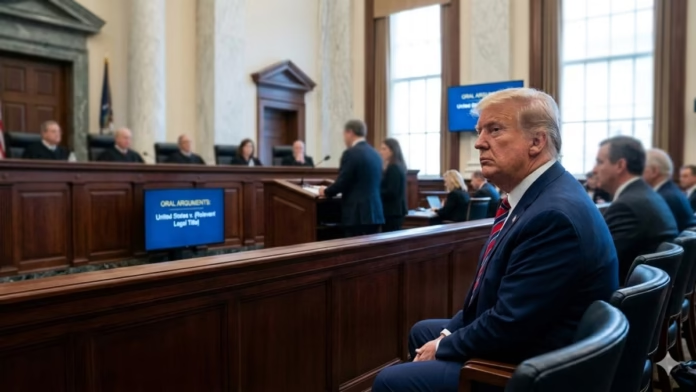
The United States Supreme Court has taken up a significant case concerning birthright citizenship, bringing renewed attention to one of the most fundamental aspects of constitutional law. The case centers on the interpretation of the 14th Amendment, which grants citizenship to individuals born on U.S. soil. At issue is whether this principle can be limited under certain conditions, a question that carries far-reaching legal and social implications.
The hearing marks a pivotal moment in the ongoing debate over immigration policy and constitutional interpretation. Birthright citizenship has long been considered a cornerstone of U.S. law, providing a clear and consistent standard for determining citizenship. However, challenges to this interpretation have emerged over time, reflecting broader discussions about immigration, national identity, and legal precedent.
During the proceedings, the Court examined arguments related to the original intent of the 14th Amendment, as well as its application in contemporary contexts. Legal experts on both sides presented differing views on whether the amendment’s language allows for exceptions or whether it establishes an absolute rule. The outcome of this case could clarify longstanding ambiguities and set a precedent for future legal interpretations.
From a legal standpoint, the case is significant because it addresses the balance between constitutional text and evolving policy considerations. The Supreme Court’s role is to interpret the law, and its decisions often have lasting effects on how statutes and amendments are applied. A ruling in this case could influence not only citizenship policy but also broader principle constitutional interpretation.
The political context surrounding the case adds another layer of complexity. Immigration remains a central issue in public discourse, with differing perspectives on how policies should be structured. While the Court’s decision is based on legal reasoning, its implications will inevitably intersect with policy debates and legislative priorities.
The potential impact extends beyond immediate legal outcomes. Changes to the interpretation of birthright citizenship could affect millions of individuals and reshape the framework of immigration policy. It could also influence how other constitutional provisions are interpreted, particularly those individual rights and government authority.
From a societal perspective, the case touches on fundamental questions about identity, inclusion, and the meaning of citizenship. These issues are deeply connected to the broader narrative of the United States as a nation built on immigration and diversity. Any change in the interpretation of citizenship laws would therefore have both practical and symbolic significance.
The Court’s deliberations also highlight the importance of judicial independence. By examining the issue through a legal lens, the Supreme Court provides a forum for resolving complex questions that extend beyond the scope of legislative debate. Its decisions contribute to the stability and continuity of the legal system, ensuring that changes are grounded in constitutional principles.
As the case moves toward a decision, stakeholders across the political and social spectrum are closely monitoring developments. The outcome will likely shape discussions on immigration policy, legal precedent, and constitutional interpretation for years to come.
Implications
The Supreme Court’s review of birthright citizenship represents a critical moment in constitutional law. The decision has the potential to redefine how citizenship is determined and to influence broader legal and policy frameworks.
In the long term, the case underscores the evolving nature of constitutional interpretation and the role of the judiciary in addressing complex societal issues. Its outcome will not only resolve a specific legal question but also contribute to the ongoing dialogue on the principles that define the United States.

