Story Highlights
- President Donald Trump said he will nominate Acting Attorney General Todd Blanche to permanently lead the Justice Department.
- Blanche previously served as Trump’s personal criminal defense lawyer before entering senior DOJ leadership.
- The nomination sets up a Senate confirmation fight over loyalty, independence, and the future direction of federal law enforcement.
What Happened
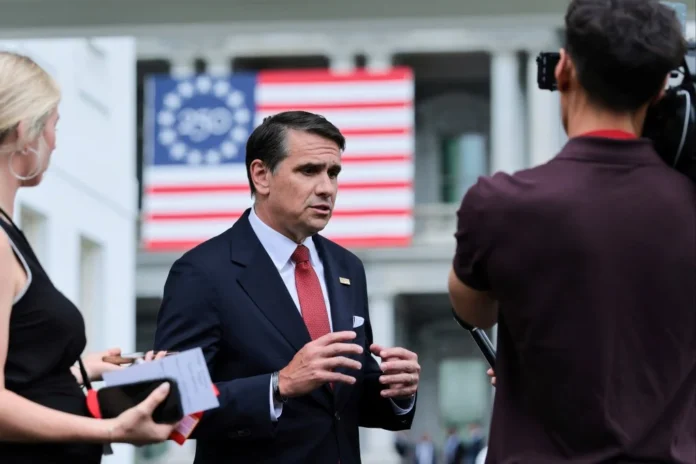
President Donald Trump said he will nominate Todd Blanche to serve as permanent attorney general, moving to install his former personal defense lawyer as the official head of the Justice Department.
Trump announced the decision during a Rose Garden dinner event, saying he intended to make Blanche the “permanent attorney general.” The announcement was later shared publicly by Deputy White House Chief of Staff Dan Scavino.
- Blanche has served as acting attorney general since April.
- He previously served as deputy attorney general before taking over the department.
- Before entering DOJ leadership, he represented Trump in several high-profile criminal cases.
Blanche’s path to the Justice Department has drawn unusual attention because of his direct personal and legal relationship with Trump. He represented Trump during major criminal proceedings before later becoming one of the most powerful officials in federal law enforcement.
Since becoming acting attorney general, Blanche has aligned the department closely with Trump’s second-term priorities. His tenure has included politically sensitive investigations, sharp criticism from Democrats, and controversy over a proposed anti-weaponization fund meant to compensate people who claimed they were unfairly targeted by the federal government.
The nomination must now go through the Senate confirmation process. Republicans hold the majority, but Blanche is still expected to face pointed questioning from Democrats and possible concern from some Republicans over whether he can separate his former role as Trump’s lawyer from the public duties of attorney general.
Why It Matters
The attorney general is the nation’s top law enforcement officer. The role includes oversight of the Justice Department, federal prosecutors, the FBI, the Bureau of Prisons, civil rights enforcement, national security cases, antitrust enforcement, and major criminal investigations.
That makes Blanche’s nomination one of the most important personnel decisions of Trump’s second term. If confirmed, Blanche would have permanent authority over federal law enforcement at a moment when the Justice Department is already central to disputes over political investigations, executive power, and institutional independence.
- The nomination could define DOJ’s direction for the rest of Trump’s term.
- It will test how much independence Senate Republicans demand from the attorney general.
- It gives Democrats a high-profile confirmation fight over law enforcement and presidential power.
Supporters of Blanche argue that he understands the Justice Department, has experience as a former prosecutor and defense attorney, and is prepared to confront what Trump allies describe as years of political weaponization inside federal law enforcement.
Critics argue that his history as Trump’s personal lawyer creates a serious public trust problem. They say the attorney general must represent the United States, not the personal or political interests of the president who appointed him.
Oversight and Accountability Context
The Senate confirmation hearings will likely focus on one central question: whether Blanche believes the attorney general’s first loyalty is to the Constitution and the law, or to the president who nominated him.
That question is especially sensitive because Blanche’s recent career has been closely tied to Trump. Moving from personal defense lawyer to deputy attorney general, then acting attorney general, and now nominee for permanent attorney general creates a confirmation battle unlike most traditional DOJ nominations.
- Democrats are expected to question Blanche about DOJ independence.
- Republicans may ask whether he can maintain public confidence in federal law enforcement.
- The anti-weaponization fund controversy is likely to become a major hearing topic.
The proposed settlement fund could create additional political risk for Blanche. Critics called it an improper use of federal resources, while some Republicans worried it could become a liability in broader spending and immigration negotiations.
Even if the fund does not move forward, it will likely remain central to the argument that Blanche’s Justice Department has been shaped too heavily around Trump’s political grievances.
Political and Public Context
Trump’s decision fits a broader second-term pattern of selecting loyalists and close allies for powerful federal positions. His supporters see that as a necessary correction after years of conflict with institutions they believe resisted his agenda.
Opponents see the Blanche nomination as evidence that Trump wants the Justice Department to operate as a direct extension of the White House. That argument will likely dominate the public debate as the nomination moves through the Senate.
- Trump allies will frame Blanche as a reformer of a politicized DOJ.
- Democrats will frame him as too personally tied to Trump.
- The hearings could become a preview of broader midterm arguments over rule of law.
The nomination also places Senate Republicans in a difficult position. Many will want to support Trump’s choice, but some may face pressure to demonstrate that the attorney general remains different from a personal presidential lawyer.
That tension could shape the tone of the hearings even if Blanche ultimately has enough votes for confirmation.
What Happens Next
The White House is expected to submit Blanche’s nomination to the Senate, where the Judiciary Committee will hold hearings before the nomination can advance to the full chamber.
Democrats are expected to use the hearings to press Blanche on his prior representation of Trump, the department’s handling of politically sensitive investigations, and his views on the limits of White House influence over federal prosecutions.
- The Senate Judiciary Committee will be the first major test.
- Republican unity will likely determine the final outcome.
- Any GOP hesitation could slow the nomination or force additional commitments from Blanche.
If confirmed, Blanche would become the permanent head of the Justice Department and gain a stronger mandate to carry out Trump’s law enforcement agenda.
The confirmation fight will therefore be about more than one nominee. It will be a defining test of whether the Senate is willing to place limits around Trump’s control of the Justice Department — or whether Blanche’s rise confirms a new model of attorney general built around personal loyalty to the president.

