Story Highlights
- Rubio told senators that Iran has agreed to negotiate aspects of its nuclear program that were off-limits as recently as one month ago.
- He is defending a State Department budget request of $33.6 billion for fiscal year 2027 amid the ongoing Iran conflict.
- Democrats accused the administration of bypassing congressional oversight on the war and pursuing regime change across multiple countries.
What Happened
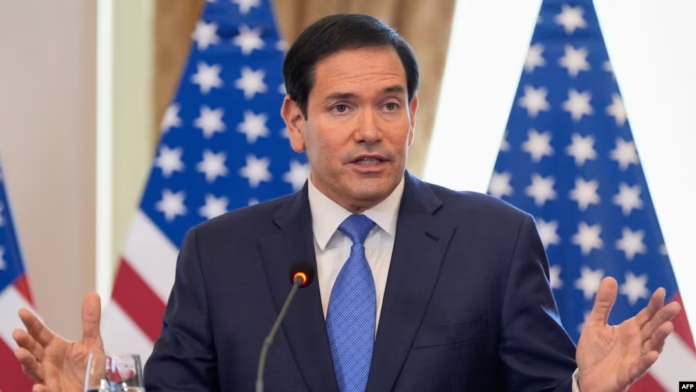
Secretary of State Marco Rubio appeared on Capitol Hill on Tuesday for his first public testimony before lawmakers since the Trump administration launched the war in Iran. Rubio began by addressing the Senate Foreign Relations Committee, ahead of an appearance in front of a House panel on State Department spending scheduled for 2 p.m.
Rubio said Tuesday that the U.S. is in talks with Iran and that Tehran has agreed to negotiate parts of its nuclear program it had previously refused to discuss, as lawmakers pressed the Trump administration for a strategy to end the war. “Talks with Iran are not like talks with Switzerland,” Rubio told the Senate Foreign Relations Committee. “They require the use of intermediators.”
Rubio told lawmakers that the Iranians have agreed to negotiate on nuclear points that they had not been willing to address in the past but would not offer an assessment on what those talks might produce. “They have agreed to negotiate aspects of their nuclear program that just a month ago, just a year ago, they were refusing to even mention,” Rubio told the committee. He acknowledged that progress in talks does not guarantee a deal acceptable to the American public or the Senate.
Rubio, who is also scheduled to testify twice on Tuesday, will defend the State Department’s $33.6 billion budget request for fiscal year 2027. Homeland Security Secretary Markwayne Mullin is slated to appear before the Senate at 2 p.m. ET to justify the Trump administration’s budget request of $63 billion for the department.
Regarding the Strait of Hormuz, Rubio outlined conditions Iran must meet: “They need to announce that they will no longer fire on commercial ships that are going through or threaten to fire on ships.” He said Iran must declare the strait open, stop charging a toll, help remove mines, and pledge not to fire on commercial vessels.
Why It Matters
Rubio’s testimony is the first major public accounting that Congress has received directly from a senior administration official since the conflict began in late February. The hearing reflects a broader demand from legislators of both parties for transparency about a military engagement that was launched without prior congressional authorization and has carried substantial economic and diplomatic costs. That accountability gap has been a source of mounting frustration on Capitol Hill.
The hearing comes as Congress has grown increasingly uneasy over the war, its economic fallout and Trump’s authority to continue the conflict without authorization from lawmakers. Sen. Jeanne Shaheen, D-N.H., the committee’s top Democrat, accused the administration of avoiding congressional oversight. “When I talk to my constituents, they asked for economic relief at home, not regime change in Havana or Caracas or Tehran,” Shaheen said. She said the administration’s war powers notification was “not consultation” but “an attempt to avoid answering to this committee and this Congress about this war.”
The nuclear dimension of Rubio’s testimony is particularly significant. If genuine, Iran’s agreement to discuss previously off-limits aspects of its nuclear program represents a potential diplomatic breakthrough that could frame what a final peace deal looks like. However, Rubio’s own careful hedging — repeatedly noting there is no guarantee of an acceptable deal — suggests the administration itself is uncertain whether these preliminary signals will translate into substantive progress.
Economic and Global Context
The war with Iran has produced significant economic dislocations felt well beyond the battlefield. The Strait of Hormuz, through which a critical share of global oil and liquefied natural gas flows in normal times, has seen severely disrupted tanker traffic since hostilities began. That disruption has contributed to elevated energy prices across international markets and is weighing on inflation in consumer economies from Europe to Asia.
Rubio’s testimony comes as talks over ending the war with Iran remain uncertain and also follows Trump’s recent visit to Beijing to meet with Chinese President Xi Jinping. Lawmakers are expected to ask Rubio about Taiwan, China, Cuba, and Venezuela in addition to the Iran conflict. The breadth of those questions reflects how deeply the administration’s aggressive foreign policy posture has extended across multiple regions simultaneously.
A small but growing faction of Republicans have joined Democrats in questioning the astronomical price tag and overall economic consequences of the conflict as they head into midterm elections in the fall. That bipartisan unease adds domestic political pressure to the economic arguments, creating a compound challenge for an administration that will need congressional cooperation to fund the war effort going forward.
Implications
Rubio’s testimony serves multiple purposes for the administration. It provides a moment to reframe the conflict’s narrative by announcing potential diplomatic progress on nuclear talks at a moment when the ceasefire is visibly fraying over the Lebanon situation. By presenting Congress with signs of diplomatic momentum, Rubio is attempting to hold off the most aggressive legislative challenges to the war, including war powers resolutions that could force a Senate floor vote on the conflict.
Members of Congress from both parties pressed Rubio on the administration’s long-term strategy. Democrats questioned why military action proceeded without prior congressional authorization and warned of the humanitarian and economic consequences. The administration’s answers did not appear to fully satisfy either chamber.
For the State Department’s budget, the $33.6 billion request faces a complicated environment. Rubio is expected to defend his request for a more than $35 billion budget for the 2027 fiscal year at a time when the war has redirected significant diplomatic and financial resources. Lawmakers who want to use the budget process as leverage over foreign policy decisions have an opening.
For the American public, the hearing provided the clearest official picture yet of where peace talks stand. The administration’s diplomatic strategy remains high-risk, dependent on informal intermediaries, and contested by Iran’s own public statements. Whether Rubio’s optimism on nuclear talks reflects genuine progress or diplomatic positioning will become clearer in the days ahead.
Sources
“Rubio says U.S. is in talks with Iran over nuclear program as senators press for war endgame”

