Story Highlights
- Congress advances plan to address DHS funding gap
- Two-step approach aims to restore operations gradually
- Emphasis on maintaining continuity in essential services
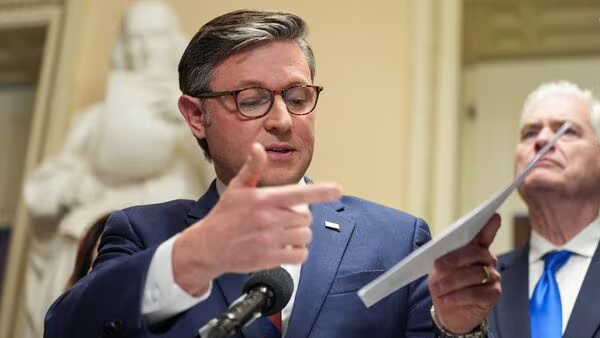
Congress is taking meaningful steps toward resolving the funding deadlock impacting the Department of Homeland Security (DHS), with a proposal that focuses on restoring operations while allowing space for continued negotiations. The plan introduces a phased funding mechanism, designed to immediately support critical functions while policymakers work through broader disagreements. This development reflects an effort to stabilize essential services without waiting for a complete resolution of all outstanding issues.
The funding gap has affected several areas under DHS, including border management, airport security coordination, and emergency preparedness systems. Although core services have continued, the uncertainty surrounding funding has created challenges in planning and resource allocation. By moving forward with a structured solution, lawmakers aim to reduce these uncertainties and ensure that key operations remain consistent and effective.
A central aspect of the proposal is the recognition that certain government responsibilities must remain uninterrupted. DHS plays a critical role in safeguarding national security and supporting infrastructure that millions depend on daily. Interruptions in its functioning can have widespread consequences, making it necessary to prioritize continuity even amid political disagreements. The phased approach is intended to address immediate needs while keeping the door open for further policy discussions.
From a legislative standpoint, the situation illustrates the complexities involved in aligning priorities within Congress. Differing viewpoints on policy and funding have contributed to the impasse, highlighting the challenges of reaching consensus. The current proposal represents a practical compromise, allowing progress to be made without requiring full agreement on every issue. This demonstrates how incremental steps can help advance solutions in a divided policy environment.
The economic dimension of resolving the funding issue is also noteworthy. Government agencies like DHS play a role in supporting economic stability by ensuring the smooth functioning of security and infrastructure systems. Uncertainty in funding can lead to inefficiencies and delays, which may have broader economic effects. By working toward a resolution, lawmakers are aiming to restore predictability and support operational efficiency.
Another important factor is the impact on the workforce. Employees within DHS have faced ongoing uncertainty due to the funding situation, which can affect morale and productivity. Providing clarity on funding helps create a more stable working environment, enabling personnel to focus on their responsibilities. A consistent and supported workforce is essential for maintaining the effectiveness of critical government functions.
The broader policy context also shapes this development. Debates over funding often reflect larger discussions about national priorities and the allocation of resources. The effort to resolve the DHS deadlock shows how these debates are navigated through negotiation and compromise. It highlights the role of the legislative process in balancing different perspectives while ensuring that essential services continue to operate.
From a governance perspective, the move toward a phased solution underscores the importance of flexibility. Policymakers are addressing urgent concerns while continuing to work on more complex issues in parallel. This approach allows for immediate progress without delaying action until all disagreements are resolved. It reflects a practical method of managing challenges within a dynamic political environment.
The progress toward resolving the deadlock also has implications for public confidence. Consistent government operations are important for maintaining trust in public institutions. Extended periods of uncertainty can affect how effectively these institutions are perceived. By taking steps to address the issue, lawmakers are working to reinforce confidence in the system’s ability to respond to challenges.
At the same time, the approach highlights that the underlying issues are still under discussion. While the immediate funding gap may be addressed, broader policy debates will continue to influence future decisions. This reflects the ongoing nature of governance, where solutions often develop gradually over time.
Implications
The progress made by Congress in addressing the DHS funding deadlock represents a step toward restoring stability in essential government functions. By focusing on immediate needs while allowing for continued negotiation, lawmakers are balancing urgency with long-term policy considerations.
More broadly, the situation highlights the importance of compromise and adaptability in the legislative process. Maintaining continuity in critical services remains a priority, while ongoing discussions will shape the direction of future policy decisions.

