An unprecedented mid-decade redistricting battle is actively rewriting the rules of the 2026 midterm elections, as Republican and Democratic state legislatures race to draw favorable congressional maps ahead of November 3. The effort, initially championed by President Donald Trump as a means to expand the GOP’s House majority, has triggered counter-moves by Democrats in California and Virginia that have partially neutralized Republican gains. The result is a volatile and contested electoral landscape unlike anything seen in a modern midterm cycle.
Story Highlights
- Republicans have enacted new congressional maps in five states targeting 13 Democratic-held U.S. House seats.
- The Virginia Supreme Court blocked a Democratic gerrymander that could have netted the party up to four House seats.
- Democrats maintain a 5.2 percentage point edge in the RealClearPolitics generic ballot average, keeping them favored to reclaim the House majority.
What Happened
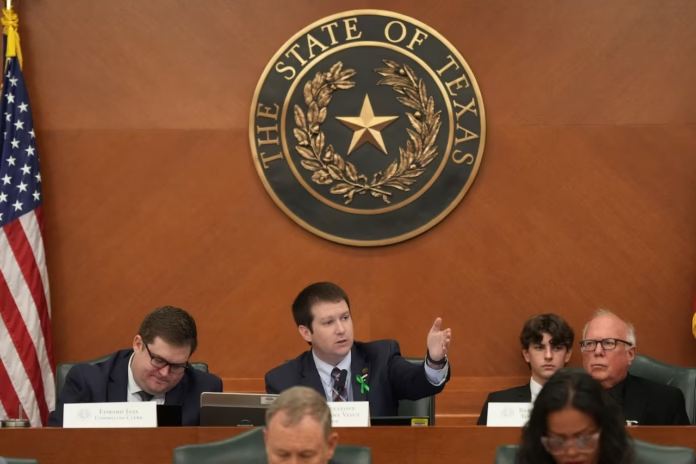
The 2026 redistricting war is without modern precedent. Traditionally, congressional district maps are redrawn every ten years following a census. President Donald Trump broke with that tradition in 2025 by pushing Texas to redraw its congressional maps mid-decade, arguing that Republicans were entitled to five additional House seats. The move opened a legal and political Pandora’s box that has since spread to more than a dozen states.
Republicans have now enacted new congressional maps in five states, collectively targeting 13 U.S. House seats currently held by Democrats. In the South, Republican-led legislatures in states including Louisiana, Alabama, and Tennessee are drawing or considering maps designed to dilute Democratic voting strength in majority-minority districts, a strategy accelerated by a recent U.S. Supreme Court decision that limited the use of race in redistricting. Each of these moves is proceeding through the courts with varying degrees of success.
Democrats have not stood idle. California voters approved a ballot initiative in November 2025 that allowed that state’s maps to be redrawn to create additional Democratic-leaning districts, a direct response to Republican gerrymandering in red states. Virginia’s Democratic-controlled legislature pursued a similar approach, but the Virginia Supreme Court last Friday blocked that gerrymander, delivering a significant setback to Democratic redistricting ambitions and costing the party tens of millions of dollars in planning and legal work.
The net effect of all redistricting completed to date gives Republicans approximately three additional favorable seats compared to the pre-cycle map. Election analysts estimate that a more realistic ceiling for total Republican gains from redistricting is five to seven net seats. Given that Republicans currently hold a five-seat House majority, even a full redistricting advantage may not be sufficient to offset what multiple analysts describe as a strongly pro-Democratic national political environment.
Why It Matters
Control of the House of Representatives determines the legislative agenda of the United States government for the next two years. A Democratic House would have the power to investigate the Trump administration, block legislation, and set the terms of the national debate in ways that would substantially alter the political landscape heading into the 2028 presidential cycle. A Republican House would allow the administration to continue pursuing its agenda relatively unimpeded.
The redistricting battle matters beyond its direct seat implications because it has become a proxy for a broader conflict about the rules of American democracy. Experts like David Becker of the Center for Election Innovation and Research have noted that the sheer volume and pace of map changes is forcing election officials to work overtime simply to maintain basic democratic functions. Voters in states where primaries have been postponed or maps redrawn mid-election-cycle face genuine confusion about which district they live in and who represents them.
The Trump administration has also floated more aggressive ideas for preserving Republican power, including suggestions about nationalizing elections and, in what the White House later described as a joke, canceling the midterms entirely. These statements, even when walked back, signal a posture toward democratic norms that has heightened Democratic motivation and generated significant negative attention from independent voters.
Cook Political Report managing editor Carrie Dann assessed the current landscape as follows: Democrats remain favored to win back the House, though redistricting has made the margin less overwhelming. Republicans could theoretically net five to seven seats from map-drawing, but the national political environment remains deeply unfavorable, and many of the redrawn seats are still competitive rather than safely Republican.
Economic and Global Context
The midterm elections are being fought against a challenging economic backdrop. Gas prices averaging $4.30 per gallon, inflation concerns, and the broader costs of the Iran war have soured public sentiment in ways that historically favor the out-party. Democrats are explicitly running on an affordability message that has proven effective in every major election cycle since 2024, including special elections and the 2025 Virginia and New Jersey governor’s races, where Democratic candidates outperformed expectations by substantial margins.
The redistricting fight also has significant implications for economic policy. A Democratic House majority would likely move to challenge Trump’s tariff policies, push for new healthcare spending provisions, and pursue regulatory changes affecting financial markets and the energy sector. Industries with significant stakes in these policy areas are watching the redistricting proceedings carefully and calibrating their political spending accordingly.
Six special House elections conducted since 2025 have shown Democrats outperforming their 2024 margins by an average of approximately 15 points. A swing of that magnitude applied universally in November would produce Democratic gains well in excess of what redistricting can offset. Republicans are counting on that early enthusiasm to fade and on their structural map advantages to matter more as the election approaches.
Implications
The outcome of the redistricting battles still pending in Tennessee, Alabama, Louisiana, and South Carolina will significantly shape the final competitive landscape heading into November. If Republicans can push their net redistricting gains above ten seats, their chances of retaining the House improve meaningfully even in a difficult environment. If Democratic legal challenges slow or block additional map changes, the current trajectory favors a Democratic majority.
For voters, the consequence of this unprecedented redistricting cycle is a Congress whose composition was shaped not only by electoral preferences but by legal maneuvering, court rulings, and partisan map-drawing conducted under emergency conditions. The legitimacy questions that accompany such a process could affect public confidence in the results regardless of which party prevails.
For the Trump administration, the stakes are direct. Losing the House would mean the end of unified Republican government and the beginning of a period of congressional oversight, subpoenas, and potential investigations. That prospect is driving the intensity of Republican efforts to squeeze every possible structural advantage from redistricting before November.

