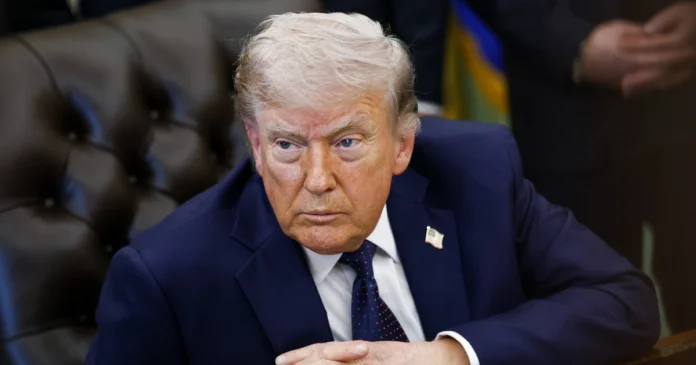
President Donald Trump delivered a forceful reminder of his grip on the Republican Party this week, engineering the defeat of five incumbent GOP state senators in Indiana who had defied him on congressional redistricting. The coordinated purge, backed by millions of dollars in outside spending, sent a clear message to every Republican officeholder in the country: crossing the president carries a steep political price. The results have redrawn the boundaries of acceptable dissent within the GOP just six months before a pivotal midterm election.
Story Highlights
- At least five of seven Trump-targeted Indiana Republican state senators lost their primary races on May 5, 2026.
- An estimated $13.4 million was spent on advertising in this year’s Indiana state Senate primaries, compared to roughly $280,000 in all state Senate primary races combined in the 2024 cycle.
- The campaign was backed by groups linked to Sen. Jim Banks, Club for Growth, and Turning Point USA, all coordinating in support of Trump’s preferred challengers.
What Happened
The saga began last December, when the Republican supermajority in the Indiana state Senate voted down President Donald Trump’s demand to redraw the state’s congressional maps in a way designed to help Republicans win two additional U.S. House seats. The senators who voted against the redistricting plan argued at the time that they were following the wishes of their constituents, a principle-based stance that would prove politically fatal for most of them.
Trump vowed revenge and then delivered it. On May 5, 2026, at least five of the seven incumbent Republican state senators who faced Trump-endorsed challengers lost their primaries. One race remained too close to call at press time, and only one incumbent, Sen. Greg Goode of Terre Haute, was projected to survive. The breadth of the losses was striking in races that in any normal cycle would have attracted minimal attention and modest spending.
What made the Indiana primaries remarkable was the sheer volume of outside resources poured into what are typically sleepy, low-cost legislative races. The political advertising tracking firm AdImpact reported that $13.4 million was spent on advertising across Indiana state Senate primaries this year. For context, in the entire 2024 election cycle, state Senate primary advertising in Indiana totaled roughly $280,000 across all races combined. The sudden infusion of national money transformed local races into proxy battles over loyalty to the president.
The organizational muscle behind the purge came from several well-funded corners of the MAGA ecosystem. A political group linked to U.S. Senator Jim Banks, a close Trump ally, led the advertising effort. Club for Growth ran direct mail campaigns casting the incumbent senators as disloyal, and Turning Point USA provided ground troops for door-to-door get-out-the-vote operations. The coordinated operation demonstrated the sophistication and reach of the infrastructure that now enforces loyalty to Trump within the GOP.
Why It Matters
The Indiana results carry implications far beyond the state. For Republican legislators at every level of government, the message is unmistakable: even a vote cast on principle, in a deeply conservative district, can end a career if it runs afoul of the president’s wishes. Most lawmakers in today’s polarized political environment face no meaningful threat in a general election. The primary is the only real test of their political survival. Trump has mastered the use of that vulnerability as a governing tool.
James Blair, a top Trump political adviser, summarized the philosophy bluntly when speaking to CNN after the results came in. The comment reflected a transactional view of political loyalty that has defined the Trump era: principled dissent is a personal indulgence that Republican officeholders can no longer afford if they wish to remain in office. That dynamic is reshaping how Republicans legislate, communicate, and build coalitions.
There is, however, a cost to this model that some analysts argue Republicans are not fully accounting for. Trump’s approval rating has fallen to historic lows for his second term, sitting in the mid-30s in some recent polls. A party that has locked itself into complete alignment with an unpopular president is poorly positioned to appeal to the independent and moderate voters who typically decide competitive general elections. The Indiana purge may have strengthened Trump’s grip on the party while further weakening the party’s broader electoral standing.
The episode also raises important questions about the role of local governance in a nationalized political environment. State legislators who once focused primarily on constituent services, local economic policy, and regional infrastructure now find themselves proxies in national political battles they did not seek and cannot easily avoid. The transformation of even low-stakes state races into loyalty tests for a national political figure marks a significant evolution in American political culture.
Economic and Global Context
The redistricting battle underlying the Indiana primaries is itself part of a much larger national campaign to reshape congressional maps ahead of the November midterms. Republicans have enacted new congressional maps in five states targeting 13 U.S. House seats currently held by Democrats. Democrats, for their part, have pursued their own redistricting efforts in states including California and Virginia, though a recent Virginia Supreme Court decision blocked one major Democratic gerrymander.
The financial scale of outside spending in this election cycle reflects the enormous economic stakes for industries that depend on federal policy. Pharmaceutical companies, energy producers, financial institutions, and technology firms all have significant interests in which party controls Congress after November. The flow of outside money into even state-level primaries reflects how thoroughly nationalized and financially intensive American electoral politics has become at every level.
For the broader economy, the redistricting war and the resulting uncertainty about which party will control the House creates planning challenges for businesses that need to anticipate the regulatory and tax environment of 2027 and beyond. A Democratic House would likely pursue a different legislative agenda than a Republican one, affecting everything from corporate tax rates to environmental regulation to healthcare policy.
Implications
The Indiana results will likely accelerate the willingness of other Republican-controlled state legislatures to comply with Trump’s redistricting demands elsewhere. States still weighing whether to redraw their congressional maps have now seen concrete evidence that resistance to Trump’s wishes carries a severe political cost, while compliance is rewarded with presidential support. That dynamic could produce additional GOP-drawn maps in the coming weeks.
For Democrats, the Indiana results are both a warning and an opportunity. The warning is that Trump’s redistricting campaign, even if it produces only modest net seat gains, could make the math for flipping the House more difficult. The opportunity is that a Republican Party fully aligned with an unpopular president is highly vulnerable to the kind of wave election that punishes the governing party in the sixth month before a midterm.
Source
Trump threatens EU with ‘much higher’ tariffs if no trade deal signed by new deadline

