Story Highlights
- The IEA has called the Hormuz blockade the largest oil supply disruption in global history, with 10–12 million barrels per day choked off from markets
- Brent crude has surged roughly 65% since the war began, trading above $113 per barrel as of this week
- China is expected to announce purchases of U.S. energy and Boeing aircraft; Trump will press Xi on China’s continued purchase of Iranian oil
What Happened
The Strait of Hormuz, a 21-mile-wide waterway between Iran and Oman that normally carries approximately 20 percent of the world’s seaborne oil trade and a similar share of global liquefied natural gas, has been effectively blocked since President Donald Trump and Israel launched a military campaign against Iran on February 28. Iran’s Revolutionary Guard Corps responded by issuing shipping warnings, attacking merchant vessels, and laying sea mines. The U.S. has simultaneously imposed a naval blockade of Iranian ports since April 13, further restricting energy flows. The combined effect has produced an energy shock with no modern precedent.
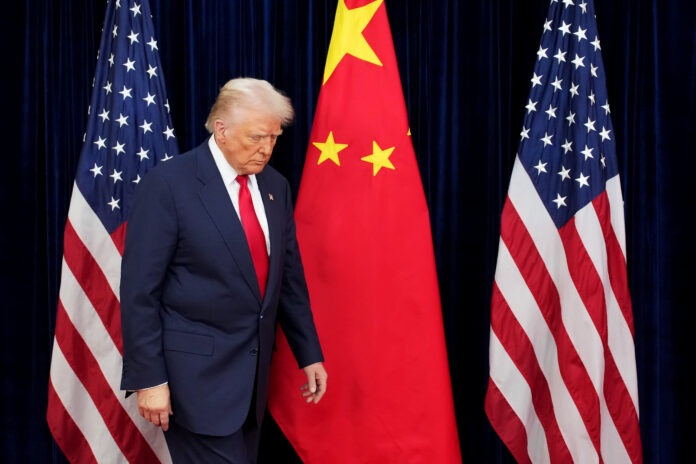
Trump arrives in Beijing on Wednesday for a two-day summit with Chinese President Xi Jinping with energy as the thread running through nearly every agenda item. The talks, scheduled for Thursday and Friday, were originally planned for April but were postponed after the Iran war broke out. The World Bank now projects average Brent crude prices of $86 per barrel for the full year, with upside scenarios reaching $95 to $115 depending on how quickly shipping flows normalize. Brent crude recently traded above $113 per barrel — its highest level in 2026 — having surged approximately 65 percent since the conflict began.
China’s role in the energy dimension of the crisis is dual and in some ways contradictory. As Iran’s largest oil customer — accounting for roughly 80 to 90 percent of Tehran’s pre-war exports — China has been effectively subsidizing the Iranian regime’s ability to continue fighting. At the same time, the Strait of Hormuz blockade has disrupted China’s own energy supply chains, restricting its access to Gulf crude from Saudi Arabia and the UAE. Beijing has a genuine economic interest in the strait’s reopening, even as it has been benefiting from below-market Iranian crude at prices discounted by sanctions pressure.
The U.S. is expected to press China to reduce or eliminate its purchases of Iranian oil, depriving Tehran of the revenue that sustains its wartime economy. In exchange, or as a separate transaction, China is expected to announce major purchases of American goods at the summit — specifically Boeing aircraft, American agricultural products, and U.S. energy, including potentially a large-scale Alaska LNG deal. Those discussions had been advancing before the Iran war broke out and have now returned to the agenda. Goldman Sachs analysts note that Beijing has increasingly positioned itself as a potential intermediary on the Hormuz crisis, and that any joint U.S.-China effort toward reopening the strait could offer near-term oil price relief — though most analysts consider such an outcome unlikely in the short term.
Treasury Secretary Scott Bessent traveled ahead of the main delegation to hold preparatory discussions with Chinese intermediaries, signaling the administration’s seriousness about producing tangible economic deliverables from the summit. American intelligence previously indicated that China was preparing to deliver new air defense systems to Iran — a move that would directly complicate U.S. military operations — though Defense Secretary Pete Hegseth said in April that Beijing had provided high-level assurances it would not transfer weapons to Iran.
Why It Matters
The energy stakes of this summit are not abstract. American consumers are currently paying an average of $4.52 per gallon for gasoline — up more than 50 percent since the war began — and Brown University’s Iran War Energy Cost Tracker estimates total household losses at more than $284 per household since February 28. Diesel is approaching all-time highs. Jet fuel has surged 85 percent. The USPS has added an 8 percent fuel surcharge. Farmers are absorbing higher fuel and fertilizer costs during planting season, with knock-on effects on food prices expected in the coming months.
If the Trump-Xi summit produces credible movement toward reopening the Strait of Hormuz — whether through Chinese pressure on Tehran, a joint diplomatic framework, or simply a signal that both powers are aligned on the need for a resolution — energy markets could respond immediately. Oil prices tend to move sharply on geopolitical signals, and even an indication of progress could provide meaningful relief at the pump within weeks. That would be enormously consequential for the administration politically, given that gas prices are the economic variable most directly correlated with Trump’s approval ratings.
The summit also matters because it establishes the architecture of U.S.-China relations for the remainder of Trump’s second term. Whether the two powers can find a workable framework for managing their competition — on trade, technology, Taiwan, and Iran — will shape the strategic environment that American businesses, allies, and policymakers navigate through at least 2029. A successful summit that produces visible wins on both sides would stabilize that environment; a failure would intensify uncertainty at a moment of already elevated global risk.
Economic and Global Context
The scale of the Hormuz disruption is staggering by any historical measure. Before the war, more than 120 ships per day passed through the strait on average. That volume has fallen to a tiny fraction of pre-war levels, with four ships crossing on one recent day, according to S&P Global Market Intelligence. The UAE’s Habshan gas processing facility is operating at 60 percent capacity following Iranian strikes, with full restoration not expected until 2027. Saudi Aramco has warned that markets will not return to normal until next year even if the strait reopens within weeks.
The rare earth minerals issue adds another dimension to the energy and economic stakes of the summit. China imposed export restrictions on rare earths in 2025, exposing critical U.S. vulnerabilities in defense manufacturing and technology. Washington has responded with billions in domestic financing and new international partnerships, but remains far from self-sufficiency. A rare earth truce — extending or formalizing the understandings reached in prior negotiations — would provide significant relief to American technology and defense industries and represents one of the more achievable deliverables from Beijing.
The macroeconomic context in the United States is one of mounting strain. CPI inflation rose to 3.3 percent in March. Consumer confidence has deteriorated sharply. Small businesses report that the Iran war has created a “perfect storm” of higher shipping, fuel, and input costs. The Penn Wharton Budget Model estimates that war-driven inflation could cost an average American household spending $5,000 per month an additional $1,800 per year. Those costs will continue to accumulate with each passing week that the Strait of Hormuz remains effectively closed.
Implications
For energy markets, the most consequential near-term question is whether the Beijing summit produces any real movement on Iran. Analysts at Deutsche Bank, Goldman Sachs, and OilPrice.com all caution that expectations for major Hormuz-related breakthroughs should be kept modest — the real measure of success may simply be leaving Beijing without triggering a new crisis. Even so, a clear signal that the U.S. and China are working together rather than at cross-purposes on the Iran issue would provide psychological relief to markets that have been pricing elevated risk for more than two months.
For American producers and exporters — Boeing, agricultural firms, LNG suppliers — the summit represents a concrete opportunity to generate new Chinese purchase commitments that would support American jobs and economic output. Boeing in particular has been under financial pressure, and Chinese aircraft orders would provide a meaningful boost to its manufacturing operations and supply chain. LNG exporters would benefit from a recommitment to the Alaska LNG framework that stalled when the war began.
For the global economy, the stakes extend well beyond the bilateral relationship between Washington and Beijing. Gulf states, European importers, Asian economies, and developing nations that depend on affordable energy are all watching this summit for signals about whether relief is coming. The longer the Strait of Hormuz remains blocked, the deeper the structural damage to global supply chains, food security, and economic growth in the most vulnerable nations. A path toward resolution — even a partial or gradual one — would be welcomed around the world.
Sources
“Trump-Xi Talks Set to Tackle Iran Oil Lifeline, Strait of Hormuz and U.S. Energy Deals”

