Story Highlights
- Xi warned Trump that mishandling Taiwan could put the entire U.S.-China relationship “in great jeopardy” and lead to “clashes and even conflicts”
- Trump attended the summit alongside top American business leaders including Elon Musk, Tim Cook, and Larry Fink
- The White House readout of the bilateral meeting omitted any mention of Taiwan, while China’s readout made it a centerpiece
What Happened
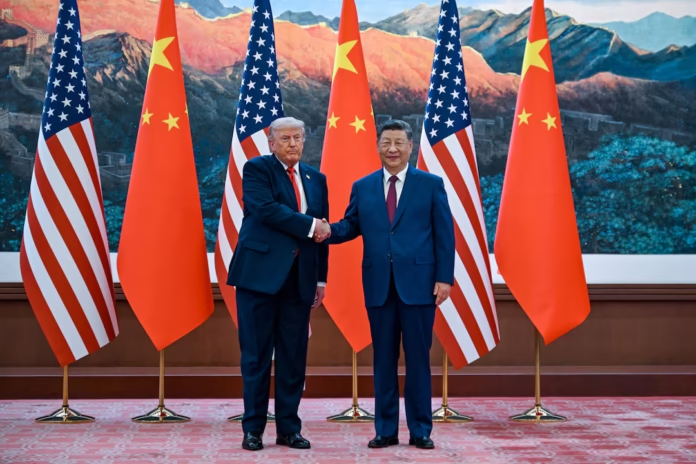
The day began with President Donald Trump and Xi Jinping shaking hands outside Beijing’s Great Hall of the People on Thursday morning local time. The two leaders chatted during an opening ceremony that featured a brass band, marching military units, and cheering children waving American and Chinese flags.
Xi’s stern warning came as the two leaders held their first round of talks in Beijing, kicking off a high-stakes two-day summit expected to cover trade, tariffs, and Iran, in addition to the longstanding friction over Taiwan. Xi stressed to Trump that the Taiwan question is the most important issue in China-U.S. relations, according to China’s state news agency Xinhua.
The White House said Trump had a “good meeting” with Xi in Beijing, highlighting discussions on expanding economic cooperation and market access for U.S. businesses. The two sides also discussed increasing Chinese purchases of American agriculture and addressing fentanyl precursor flows into the United States.
Trump attended the Beijing summit alongside top American CEOs, including Elon Musk, Tim Cook, and Larry Fink. Huang and Musk told reporters the meetings had gone well as the CEOs exited the venue, with Musk saying “many good things” had been achieved.
At a state banquet later, Trump said he was inviting Xi and his wife for a reciprocal visit to the White House on September 24. The closed-door bilateral session lasted roughly two hours and fifteen minutes.
Why It Matters
The visit to China is the first by a sitting U.S. president in nearly a decade. Much has changed since Trump’s 2017 trip, including an escalation in trade tensions, U.S. restrictions on Chinese technology, and rapid growth in Chinese auto manufacturing. The symbolism of an American president returning to Beijing carries enormous weight, both domestically and abroad, signaling that the world’s two largest economies are attempting to manage their rivalry rather than let it spiral.
Leaders agreed the Strait of Hormuz must remain open to ensure global energy flows, while Xi expressed opposition to its militarization and signaled interest in buying more U.S. oil. Both sides also agreed that Iran should not be allowed to obtain a nuclear weapon. These shared positions on Iran, even if limited, represent an area of meaningful overlap between Washington and Beijing at a moment when the ongoing conflict has complicated American foreign policy significantly.
Trump, whose approval ratings are at their lowest point in his second term, has seen much of his global tariff regime struck down by U.S. courts and is engaged in an unpopular war with Iran that has stretched past an initial six-week timeline and sent gas prices soaring. For both leaders, the goal is to return home with positive economic headlines and a reinforced personal relationship.
The summit also carries weight for American companies seeking deeper access to Chinese consumers. Xi told the assembled CEOs that China’s door would only open wider, a message calibrated to encourage continued U.S. corporate investment in the country.
Economic and Global Context
Just over a year ago, the U.S.-China relationship was far rockier. Trump’s hefty tariffs on China and dozens of other trading partners sparked a tit-for-tat trade war with Beijing, leading the two countries to briefly impose tariffs on each other’s goods exceeding 100 percent. Both nations have since scaled back, with China agreeing to halt export restrictions on rare earths.
The two leaders are expected to discuss a U.S.-China trade board and potential agreements on aerospace, agriculture, and energy, though aides say no comprehensive deal is on the table. Analysts say the summit is best understood as an effort to stabilize relations rather than resolve long-standing disputes.
Washington’s leverage has narrowed in the lead-up to the meeting. The U.S. Court of International Trade last week struck down Trump’s 10 percent global tariffs, dealing a blow to one of the administration’s primary pressure tools and constraining the White House’s ability to enact coercive options during talks.
Some experts argue the ongoing Iran conflict could give China greater leverage when dealing with Trump. Beijing is Iran’s largest trade partner and top buyer of its oil, giving Xi a degree of indirect influence over a conflict that has become a significant political liability for the White House.
Implications
In the lead-up to the summit, Chinese state media referred to Taiwan as “the first red line” in the bilateral meeting, and the divergence between the White House and Chinese readouts of Thursday’s session suggests the issue remains deeply unresolved. For policymakers in Washington, managing Beijing’s Taiwan expectations while maintaining support for Taipei will continue to be one of the most delicate diplomatic balancing acts of the Trump second term.
For American businesses, the summit offers cautious hope. If both governments follow through on pledges regarding agricultural purchases, market access, and rare earth stability, companies dependent on Chinese supply chains and consumers could see meaningful relief. The presence of major CEOs in the delegation was a deliberate signal of American commercial interest in the relationship.
Analysts note that China comes into this meeting far more confident than in 2017, when it feared even a small rise in U.S. tariffs. In the last year, Xi has been able to push back and neutralize much of Trump’s actions, according to experts at the Center for Strategic and International Studies. That shift in relative confidence shapes the negotiating dynamics as both sides head into Friday’s second round of talks.
The summit’s outcomes will reverberate well beyond Beijing and Washington. From Seoul to Brussels, allied governments are watching closely to assess how far Trump is willing to accommodate Chinese demands, particularly on Taiwan, before the midterm elections in November reshape American domestic politics once again.
Sources

