Story Highlights
- Warsh was confirmed by the Senate on a 54-45 vote on May 13, the most divisive confirmation vote ever recorded for a Federal Reserve chair.
- Powell’s term as Fed chairman expired today, May 15, though he has stated he will remain on the Fed’s Board of Governors for a period to be determined.
- Warsh’s first meeting as chair of the Federal Open Market Committee is scheduled for June 16–17, when rate policy decisions will come into immediate focus.
What Happened
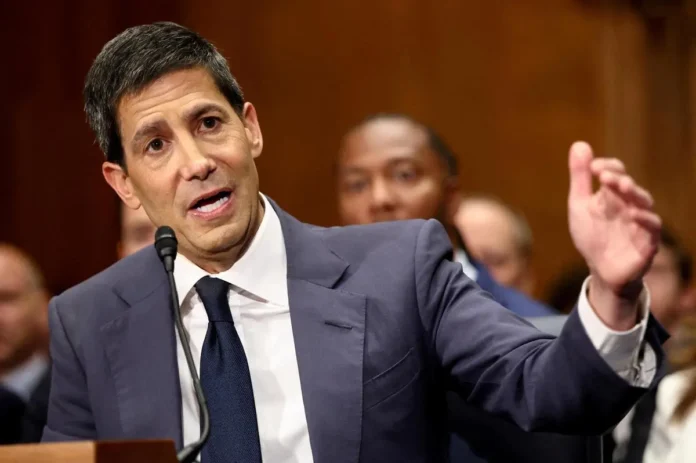
Kevin Warsh, 56, officially became the 17th chair of the Federal Reserve Board on Friday, succeeding Jerome Powell, whose second four-year term as chairman expired today. The transition follows a Senate confirmation vote on Wednesday in which Warsh secured approval 54-45 — the narrowest and most partisan confirmation margin ever recorded for a Fed chair nominee. Every Republican senator present voted in favor, with the exception of procedural holdouts that were ultimately resolved, while nearly all Democrats opposed the nomination.
Warsh’s path to the chairmanship was complicated by a pressure campaign from the Trump administration that included a Justice Department criminal investigation of the Federal Reserve, an extraordinary intervention that alarmed financial markets and drew bipartisan concern about central bank independence. Republican Senator Thom Tillis of North Carolina initially blocked a committee vote on Warsh’s nomination to protest the probe, dropping his opposition only after the relevant U.S. attorney agreed to close the investigation.
Powell, who has led the Fed since 2018 and was originally appointed by Trump during his first term, spent much of his tenure managing an extraordinarily difficult macroeconomic environment. He guided the institution through the COVID-19 pandemic, during which the Fed deployed unprecedented asset purchases and near-zero interest rates to stabilize the economy, and subsequently oversaw an aggressive rate-hiking cycle to combat inflation that reached its highest level in more than four decades. Throughout his tenure, he faced repeated, public criticism from Trump for not cutting interest rates more aggressively.
In an unusual break with historical precedent, Powell will not depart the Federal Reserve entirely. He announced in late April that he would remain on the Fed’s seven-member Board of Governors, where his separate 14-year term does not expire until January 2028. Powell cited the central bank’s ongoing vulnerability to legal challenges from the Trump administration as a reason for staying on, stating that the institution remains “at risk” and that he would remain until related matters are resolved “with transparency and finality.”
Warsh previously served as a Fed governor from 2006 to 2011 and has been a lecturer at Stanford Business School in the years since. He has been a vocal critic of Federal Reserve monetary policy, calling in a 2025 television interview for “regime change” at the institution. Trump has made clear that he expects Warsh to move toward lower interest rates, though rising inflation driven partly by tariff-related price pressures complicates the case for near-term rate cuts.
Why It Matters
The Federal Reserve chairmanship is among the most consequential economic policy positions in the world. The chair’s decisions on interest rates directly affect mortgage costs, business borrowing, consumer credit, and the broader trajectory of the U.S. economy. The transition from Powell to Warsh represents not merely a change in personnel but a potential change in the philosophical orientation of America’s central bank.
Warsh arrives at a moment of considerable economic uncertainty. Tariff-driven inflation has put upward pressure on consumer prices, complicating the case for the rate cuts that Trump and many Republican lawmakers have publicly demanded. If Warsh moves to cut rates prematurely in response to political pressure, he risks reigniting inflationary dynamics that took years to bring under control. If he holds rates steady or raises them in response to inflation data, he risks a confrontation with the White House similar to the one that defined Powell’s tenure.
The question of Fed independence — the principle that monetary policy should be set on the basis of economic data rather than political direction — is now more prominently at issue than at any point in decades. Powell’s decision to remain as a board governor keeps him in the institution, preserving a degree of institutional continuity while also creating a potential dynamic in which his views are publicly available and occasionally at odds with those of the new chairman.
For ordinary Americans, the immediate practical question is whether borrowing costs will fall. Mortgage rates, auto loan rates, and credit card interest rates are all influenced by the federal funds rate that the Fed controls. If Warsh signals a more accommodative stance, those rates could soften. If inflation data remains stubborn, the Fed may have little room to maneuver regardless of political preferences.
Economic and Global Context
At the time of the transition, the federal funds rate remains elevated relative to pre-pandemic norms, reflecting the rate-hiking cycle Powell implemented beginning in 2022 to combat the post-pandemic inflation surge. Warsh’s first formal meeting as FOMC chairman will take place June 16–17, and financial markets will parse every word of his post-meeting statement for indications of the direction he intends to take.
Global markets pay close attention to Federal Reserve policy because the U.S. dollar functions as the world’s primary reserve currency and because changes in U.S. interest rates influence capital flows, exchange rates, and borrowing costs in economies from Europe to emerging markets. A significant dovish shift by the new Fed chairman could weaken the dollar and stimulate capital flows into riskier assets globally. A more hawkish stance would have the opposite effect.
Trump replaced Stephen Miran, who had briefly held a Fed board seat, with Warsh, meaning the Board of Governors now includes multiple Trump appointees. Warsh was confirmed to a full board term running until 2040, ensuring his influence at the institution will extend well beyond the current administration regardless of future political changes in Washington.
Implications
For financial markets, Warsh’s arrival introduces meaningful uncertainty. His stated skepticism of large-scale asset purchases and his calls for institutional reform signal that the post-2020 era of aggressive monetary accommodation is unlikely to return. However, his responsiveness to political pressure from the Trump administration remains an open and heavily watched question among investors and institutional economists.
For the Republican Party, the Warsh confirmation represents a significant policy victory. Trump sought for years to reshape the Fed’s leadership in a direction more consistent with his preference for lower rates and a more growth-oriented monetary posture. Having a hand-picked chairman in place with a term extending to 2040 locks in that influence structurally.
For businesses making long-term investment decisions, the transition injects short-term uncertainty into planning around capital costs. The June FOMC meeting will be a critical early test of Warsh’s approach and whether his policy instincts diverge from or align with the data-dependent framework Powell carefully maintained.
For Powell himself, remaining as a governor preserves his presence in the institution he shaped for nearly a decade. His legacy — managing the economy through a pandemic and a historic inflation cycle while defending the Fed’s independence against political pressure — will be debated by economists and historians for years to come.
Sources
“Kevin Warsh wins Senate confirmation as the next Federal Reserve chair”

