Story Highlights
- Trump publicly floated a Vance-Rubio 2028 ticket at a recent event, asking the audience “Who likes JD Vance? Who likes Marco Rubio?” and calling it a “dream team.”
- A new AtlasIntel poll conducted May 4–7, 2026 showed Vance at 35% and Rubio at 30% on prediction markets for the 2028 Republican nomination.
- Vance shut down the speculation at a May 13 White House press briefing, saying there are “few topics” he wants to discuss less than future office-seeking.
What Happened
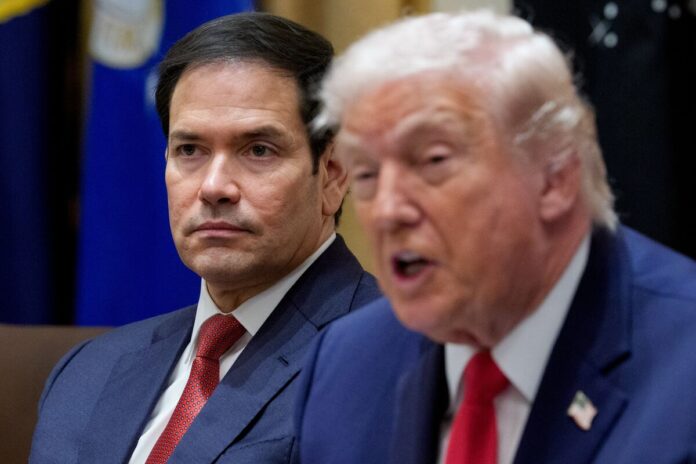
The succession conversation crystallized in public view when President Donald Trump, speaking to a crowd at a recent event, paused to informally poll his audience on the two highest-profile figures in his administration. “Who likes JD Vance?” he asked, drawing cheers. “Who likes Marco Rubio?” More applause. “Sounds like a good ticket,” Trump said. “That was a perfect ticket. By the way, I do believe that’s a dream team, but these are minor details.” He added pointedly, while looking at Vance: “That does not mean you have my endorsement, under any circumstance.”
According to multiple sources close to the president, Trump has made similar remarks in private settings — at dinner, in the Oval Office, and during conversations at Mar-a-Lago — asking advisers who they prefer between the two men and sometimes musing that they should run together. Trump’s aides say he is simply having fun with the speculation and that 2028 is not near the top of his current priorities. But the public floats, combined with the simultaneous rise in profile of both Vance and Rubio through a series of high-visibility events, have sent the political media into full 2028 speculation mode.
Vice President JD Vance addressed the topic directly on May 13 at a White House press briefing, where he was showcasing the administration’s new anti-fraud efforts in federal healthcare programs. When a reporter pressed him on the Vance-Rubio ticket comments, Vance shut the question down firmly. “There are few topics that I want to talk about less than what office I’m going to run for years down the road,” he said, “when I’m having a good time and trying to do good work in the job that the American people already elected me to do.” He praised Secretary Marco Rubio as a “very, very dear friend” and called him a great Secretary of State. When pushed again on whether Trump was “toying” with both men, Vance responded: “I just don’t think it sounds like the President of the United States to have a televised competition for who would succeed him as his apprentice.”
The contrast in the two men’s positioning has been notable. While Trump and Rubio were in Beijing together, Vance remained at the White House, where Secret Service protocols required him to stay stateside while the president was abroad. He used the moment to lead an anti-fraud event and crack a self-deprecating joke about feeling like Macaulay Culkin in “Home Alone.” Rubio, meanwhile, made waves the previous week by filling in for press secretary Karoline Leavitt during her maternity leave — the first Cabinet secretary to do so — and by releasing a campaign-style video in which he articulated his vision for America that quickly went viral and accelerated the succession conversation.
Why It Matters
The Vance-Rubio dynamic represents the Republican Party’s most substantive succession conversation in years. Trump will be constitutionally barred from seeking a third consecutive term in 2028 — though he has teased the idea of exploring “loopholes” in the 22nd Amendment, a comment Georgetown University political scientist Hans Noel called characteristic of Trump’s instinct toward showmanship. In any scenario where Trump does not run, the 2028 Republican primary will be among the most open and competitive in the modern era.
The two men represent meaningfully different visions for post-Trump Republicanism. Vance — a former venture capitalist and author who made an ideological journey from Trump critic to his most devoted advocate — is closely identified with the populist, working-class-focused, noninterventionist strain of MAGA politics. He has consolidated support among Trump’s core base and leads prediction markets. Rubio, a more conventionally polished figure with deep foreign policy expertise and strong appeal to Hispanic voters, represents a potential bridge between MAGA nationalism and traditional conservative internationalism.
For the party as a whole, the succession question carries enormous strategic weight. The midterms will play a significant role in shaping the 2028 race: if Republicans hold their congressional majorities, the case for continuity with the Trump era will be strengthened and both Vance and Rubio will benefit. If Democrats make major gains, a realignment debate within the GOP may accelerate, potentially elevating candidates who argue the party needs a broader coalition.
Economic and Global Context
The 2028 succession dynamics are unfolding against a backdrop of significant economic anxiety among Republican-leaning voters. Tariff-related price increases, the Iran conflict’s energy market impact, and the ongoing cost-of-living pressures that drove much of the 2024 electoral realignment remain salient kitchen-table issues. Any potential 2028 Republican nominee will be shaped by the economic record of the Trump second term and the policy choices made in 2025 and 2026 on taxes, trade, and the Big Beautiful Bill.
Both Vance and Rubio have been closely associated with the administration’s core legislative and foreign policy achievements. Vance presided over the Senate in his constitutional role and was the tie-breaking vote on the One Big Beautiful Bill Act. Rubio has been the public face of American diplomacy across the Iran conflict, the Ukraine peace effort, and the ongoing trade negotiations with China.
Early polling and prediction market data suggest both men have genuine national support beyond the Republican base. A Vance-Rubio or Rubio-Vance pairing, if it ultimately materialized, would reflect a deliberate strategic attempt to combine MAGA populism with broader electoral appeal — a coalition-building approach that reflects lessons drawn from both the 2022 midterm underperformance and the 2024 landslide.
Implications
The coming months will be the most revealing period for both potential successors. The midterm elections in November will be the defining political event of Trump’s second term, and how each man performs in their roles — Vance managing the domestic political environment, Rubio conducting diplomacy — during the final stretch will be watched closely by donors, activists, and rank-and-file Republican voters.
Major candidates historically do not announce presidential campaigns until after the midterm cycle concludes, meaning formal declarations are unlikely before early 2027. But the “invisible primary” — the period of donor cultivation, staff recruitment, and name-recognition building — is already underway in earnest.
Trump’s role as kingmaker may ultimately be the most consequential variable. His endorsement of Letlow in Louisiana just weeks ago demonstrated that his backing remains the most powerful force in Republican primary politics. His choice of whether to endorse a successor for 2028, and whom, will shape the race as no other single factor can. Whether he uses that power before or after the midterms — and whether he ultimately endorses the “dream team” he has been publicly teasing — is the question every Republican strategist is watching.
Sources
“As Trump fuels Vance vs. Rubio speculation, his vice president makes anti-fraud push”

