Story Highlights
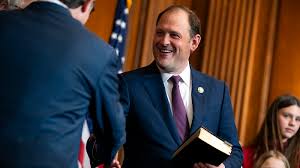
- Barr won the Republican primary with 64% of the vote, decisively defeating Cameron’s 28% share, according to the Associated Press.
- Trump intervened directly in the race by endorsing Barr and urging businessman Nate Morris to drop out and accept an ambassadorship — which Morris did.
- Barr will face Democratic nominee Charles Booker in November in a race where no Democrat has won a Kentucky Senate seat since 1992.
What Happened
The race to succeed Sen. Mitch McConnell had been a competitive three-way contest for months, with Rep. Andy Barr, former Kentucky Attorney General Daniel Cameron, and businessman Nate Morris each making credible cases for the Republican nomination. Morris, a MAGA-aligned candidate who had announced his campaign on Donald Trump Jr.’s podcast, held significant support within Trump’s orbit and had won an endorsement from conservative activist Charlie Kirk.
The contest changed dramatically when President Donald Trump intervened in early May, endorsing Barr and publicly urging Morris to “step aside” and accept an ambassadorship instead. Morris accepted the offer, calling it an honor to serve when the president asks. He then endorsed Barr, consolidated outside support behind the congressman, and the race effectively became a two-man contest.
Trump reinforced his backing in a recorded phone call to Kentucky voters on the eve of the primary, praising Barr as “a proven winner and patriot.” He also placed the endorsement in a broader strategic context, voicing support simultaneously for Gallrein in the 4th Congressional District and Ralph Alvarado in the 6th Congressional District. The coordinated endorsements reflected a comprehensive effort to reshape Kentucky’s Republican delegation.
Cameron, once considered a rising national star, was never able to fully separate himself from his past work with McConnell, a liability in a primary where every candidate sought to distance themselves from the retiring senator. Cameron had served as legal counsel to McConnell and had previously lost to Democratic Governor Andy Beshear in 2023, making Tuesday’s result his second statewide defeat in less than three years. Barr, despite also having a record of working within the McConnell-aligned establishment, successfully repositioned himself as an independent voice. “I am neither a Mitch McConnell-Republican nor a Rand Paul-Republican,” Barr said at a campaign event. “I am an Andy Barr Republican.”
Why It Matters
McConnell’s retirement ends an era in Kentucky and national Republican politics. The seven-term senator was the longest-serving Senate party leader in American history and played an instrumental role in reshaping the federal judiciary during both Trump administrations. His seat has been a fixed point of Republican power in Washington for four decades, and the question of who succeeds him matters significantly to the character of the Senate GOP caucus.
Barr represents a different model of Republican politics — Trump-aligned and transactional, rather than institutionalist. His victory confirms that the McConnell wing of the party has little purchase in contemporary Kentucky Republican primaries, even in the race to fill McConnell’s own seat. Candidates who tried to attack McConnell most aggressively, like Morris, were leveraged by Trump and then absorbed into the coalition rather than allowed to run as independent challengers.
The race also illustrates the remarkable degree to which Trump has centralized control over Senate candidate selection. By orchestrating Morris’s exit and elevating Barr, Trump effectively chose Kentucky’s next senator without voters having a meaningful choice between competing factions of the party. That consolidation of power has implications for how the next Senate will relate to the White House on issues ranging from the Iran war to spending to judicial nominations.
For Kentucky voters, the general election in November offers a clear contrast. Barr will run as a reliable conservative aligned with Trump’s America First agenda. Democratic nominee Charles Booker has positioned himself as an unapologetic progressive, drawing on his “Hood to the Holler” movement from previous campaigns.
Economic and Global Context
The Kentucky Senate race carries significant economic stakes. McConnell spent decades steering federal investment into Kentucky, delivering billions in infrastructure funding, defense contracts, and agricultural support. Barr, while philosophically committed to fiscal restraint, will need to demonstrate that he can protect Kentucky’s share of federal resources while also supporting the Trump administration’s broader spending cuts.
The “big beautiful bill” signed earlier this year includes substantial Medicaid reductions. Kentucky has one of the highest Medicaid enrollment rates in the country, meaning the cuts will be felt acutely by the state’s working-class population. Barr’s ability to hold the seat in November could hinge partly on how effectively he can reassure voters that those cuts will not harm their coverage.
Nationally, the Senate composition going into 2027 matters for the president’s ability to confirm judges, ratify any potential Iran peace deal, and advance further legislative priorities. A reliable Trump ally in a seat previously held by the institutionalist McConnell strengthens the administration’s position in Senate negotiations.
The Kentucky race also sends a signal to global markets about the stability of U.S. governance. A competitive Senate primary that resolves cleanly, without the prolonged chaos seen in some other states, suggests that the Republican political operation remains organized and functional heading into what promises to be a consequential fall election cycle.
Implications
Barr enters the general election as a heavy favorite. Kentucky has not elected a Democrat to the Senate since awarding Wendell Ford a fourth term in 1992, and despite Booker’s energy and grassroots following, the structural disadvantages facing a progressive Democrat in a deeply red state are substantial.
If Barr wins in November, as expected, it will add another reliable presidential vote to the Senate Republican caucus at a critical moment. Confirmation battles for judges and executive branch officials, the potential ratification of a nuclear deal with Iran, and future budget negotiations will all play out in a Senate where Barr’s vote is virtually guaranteed for the president’s position.
For Cameron, the defeat likely ends his aspirations for statewide office in the near term. He has now lost two consecutive high-profile campaigns and failed to consolidate support even from the McConnell-aligned faction of the party that might have been expected to rally behind him.
For the broader Republican Party, the Kentucky results — Gallrein’s win over Massie, Barr’s primary victory — represent a single coherent statement: Trump’s endorsement is the most valuable commodity in Republican politics, and his political operation remains the dominant force shaping the party’s future in the critical months before November.
Sources

