Story Highlights
- Trump told the graduates that Iran’s military has been effectively eliminated, saying “their navy’s gone, their air force is gone, just about everything.”
- The president posed a pointed public question: “Do we go and finish it up? Are they going to be signing a document?”
- Approximately 200 protesters gathered near the Academy, many demanding the release of the Epstein files or an end to the Iran conflict.
What Happened
President Donald Trump arrived at Groton-New London Airport shortly before 11 a.m. Wednesday, with his motorcade proceeding to the Coast Guard Academy’s Cadet Memorial Field for the 145th Commencement Exercises. The event was not open to the general public, and New London police established designated assembly areas for observers at McKinley Park and along Williams Street. Dozens of roads throughout the city were temporarily blocked to accommodate the presidential visit.
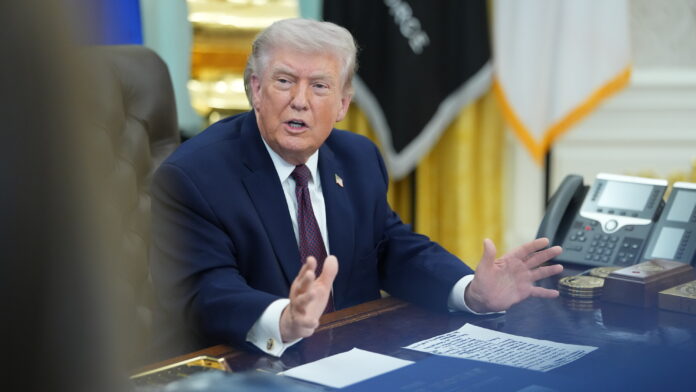
Trump’s address began around 11:50 a.m. and quickly moved beyond standard commencement themes to address the ongoing standoff with Iran. The president boasted about American standing in the world, telling the gathered cadets: “Right now we’re the hottest country anywhere in the world. We’re respected all over the world. You saw that with China just recently. You saw that in Venezuela. You saw that right now in Iran.”
The most striking passage of the speech addressed the war directly and in stark terms. Trump declared that American and Israeli operations had effectively dismantled Iran’s military capacity. Then, in remarks carried live by major networks, he framed the next phase of the conflict as a binary choice. The question before the administration, he suggested, was whether to “go and finish it up” or allow Iran to “sign a document” ending the war. He added: “Let’s see what happens” — leaving open the prospect of resumed strikes as a live option.
New London Mayor Michael Passero welcomed the presidential visit, noting the significance of having a sitting commander in chief address the graduating class. The academy’s commencement has been a traditional venue for presidential remarks, with Trump having previously addressed the Coast Guard’s graduating class during his first term in 2017 under markedly different circumstances.
Outside the perimeter, a crowd of approximately 200 protesters gathered in designated areas, carrying signs focused on two distinct grievances: the demand for the release of the Epstein files and opposition to the continuing U.S. military involvement in Iran. The dual focus of the protest reflected the politically heterodox coalition that has formed around Epstein transparency, a cause that had connections to the recently defeated Rep. Thomas Massie.
Why It Matters
A presidential commencement address at a military academy is never merely ceremonial, and Trump’s choice to use the Coast Guard platform to deliver a public ultimatum to Iran is significant. By framing the war’s next phase as an open question before an audience of America’s newest military officers — and before the cameras of every major network — the president was simultaneously sending a message to Tehran, to the American public, and to his own diplomatic team.
The speech comes at a delicate moment. The Trump administration has been engaged in diplomatic back-channel communications through Pakistani intermediaries, with Iran having submitted a 14-point peace proposal that Washington has been reviewing. Trump’s public statements suggest he finds elements of Tehran’s proposal insufficient, particularly on the issue of uranium enrichment, and the Coast Guard speech reinforced that posture by reminding Iran that the military option remains fully available.
For the American public, the speech is a reminder that the Iran conflict — now approaching its third month as an active U.S. engagement — remains unresolved. Oil and gas prices have been elevated since the war began, and the conflict has been a drag on the president’s approval ratings. The rhetorical pressure Trump applied Wednesday may be designed to accelerate Iranian decision-making toward a deal, rather than signal an imminent resumption of strikes.
There is also a domestic political dimension. With midterm elections approaching, the administration has strong incentives to project strength while also showing forward momentum toward an exit. A prolonged, inconclusive war is a political liability. A president who negotiated a favorable peace deal — or who finished the military job decisively — could reframe the conflict as a success before November.
Economic and Global Context
Iran’s strategic position at the Strait of Hormuz has had measurable economic consequences since the conflict escalated. Before the U.S.-Israeli military campaign began, roughly 25 percent of the world’s seaborne oil trade and 20 percent of global liquefied natural gas transited the strait. The U.S. naval blockade imposed in April 2026, combined with Iran’s counter-blockade of commercial shipping, has choked off a significant share of global energy supply chains.
American consumers have felt the impact directly. National gas prices crossed $4 per gallon on average following the war’s outbreak in late February, and they have remained elevated since. The economic pressure has contributed to a broader inflationary environment that is weighing on Republican polling heading into the fall campaign cycle.
Global markets have priced in a risk premium on oil that will remain elevated as long as the Strait of Hormuz remains contested. A peace deal that reopens the strait to commercial shipping would deliver an immediate positive economic shock — lower energy costs, reduced shipping insurance premiums, and restored confidence in Middle East supply chain stability. That economic upside gives the Trump administration a powerful incentive to close a deal, even if the terms require significant compromises.
Vice President JD Vance reinforced the diplomatic framework in a White House briefing Tuesday, saying the administration sees two possible outcomes: a good settlement or a return to military operations. He stated that the Iranians want a deal and have internalized that a nuclear weapon is the American red line.
Implications
Trump’s Coast Guard remarks will be read in Tehran as both an invitation and a warning. The explicit statement that “everything’s gone” regarding Iran’s military capacity is a public declaration of American dominance in the conflict, designed to pressure Iranian negotiators to accept terms that reflect their weakened position. The framing of the deal-or-escalate choice as an open public question maximizes psychological pressure on Iran’s leadership.
For U.S. allies in the Gulf region, who have previously urged restraint on the Trump administration, the speech will be monitored closely. Saudi Arabia, the UAE, and Qatar all have significant stakes in the stability of the region and have been active intermediaries in the peace process. Their cooperation is essential to any diplomatic resolution, and any signal of renewed hostilities complicates their domestic positions.
For the Coast Guard’s Class of 2026 specifically, the address marked their entry into service during one of the most consequential periods of American foreign policy in a generation. The Strait of Hormuz blockade is a Coast Guard-adjacent mission, and the graduates will serve in a maritime security environment shaped directly by decisions being made at the highest levels of government right now.
For American voters, the coming days will be decisive. Trump’s self-imposed deadline — described in earlier remarks as “maybe Friday, Saturday, Sunday, something, maybe early next week” — means the choice between diplomacy and escalation will be made shortly, with major consequences for energy prices, military commitments, and the political landscape heading into the fall.
Sources

