Story Highlights
- Former U.S. Capitol Police Officer Harry Dunn and Metropolitan Police Officer Daniel Hodges filed a federal lawsuit on May 20, 2026, seeking to block the Anti-Weaponization Fund
- The suit argues the fund violates the 14th Amendment by compensating individuals who participated in an insurrection against the United States
- Acting Attorney General Todd Blanche and Treasury Secretary Scott Bessent are named as defendants alongside President Trump
What Happened
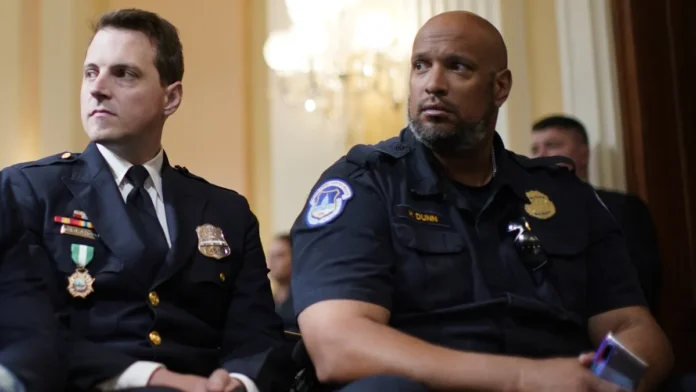
Harry Dunn, a former U.S. Capitol Police officer who became one of the most recognized faces of the January 6 defense, and Daniel Hodges, an active officer of the Metropolitan Police Department in Washington, filed a civil complaint in U.S. District Court in Washington on May 20. The lawsuit names President Donald Trump, Acting Attorney General Todd Blanche, and Treasury Secretary Scott Bessent as defendants. It is the first known legal challenge to the newly announced Anti-Weaponization Fund, which the Justice Department announced as part of a settlement of a Trump lawsuit against the federal government.
The fund, valued at approximately $1.776 billion, was established after Trump sued the federal government for $10 billion over the leak of his private tax returns by an IRS employee. The DOJ settled that lawsuit, and the resulting fund is to be used to compensate individuals who claim they were victims of prosecutorial overreach or government “weaponization” under previous administrations. The Justice Department has acknowledged that some of the money could go to January 6 defendants, many of whom received presidential pardons.
The lawsuit centers on the Fourteenth Amendment, adopted after the Civil War. That amendment explicitly states that neither the United States nor any state shall pay any debt or obligation incurred in aid of insurrection or rebellion against the United States. The plaintiffs argue that January 6 rioters engaged in precisely such an insurrection by storming the Capitol to prevent the certification of the 2020 presidential election, and that paying them from federal funds violates this constitutional prohibition.
The suit was filed by Brendan Ballou, a former federal prosecutor who worked on January 6 cases and now leads the anti-corruption group Public Integrity Project. Ballou has described the fund in stark terms, telling NPR it represents potentially the most corrupt exercise of presidential power in American history. The lawsuit further warns that disbursements from the fund would embolden future violence and signal to those who attacked officers that assault carries no consequence — and may in fact be financially rewarded.
Why It Matters
The legal challenge places the Anti-Weaponization Fund at the center of a constitutional confrontation that could reach the Supreme Court. The Fourteenth Amendment’s insurrection clause has rarely been litigated in modern times, but it carries significant weight as a foundational protection designed specifically to prevent the government from rewarding rebellion. If the courts agree that January 6 constituted an insurrection as defined by the amendment, the legal basis for payments to participants could be invalidated.
The case also elevates the personal stakes for the officers who defended the Capitol. Dunn and Hodges are not abstract legal figures — they were present during the attack, sustained injuries, and spent years testifying about their experiences before Congress. Their willingness to take legal action against the sitting president underscores how viscerally the fund is experienced by those who stood on the front lines that day.
For Republican senators, the lawsuit adds political weight to concerns they were already voicing internally. The existence of an active federal court challenge gives members a concrete legal argument for stripping the fund from legislation, rather than simply expressing political discomfort. Courts may ultimately determine the fund’s fate independently of Congress, but a pending lawsuit makes the politics even harder to manage.
The lawsuit also highlights a structural irregularity in how the fund was created. By suing the government he leads and then settling that lawsuit with taxpayer money directed to his political allies, Trump has created a financial mechanism with no clear legislative authorization or congressional appropriation. That raises separation of powers concerns separate from the Fourteenth Amendment argument at the heart of the officers’ suit.
Economic and Global Context
The Anti-Weaponization Fund involves nearly $1.8 billion in federal resources — money that critics argue has no legitimate legal basis and that was authorized through a settlement process that bypassed normal congressional appropriations. The federal government’s ongoing fiscal challenges make the allocation of such resources without clear statutory authority a point of particular concern among fiscal conservatives. Deficit projections for the current fiscal year remain elevated, and unauthorized disbursements of this scale add to budget complexity.
Former January 6 defendants and their legal representatives have already begun preparing applications to the fund, anticipating significant payouts. Legal analysts have noted that with more than 1,600 individuals prosecuted in connection with January 6 activity, the potential pool of applicants for the fund is large. Whether violence-related convictions disqualify applicants has not been definitively resolved, despite Blanche’s stated assurances.
Internationally, the fund has attracted attention from governments and legal bodies that monitor democratic backsliding and rule of law. Payment to individuals convicted of political violence at the seat of government would be unusual by the standards of any established democracy and may factor into ongoing assessments by organizations that track democratic governance indicators worldwide.
Implications
The federal court proceeding will move on its own timeline, but the officers’ lawsuit creates an early legal record that could be consequential. If a judge issues a preliminary injunction blocking the fund while the case is heard, it could effectively freeze disbursements and remove the political pressure from the Senate immigration debate. If the court allows the fund to proceed, it will embolden the administration and signal that the legal challenge faces an uphill path.
For Dunn and Hodges personally, the lawsuit is an extension of years of advocacy. Both officers have testified before Congress, spoken publicly about their experiences, and resisted pressure to move on from January 6. By filing suit, they have converted their moral objection into a legal instrument with the potential to produce binding consequences.
For the Republican Party, the case is another unwanted focal point during a period when the party is already under pressure from internal divisions, a stalled Senate agenda, and a competitive midterm environment. Each new development surrounding January 6, five years after the event, risks reminding persuadable voters of a day many would prefer not to relitigate.
Sources
“Trump sued by Jan. 6 police officers to block DOJ lawfare fund”

