Story Highlights
- Trump’s endorsement activity against GOP critics has created a Senate environment where multiple members are openly defying White House wishes
- Senate Majority Leader John Thune acknowledged that the primary campaign is making it harder to hold the Republican conference together on legislation
- The collapse of the immigration enforcement vote before Memorial Day recess represents the clearest legislative consequence to date
What Happened
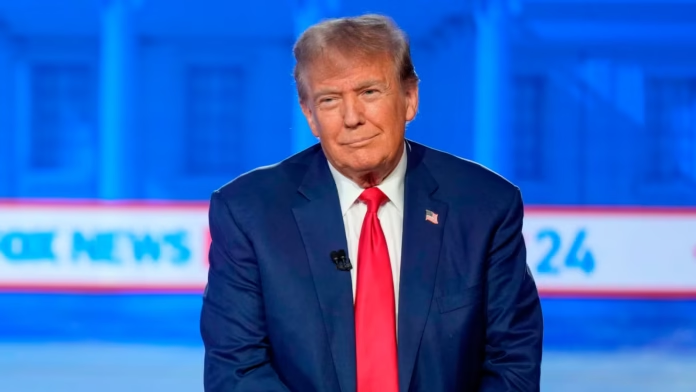
A pattern has emerged in Washington over the past two weeks that connects Trump’s political behavior outside the Capitol to increasingly fractious Republican politics inside it. President Donald Trump successfully backed primary challengers who defeated Sen. Bill Cassidy of Louisiana and Rep. Thomas Massie of Kentucky, and then extended his endorsement of Texas Attorney General Ken Paxton against incumbent Sen. John Cornyn — all within a span of days. Each move was celebrated by Trump allies as a demonstration of presidential political power.
But the secondary effects have been disruptive. Senate Majority Leader John Thune, asked about the state of the Republican conference during the anti-weaponization fund controversy, acknowledged that the president’s political activities are making legislative unity harder to achieve. Senators who have been publicly scorned by Trump — or who now represent states where a Trump-backed challenger is waiting in the wings — are recalibrating their behavior and making independent calculations rather than defaulting to White House preferences.
Cassidy, in the days following his primary loss, was among the most vocal critics of the anti-weaponization fund. He posted publicly that ordinary Americans are worried about mortgages, groceries, and gas — not about a $1.8 billion fund for the president and his allies to distribute without legal accountability. His willingness to speak plainly reflected the freedom that comes with having already paid the political price for independence.
Sen. Dick Durbin of Illinois, a Democrat, gave voice to a growing sentiment on both sides of the aisle when he asked aloud on May 21 whether Republicans had finally found an ethical limit they were unwilling to cross. The question resonated because, for the first time in months, the answer was not obviously no. Republican senators blocked a vote they had been preparing to take, forced a recess without a legislative victory, and are now returning to their states having failed to meet the president’s stated June 1 deadline.
Why It Matters
The connection between Trump’s primary strategy and his legislative challenges illustrates a tension that has characterized both of his terms. When Trump uses political force to punish critics, he gains short-term loyalty but depletes the goodwill and institutional cohesion that effective legislation requires. Senators who fear primary challenges tend to avoid visible conflict with the president — but senators who have already been targeted, or who are watching colleagues be targeted, often conclude that cooperation offers no protection anyway.
The anti-weaponization fund episode is a case study in how these dynamics unfold. Had Trump not insisted on inserting the fund into an immigration bill that had broad Republican support, the legislation would likely have passed before Memorial Day recess without controversy. Instead, the addition of the fund — combined with Cassidy’s high-profile defeat and his subsequent willingness to speak freely — gave wavering senators permission to voice concerns they might otherwise have suppressed.
For Republican strategists thinking about the November midterms, the episode is a warning. A Senate caucus that cannot deliver legislation on the president’s core priorities looks ineffective to voters who were told unified Republican government would produce results. Whether the cause is White House overreach, internal fractures, or both, the optics of a failed vote and a missed deadline are damaging.
Trump’s approval ratings have softened since his second inauguration, though he remains strongly popular with Republican primary voters. That split — popular among primary voters but weaker in broader polling — is precisely the dynamic that makes his primary threats effective inside the party while potentially weakening the party’s general election appeal.
Economic and Global Context
The legislative paralysis has real policy consequences. The $72 billion immigration enforcement bill was intended to provide sustained, multi-year funding for ICE, Customs and Border Protection, and related border security infrastructure. Without that funding locked in, operational planning for long-term deportation and detention operations becomes more difficult. Federal agencies manage on existing appropriations, but uncertainty about future funding affects staffing decisions, contract commitments, and capital investments in detention capacity.
Broader economic context adds pressure to the political dynamics. Consumer confidence surveys have reflected public anxiety about inflation and cost-of-living pressures. Several Republican senators have explicitly noted that constituents are focused on economic issues, not political grievances. To the extent that the anti-weaponization fund symbolizes a government spending money on inside political disputes rather than addressing citizen concerns, it reinforces a damaging narrative for a party that has staked its midterm appeal on economic competence.
The federal deficit context matters as well. With the government borrowing $1.7 trillion over the past year, any large new expenditure that lacks clear statutory authorization and cannot be explained as serving a public benefit invites criticism from both fiscal conservatives and voters skeptical of Washington spending priorities.
Implications
The Senate Republican conference will return from Memorial Day recess in June facing unresolved questions about how to handle the anti-weaponization fund. Procedural options include stripping the fund from the immigration bill, adding amendment language that restricts who can receive payments, or pushing forward and accepting the political and legal exposure. Each option carries costs, and none is clean.
For Trump, the episode tests whether his political methodology — which prioritizes loyalty enforcement over coalition management — can sustain a governing majority capable of passing legislation. Winning primaries is a different skill set from managing a legislative conference, and the gap between those two activities is becoming visible in the form of missed deadlines and stalled bills.
For Republican voters, the dynamic creates cognitive dissonance. They elected a president and a Senate majority to deliver results on immigration enforcement, tax policy, and fiscal priorities. If those majorities cannot advance those priorities because of internal conflicts driven by the president’s own demands, the political case for returning Republicans to power in November weakens.
The broader signal to American political observers is that presidential power, even when exercised aggressively, has institutional limits. The Senate is a constitutional co-equal branch, and senators — particularly those who have already absorbed Trump’s political punishment — are demonstrating a willingness to exercise that co-equal status in ways that complicate the White House’s legislative calendar.
Sources

