
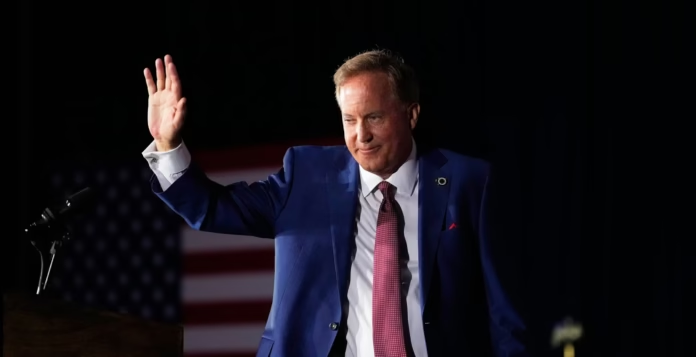
In a stunning political upset, President Donald Trump’s last-minute endorsement propelled Texas Attorney General Ken Paxton to a commanding victory over longtime incumbent Senator John Cornyn in Tuesday’s Republican Senate primary runoff. Trump-backed Paxton will win the Senate primary runoff for the GOP nomination, unseating Cornyn in a seismic shift for Republicans in the Senate. The result reshapes the competitive landscape heading into the November general election and raises new questions about the Republican Party’s ability to hold its Senate majority.
Story Highlights
- Paxton topped Cornyn by over 27 points with the vast majority of votes counted.
- A Democrat has not won a statewide race in Texas since 1994, and has not won a U.S. Senate race in the state since 1988.
- Paxton now faces off against state Rep. James Talarico — described as a rising star in the Democratic Party — in the general election in a race that is among a handful that may decide if Republicans hold their slim 53-47 majority in the Senate.
What Happened
Tuesday’s Republican Senate primary runoff in Texas delivered one of the most dramatic results of the 2026 election cycle. President Donald Trump issued a last-minute endorsement for Attorney General Ken Paxton, breaking months of silence in a race that Senate Republican leadership had desperately wanted him to stay out of, or to back incumbent Senator John Cornyn. The endorsement proved decisive.
The lopsided victory for Paxton in the election results captured an important reality of the GOP in 2026: Trump’s word still dominates primary outcomes. Cornyn, a four-term senator, entered the race with massive institutional support, including backing from Senate Majority Leader John Thune and the National Republican Senatorial Committee, along with a formidable fundraising advantage. None of it was enough once the president spoke.
Cornyn, speaking to reporters after the race was called, said, “I’ve always supported the Republican ticket, and I intend to do so again in this general election.” His measured concession underscored the reality that Senate Republicans, however frustrated by Trump’s intervention, are unwilling to publicly break with the party heading into a difficult midterm environment.
Paxton was first elected Texas attorney general in 2014, aggressively taking on the Obama administration when he assumed office, and became a close ally of Trump’s — going so far as to file a lawsuit challenging the 2020 election results in multiple states. Despite a turbulent legal history, including a 2023 impeachment by the Texas House on charges of bribery and dereliction of duty — from which he was later acquitted by the state Senate — Paxton successfully positioned himself as the MAGA standard-bearer in the race.
Trump’s stamp was all over Tuesday’s results, as his endorsed candidates proceeded to the general election. The broader primary picture reinforced a familiar pattern: Republican voters in contested primaries continue to follow the president’s lead, regardless of the preferences of the party’s Washington establishment.
Why It Matters
The Texas Senate race is about far more than a single seat. It is a test of whether Trumpism can sustain itself at the ballot box even as the president faces historically low approval ratings. For Senate Republicans in Washington, the result sends an uncomfortable message: the base has chosen loyalty to Trump over electability calculations made by party strategists.
Cornyn and his allies repeatedly argued that if Paxton were the GOP’s nominee, the party would be forced to spend millions of dollars to keep the seat from flipping, and that Republicans down-ballot would suffer. Those warnings went unheeded by primary voters. Whether those warnings prove prescient will only be known in November, but the general election contest is now set to be one of the most closely watched in the country.
The replacement of a Senate committee chairman and seasoned appropriator like Cornyn with a figure as polarizing as Paxton represents a significant shift in Texas’s institutional weight in Washington. Cornyn, known for his legislative acumen and bipartisan relationships, would have been a reliable vote and voice in a Senate Republican conference that increasingly faces intra-party tensions.
Democratic nominee James Talarico characterized Paxton as corrupt and branded the fall matchup as “the people versus Ken Paxton.” Whether that framing resonates with the broader Texas electorate — especially suburban voters and independents who have shown signs of drifting away from the Republican Party in recent cycles — will be the defining question of the general election.
Economic and Global Context
The Texas Senate race carries economic implications beyond electoral politics. Texas is home to the nation’s energy industry, major financial institutions, and a growing technology sector. Control of that Senate seat affects committee assignments, regulatory oversight, and federal resource allocation to one of the country’s most economically consequential states.
Republicans have seen lackluster turnout in primaries across the country in 2026. Meanwhile, Democrats have been showing up in a big way, starting in Texas. Low Republican primary turnout in a high-profile race is a warning signal for party operatives who are already contending with a challenging national environment on economic issues including inflation and tariff costs.
Texas’s political significance extends beyond its borders. The state’s congressional delegation, its Senate representation, and its electoral vote share make it a pillar of Republican national strategy. If demographic and political trends continue shifting, the resources required to defend Texas will complicate GOP efforts in more traditional battleground states, straining campaign budgets and candidate attention heading into the fall.
The Senate majority itself is on the line. Republicans hold a 53-47 margin, meaning the loss of even a few seats would hand Democrats the chamber. A competitive Texas race forces the NRSC to divert money and infrastructure to a state it would normally treat as safe, with downstream effects on Senate races in Nevada, Arizona, and other swing states.
Implications
For the Republican Party, the Paxton victory creates both a short-term test and a long-term strategic dilemma. In the short term, the party must now mobilize behind a candidate with significant legal baggage and high unfavorability numbers among moderates and independents — precisely the voters Republicans need to hold the Senate.
The intra-party tension is palpable. Senate Republican leaders who publicly or privately backed Cornyn will need to decide how enthusiastically they campaign for and fundraise on behalf of Paxton. Their willingness to do so will signal how unified — or fractured — the Republican Senate conference is heading into November.
For Trump, the victory reinforces his grip on the Republican base, but the political calculus is complicated. If Paxton loses Texas in November, the president will own the result. That outcome would accelerate existing conversations within the GOP about whether blind fealty to Trump’s endorsements is a winning long-term strategy at the national level.
Trump’s run of endorsements in May shows he retains power over the Republican base even as his national approval ratings slip. The central tension of the 2026 cycle — between Trump’s ability to shape primaries and the party’s ability to win general elections — has never been more sharply illustrated than in Tuesday’s Texas result.

