Story Highlights
- The Strait of Hormuz closure has blocked roughly 14 million barrels of oil per day from reaching global markets
- U.S. gasoline prices remain approximately $1.50 per gallon above pre-war levels despite recent declines
- Energy executives and the IEA warn full supply normalization may not occur until 2027 regardless of when a deal is reached
What Happened
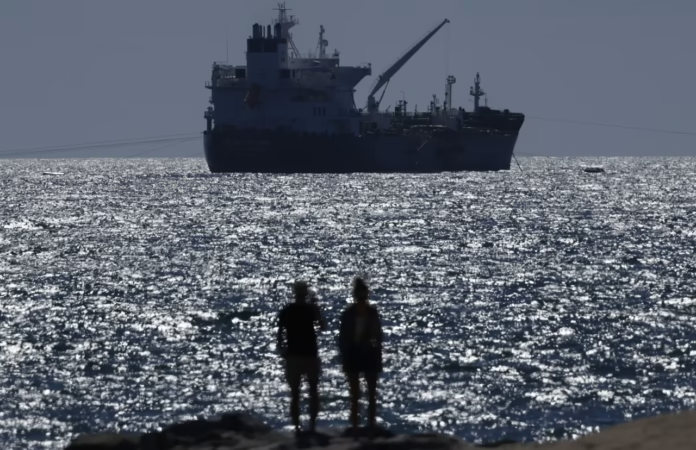
When President Donald Trump announced joint U.S.-Israeli strikes against Iran on February 28, the immediate military calculation was that a rapid degradation of Iranian military capability would force Tehran to the negotiating table quickly. What followed instead was an extended conflict that triggered one of the most significant disruptions to global energy markets in decades. Iran’s effective closure of the Strait of Hormuz — the narrow waterway between Iran and Oman through which roughly 20% of the world’s oil and liquefied natural gas normally passes — sent crude prices soaring and gas prices climbing at American pumps within days.
The throttling of the Strait of Hormuz has raised energy costs and is weighing down economies worldwide, including the United States, where average pump prices are approximately $1.50 per gallon above pre-war levels. The situation has pushed the administration into urgent negotiations with Iran, while simultaneously forcing the Federal Reserve and Treasury Department to manage a new inflationary impulse at the worst possible moment — just as the U.S. economy had been showing signs of stabilizing from earlier price pressures.
Treasury Secretary Scott Bessent has been coordinating economic response measures, including an insurance program designed to encourage shipping companies to resume transits through Hormuz by providing federal backing for vessels willing to test the waterway. The program has had limited uptake so far, as tanker operators remain unwilling to risk billion-dollar assets until a formal ceasefire agreement is signed and has demonstrated durability.
As of mid-May, the conflict was blocking the flow of around 14 million barrels of oil per day, according to the International Energy Agency. Saudi Arabia and the United Arab Emirates have increased the use of overland pipelines that bypass the strait, but those additional volumes represent only a fraction of the lost throughput. The gap between supply and demand has pushed global inventories into an accelerating drawdown that the IEA has described as unsustainable heading into summer.
Why It Matters
Energy costs touch every corner of the American economy. Elevated gas prices function as a tax on working families and small businesses, reducing disposable income and squeezing transportation-dependent industries. Trucking companies, airlines, agricultural operations, and delivery services have all reported margin compression as fuel costs remain elevated, pressures that eventually pass through to consumer prices across the board.
For the Trump administration, the energy shock is a direct political challenge. The president built significant public support during his campaign by attacking Biden-era inflation and promising lower energy costs. The Iran conflict — which the administration initiated — has produced the opposite outcome, at least in the near term. White House officials have attempted to frame the higher prices as a temporary cost of a necessary national security operation, but that framing carries limited weight with voters paying $4.50 per gallon on a regular basis.
The Federal Reserve faces an uncomfortable dilemma. Inflation driven by an external supply shock is different from inflation caused by domestic demand, and responding with aggressive interest rate increases risks slowing an economy that is already feeling the weight of higher energy costs. The Fed has signaled it is monitoring the situation closely but has avoided committing to a specific policy path until the geopolitical picture becomes clearer.
Congressional Republicans have been broadly supportive of the Iran conflict, but private conversations have reflected growing anxiety about the economic costs heading into a midterm environment where kitchen-table issues tend to dominate. Several Senate Republicans have quietly urged the administration to accelerate diplomatic efforts, and the news that Trump is in the Situation Room making a final determination on a deal has been received with cautious optimism in Republican caucus circles.
Economic and Global Context
The energy shock from the Iran war is not uniformly distributed across the global economy. The countries feeling the most acute pain are developing nations in Asia and Africa that depend heavily on Middle Eastern energy imports and lack the financial buffers that allow wealthier economies to absorb the price spikes. The International Energy Agency’s executive director has stated explicitly that developing nations in Asia and Africa will feel the “biggest pain of this crisis.”
Global oil prices have tumbled approximately 20% from their 2026 highs as investors grow increasingly optimistic about the prospects for a long-lasting ceasefire deal, providing some measure of relief. However, analysts at UBS and other institutions have cautioned that even a signed agreement will produce only a gradual normalization of energy flows. Infrastructure damaged during the conflict — including refineries, pipelines, and port facilities across the Gulf — will require significant time and investment to restore, independent of when the shooting stops.
Goldman Sachs projected in earlier analysis that elevated oil prices could persist through 2027 in certain scenarios. Energy executives have broadly echoed that timeline, noting that the logistical and financial infrastructure required to resume large-scale tanker transits through Hormuz — including insurance availability, crew willingness, and terminal readiness — cannot be rebuilt overnight.
Implications
If Trump approves the memorandum of understanding this weekend and Iran follows through on opening the Strait of Hormuz, the energy market response will be swift but incomplete. Futures prices will likely fall further, providing some pump-price relief within weeks. However, fully restoring U.S. crude oil and refined product inventories — which have been depleted at record pace during the closure — will take months, meaning that the economic hangover from the Iran conflict will extend well past any formal ceasefire.
For American businesses and households, the most useful near-term guidance is that prices will improve gradually rather than sharply, and that prudent financial planning should account for above-average energy costs through at least the end of 2026. For the Trump administration, the economic legacy of the Iran conflict will depend heavily on how quickly a real diplomatic resolution produces tangible results for consumers — and whether those results arrive before November.
Sources
“Oil drops 20% from 2026 peak on optimism over U.S.-Iran ceasefire talks”

