Story Highlights
- Trump-backed challengers defeated incumbent Republicans in eight of ten targeted primary races in May, a success rate that political analysts say is historically extraordinary for a sitting president intervening against members of his own party
- Major scalps include Louisiana Senator Bill Cassidy, Kentucky Representative Thomas Massie, five Indiana state senators, and Texas Senator John Cornyn — all of whom had demonstrated independence from Trump at key moments
- The results are creating what Washington Post analysis described as a class of “lame-duck” senators who owe Trump nothing and are now free to oppose him, compounding the president’s challenges with Senate governance
What Happened
President Donald Trump concluded the month of May 2026 with a primary record that solidified his reputation as the Republican Party’s most consequential internal disciplinarian. Across Senate, House, and state legislative races, Trump endorsed challengers against ten sitting Republican incumbents and prevailed in all but two contests, with one additional race still undecided. The breadth and success rate of the campaign left political analysts searching for historical precedent.
The most prominent victim was Louisiana Senator Bill Cassidy, one of seven Republican senators who voted to convict Trump in his second impeachment trial following the January 6, 2021 Capitol attack. Cassidy, who had defended that vote publicly for five years and acknowledged he would likely face primary consequences, lost his reelection bid on May 17 — the culmination of a years-long political reckoning. The loss removed one of the most prominent institutionalist voices in the Senate Republican caucus.
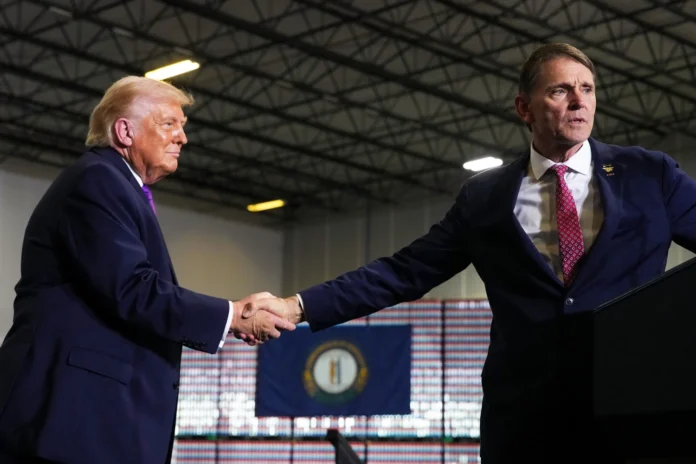
In Kentucky, Representative Thomas Massie — a libertarian-leaning Republican whose confrontational independence on issues including January 6 and the Epstein files had repeatedly annoyed Trump — was defeated handily by a Trump-backed challenger. In Indiana, five state senators who had blocked Trump’s push for mid-decade congressional redistricting were all ousted in coordinated primary challenges. Each loss was accompanied by explicit statements from Trump’s team that the defeats were directly tied to insufficient loyalty.
The capstone of the month came in Texas, where Trump’s late endorsement of Attorney General Ken Paxton over four-term Senator John Cornyn delivered one of the most jarring results of the cycle. In Georgia, Secretary of State Brad Raffensperger — the official who refused Trump’s 2020 request to “find 11,780 votes” — also lost his primary for governor to candidates aligned with Trump’s election denial position. Trump’s endorsed candidate Burt Jones advanced to a runoff.
Political analysts noted that the scale of Trump’s primary intervention against fellow Republicans is historically unusual. While presidents frequently endorse primary challengers against opposition-party incumbents, systematically targeting sitting members of their own party at this volume and success rate represents a qualitatively different use of executive political power.
Why It Matters
The primary purge has produced a Republican congressional pipeline increasingly populated by candidates whose defining political characteristic is loyalty to Trump rather than independent policy expertise, constituent service, or institutional experience. As those candidates advance to general elections and potentially to Congress, the question of how they will behave when Trump’s preferences conflict with their own constituents’ interests becomes urgent.
For Senate governance, the results create a paradox. By eliminating senators who had shown willingness to dissent — even occasionally — Trump has, as Washington Post analysis noted, created a new category of lame-duck senators who lost their primaries and now owe him nothing for the remainder of their terms. Both Cassidy and Cornyn could conceivably vote against the White House on key legislation between now and January, with no reelection pressure to restrain them.
For the Republican Party’s general election prospects, the primaries produced candidates with varied electability profiles. In states like Texas, nominating a candidate with an impeachment record and ongoing legal controversies introduces risk that would not exist with a more conventional incumbent. Party strategists are privately calculating the difference between winning primaries and winning November races — a gap that could determine Senate control.
Economic and Global Context
The ideological composition of Congress has direct economic consequences. A Senate caucus composed primarily of Trump loyalists would be more likely to pass his preferred fiscal, trade, and regulatory agenda with fewer internal obstacles. However, it could also make Senate Republicans less capable of forming the bipartisan coalitions occasionally necessary for must-pass legislation, including debt ceiling agreements, government funding bills, and disaster aid packages.
Midterm elections determine not only the immediate legislative agenda but the oversight capacity of Congress. A more loyal Republican Senate would conduct different oversight of executive branch activities than a caucus with independent voices. For financial markets, which price political risk based on expectations about policy stability and institutional predictability, the composition of the post-November Congress is a meaningful variable.
The total cost of Republican intraparty primary battles in May alone ran into hundreds of millions of dollars — funds that cannot be used in general election contests against Democratic challengers. That resource drain compounds the midterm challenges the party faces with a president whose approval ratings have declined significantly.
Implications
For November, the primary results set up a series of individual general election contests in which electability questions will be front and center. Democrats have identified Paxton in Texas, the open seat in Louisiana following Cassidy’s departure, and potentially Massie’s Kentucky seat as pickup opportunities created or amplified by Trump’s primary interventions.
For Trump personally, the primary record provides political capital heading into the second half of 2026. A president who can credibly threaten any Republican lawmaker with a primary challenge maintains leverage that is independent of his approval rating among the general public. Senate Republicans navigating the anti-weaponization fund dispute and the SAVE America Act standoff are making their calculations with that leverage explicitly in mind.
For Republican voters, the primary cycle raises a fundamental question about party identity that will not be resolved before November: whether the GOP is a governing coalition capable of delivering on economic and policy promises, or a loyalty-enforcement mechanism operating primarily in service of one man’s political interests.
Sources
“Trump racks up May primary wins in Republican retribution campaign”

