Story Highlights
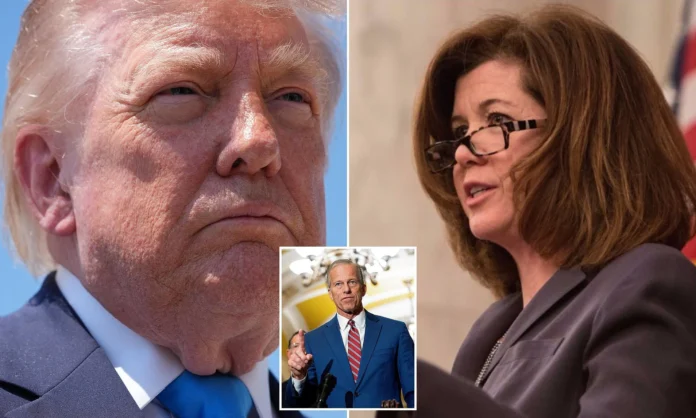
- Trump demanded the Senate fire parliamentarian Elizabeth MacDonough after she blocked ballroom-linked security funding
- MacDonough ruled that the $1 billion White House Secret Service provision did not qualify under reconciliation’s Byrd Rule
- Senate Republicans declined to remove her, leaving Trump without a legislative tool he wanted and the immigration bill stalled
What Happened
In mid-May, Senate Parliamentarian Elizabeth MacDonough ruled that provisions in the Republican reconciliation package, specifically a $1 billion Secret Service funding measure connected to President Trump’s planned White House East Wing ballroom renovation, did not comply with the Byrd Rule. The Byrd Rule restricts what can be included in reconciliation bills to genuinely budget-related items, and MacDonough found that the ballroom security provision fell outside the Judiciary Committee’s jurisdiction under those standards.
President Trump responded with a pointed Truth Social post that reverberated across Capitol Hill. He singled out MacDonough by name, questioning why Senate Republicans had “kept the very important position of ‘Parliamentarian’ in the hands of a woman” originally appointed by Democrats, describing her as having been placed there by former President Barack Obama and the late Senator Harry Reid. He demanded her replacement and renewed longstanding calls to abolish the Senate filibuster entirely.
Senate Majority Leader John Thune acknowledged the ruling and said Republicans would work to revise the problematic language. But neither he nor the broader caucus showed any appetite for actually removing MacDonough, a move that would require the cooperation of the Senate Republican conference and would itself generate significant institutional controversy. Senator Ron Johnson of Wisconsin told reporters that the root problem was the 60-vote filibuster threshold, not the parliamentarian herself. Senator John Kennedy of Louisiana, asked whether MacDonough should be replaced, responded with dry skepticism: “For what? Does she have a DWI or something?”
The dispute formed part of a larger legislative train wreck surrounding the immigration enforcement bill, a roughly $70 billion reconciliation measure designed to fund ICE and Border Patrol through the end of Trump’s term without needing Democratic votes. Republicans chose reconciliation specifically because they could not reach the 60-vote filibuster threshold for regular legislation. But the same procedural shelter that allowed them to bypass the filibuster also subjected the bill to MacDonough’s rulings on what qualified as legitimately budget-related content.
Why It Matters
The parliamentarian episode crystallizes a recurring challenge for the Trump administration: the executive’s ambitions frequently outpace the procedural architecture through which the Senate operates. MacDonough has now blocked or trimmed provisions pursued by both parties under reconciliation, including Democratic attempts to include immigration protections in the 2021 COVID relief package and minimum wage increases under the same vehicle. She is not a partisan actor — she is an institutional one. That distinction is lost on the president, for whom procedural constraints register as political obstruction.
The demand to fire her placed Senate Republicans in an uncomfortable position. Removing a parliamentarian mid-reconciliation is not without precedent — Senate Majority Leader Trent Lott did it in 2001 — but it would provoke significant backlash and raise questions about the integrity of the process. For senators already worried about their reelection prospects in a difficult midterm environment, adding an institutional controversy on top of the anti-weaponization fund fight and the Iran war was not appealing.
More fundamentally, the episode illustrates the limits of reconciliation as a governing tool. The process is powerful but narrow, and the Byrd Rule constrains its use in ways that prevent the kind of sweeping legislative package that Trump has repeatedly envisioned.
Economic and Global Context
The stalling of the $70 billion immigration enforcement bill has direct budgetary and operational consequences for the agencies it was designed to fund. ICE and Border Patrol were underfunded in the current fiscal year’s appropriations process because Democrats refused to provide the levels Republicans sought. Without the reconciliation bill, those agencies face operational constraints at a time when immigration enforcement remains one of the administration’s highest stated priorities.
The ballroom provision that triggered the MacDonough ruling is itself economically notable. The White House East Wing renovation and ballroom construction project has been estimated at substantial cost to taxpayers, and the effort to route an additional $1 billion in security funding through a legislative vehicle designed for border enforcement raised eyebrows even within the Republican conference, where some members viewed it as a misuse of scarce reconciliation bandwidth.
Implications
The parliamentarian fight will return when the immigration bill comes back to the Senate floor after the Memorial Day recess. Republicans will need to revise their language to satisfy the Byrd Rule requirements, and there is no guarantee that a rewritten version will retain all the policy content the administration wants. That negotiation will unfold as the anti-weaponization fund controversy continues and Trump’s approval numbers sit at second-term lows.
For Trump, the inability to fire the parliamentarian underscores a broader reality: there are institutions and individuals within the American governmental system over whom he does not have direct removal authority, and Senate Republicans have shown they are not willing to exercise that authority on his behalf when the institutional costs are high. That boundary is consequential and will likely be tested again.
For voters watching the Republican Senate majority struggle to advance its own president’s agenda, the procedural battles reinforce a narrative of governmental dysfunction. Whether that narrative helps or hurts Republicans in November depends largely on whether they eventually deliver legislative wins before the campaign season begins.
Sources
“Trump demands Senate fire parliamentarian over ballroom security ruling”

