Story Highlights
- Jones received 38% and Jackson 33% in the May 19 primary, with no candidate clearing the 50% threshold
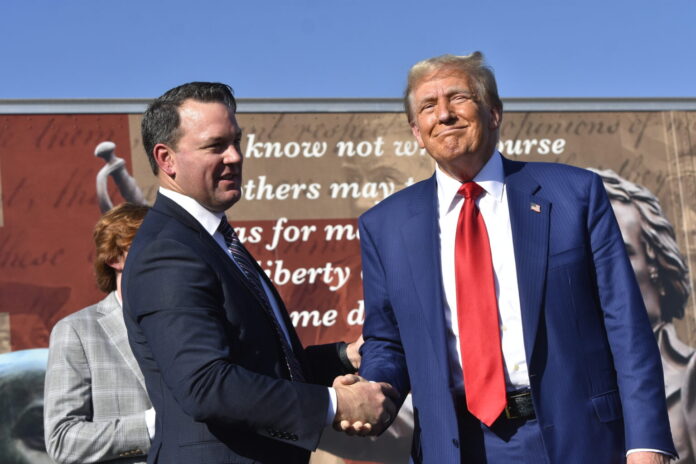
- Trump endorsed Jones, calling him “tried and true” in a tele-rally call days before the primary
- Jackson, a healthcare billionaire who entered the race in February, has spent more than $30 million of his own money on ads
What Happened
When Rick Jackson — a healthcare executive and billionaire who had never previously held or sought public office — descended in a glass elevator at his office building in Alpharetta to announce his candidacy for governor in February 2026, deliberately echoing President Trump’s famous 2015 escalator moment, it set the tone for what would become one of the most contentious Republican primaries in Georgia’s recent history. Within weeks, Jackson had committed more than $30 million to television advertising, more than any candidate had ever spent in a single Georgia governor’s primary.
Lieutenant Governor Burt Jones, who had entered the race with a clear organizational and credential advantage backed by Trump’s official endorsement from August 2025, suddenly found himself in a genuine fight. Jones, a sixth-generation Georgia native and former University of Georgia football player, had served as lieutenant governor since 2022 and played a central role in passing Georgia’s Election Integrity Act. He was among the first Georgia Republicans to endorse Trump in 2016 and has maintained that loyalty across three presidential campaigns.
With 87 percent of the vote counted on primary night, Jones led with 38 percent to Jackson’s 33 percent. The remaining candidates — including state Attorney General Chris Carr and Secretary of State Brad Raffensperger, both prominent figures in Georgia Republican politics — were eliminated without reaching competitive thresholds. The June 16 runoff was confirmed, setting up a direct rematch.
Trump moved to eliminate any ambiguity about his continued support in a tele-rally call ahead of the primary. “There’s a lot of confusion. Everyone’s saying I endorsed them. I didn’t,” Trump said. “I endorsed a man named Burt Jones, your lieutenant governor. Vote for Burt Jones. He’s just an incredible guy who has my complete and total endorsement in the race.” Jackson, who had been actively courting Trump’s political brand while positioning himself as someone who embodied the MAGA spirit without the formal endorsement, pushed back by questioning Jones’s financial dealings and integrity in public office.
Why It Matters
Georgia is not merely a Southern state — it is one of a small number of genuinely competitive battlegrounds that determines the direction of national politics. Republicans have held the governorship since 2002, but Keisha Lance Bottoms, the Democratic nominee and former Atlanta mayor with strong name recognition in the state’s most populous metropolitan area, represents a credible threat to extend Democratic competitiveness beyond the presidential level.
The choice between Jones and Jackson carries real stakes for how Republicans approach that general election. Jones, with Trump’s formal endorsement, brings with him the organizational machinery and base energy that MAGA endorsements generate. Jackson, self-funded and tactically positioned as a Trump-style outsider, argues that voters want an actual businessman-politician in the mold of Trump rather than an endorsed incumbent carrying the baggage of state government.
The race also tests whether Trump’s endorsement power — which has performed well in primary contests this cycle — can translate into victories when a wealthy, self-funding candidate presents himself as an equally authentic alternative. If Jackson wins despite Trump’s opposition, it would complicate the narrative of total presidential control over Republican primaries that the Paxton, Cassidy, and Massie results appeared to establish.
Economic and Global Context
Georgia’s economy is one of the fastest-growing in the country, with Atlanta having developed into a major logistics, technology, and film production hub over the past decade. The governor’s race will shape the state’s approach to business recruitment, tax policy, workforce development, and the regulatory environment for key industries.
The influx of self-funded campaign spending by Jackson — over $30 million before the primary and more expected before the runoff — reflects a broader national trend of billionaire self-funders entering politics, a trend that Trump himself pioneered at the presidential level. Jackson’s healthcare empire gives him both the financial resources and a sectoral lens for policy that differs meaningfully from the political career path Jones has followed.
Republicans have also invested in Georgia redistricting efforts that could affect the state’s congressional delegation composition following this year’s midterms, adding another layer of state-level political significance beyond the governor’s race itself.
Implications
The June 16 runoff arrives two weeks from today and is likely to be defined by two questions: whether Trump’s formal endorsement of Jones can overcome Jackson’s financial firepower, and whether the personal attacks that have already produced lawsuits and a defamation claim will further damage the eventual nominee before the general election begins.
If Jones wins, he enters the November race with Trump’s backing and the organizational advantages of the lieutenant governorship, but will need to consolidate the Jackson coalition quickly. Bottoms and the Democrats will use the Trump endorsement as a central line of attack in the general election, as they did with Herschel Walker in 2022 — a Senate race Trump’s preferred candidate lost.
If Jackson wins, he proves that money and cultural alignment with MAGA can substitute for formal presidential endorsement, a finding that would influence candidate recruitment and political strategy far beyond Georgia. It would also represent a rare and notable defeat for Trump’s endorsement infrastructure in a high-profile race.
Either way, Georgia in November will be a critical indicator of whether Democrats can capitalize on Trump’s declining approval numbers to compete for statewide offices in states that have leaned reliably Republican.
Sources
“Trump-endorsed Burt Jones forced into Georgia governor runoff with Jackson”

