Story Highlights
- Lahn defeated Feenstra by less than one percentage point with 99 percent of the vote counted
- Trump endorsed Feenstra just four days before the primary, calling him “MAGA all the way” on Truth Social
- The loss opens the Iowa governorship to meaningful Democratic competition for the first time in more than two decades
What Happened
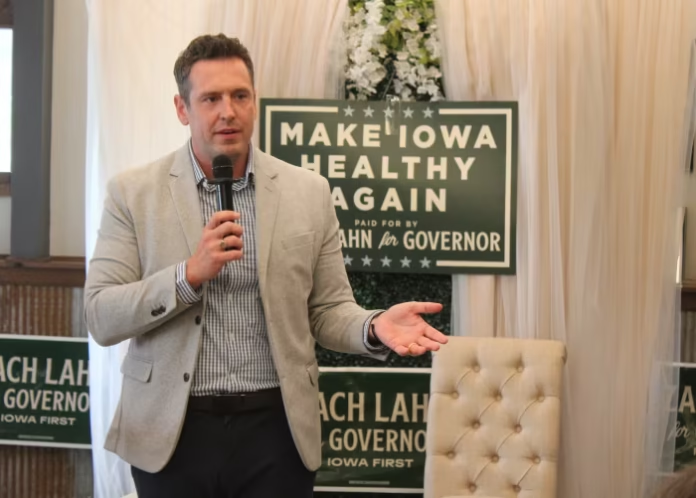
Zach Lahn, a farmer and businessman from rural Iowa, defeated three-term Congressman Randy Feenstra in Tuesday’s Republican gubernatorial primary, dealing President Donald Trump his first significant primary loss of the 2026 midterm election cycle. The Associated Press called the race at 11:50 p.m., with Lahn holding a margin of less than one percentage point after a night of extremely tight counting.
Trump had endorsed Feenstra just days before the election in a gushing Truth Social post, calling the congressman “MAGA all the way” and writing “Randy Feenstra has my Complete and Total Endorsement.” The endorsement came so late that Feenstra’s campaign was unable to incorporate it into TV advertisements before the primary closed, depriving the endorsement of much of its usual amplifying power.
Lahn entered the five-person race as a relative outsider. He aligned himself with the “Make America Healthy Again” movement championed by Health and Human Services Secretary Robert F. Kennedy Jr., drew support from Turning Point Action, and won the backing of former Congressman Steve King, who lost to Feenstra in a bitter 2020 House primary. Lahn carried 16 of the 19 Iowa counties that King had won in that earlier contest, suggesting King’s endorsement delivered tangible geographic reach.
Feenstra’s campaign had attempted to disqualify Lahn by highlighting his investment in a company that manufactures adult products, an attack that apparently failed to resonate with primary voters. Feenstra, in his concession speech, called Lahn to pledge his full support, urging supporters to “carry the torch” and keep Iowa red ahead of the November general election.
A Trump political strategist, reacting anonymously by text message to reporters, offered a blunt summary of the defeat: “Clearly a Randy problem. Barely won his own district. But it is what it is. So we go with Lahn.” Trump’s operation quickly pivoted to supporting Lahn as the Republican nominee.
Why It Matters
Iowa has been one of the most reliably Republican states in the country, backing Trump by 13 percentage points in the 2024 presidential election. Republicans have not lost a gubernatorial race in Iowa since the presidency of George W. Bush. The fact that Trump’s endorsement could not save his chosen candidate, even in such favorable terrain, raises legitimate questions about the limits of his political influence inside his own party.
The MAHA movement’s role in the outcome is significant. Lahn’s alignment with Kennedy’s health agenda suggests that a distinct strand of Republicanism — one skeptical of industrial food systems, vaccine policy, and corporate agriculture — is gaining enough electoral traction to defeat establishment-aligned candidates even when they carry Trump’s name. This creates a potential intraparty tension the Republican Party will need to navigate as midterms approach.
The loss also exposes a tactical vulnerability in late endorsements. Trump’s political operation has built a reputation for delivering primary victories, but that machinery depends in part on timing. An endorsement delivered with enough runway allows campaigns to blanket airwaves with presidential imagery. One delivered four days before election day has limited operational utility, especially in a competitive multi-candidate field where grassroots organization matters enormously.
For the Democratic Party, Feenstra’s loss is an unexpected opportunity. Democratic nominee Rob Sand, Iowa’s state auditor, ran unopposed in his primary and has spent months constructing a bipartisan message aimed at winning over moderate Republicans and independents. Lahn, as a less-known figure whose candidacy sparked intraparty conflict, enters the general election in a weaker position than Feenstra would have.
Economic and Global Context
Iowa’s political economy is defined by agriculture, and the 2026 primary cycle has taken place against a backdrop of genuine farm sector stress. Lahn’s central argument — that Iowa has lost 10,000 family farms since 2000 and that young residents are leaving faster than in 46 other states — reflects documented demographic and economic pressures that mainstream Republican candidates have not always addressed directly.
Trump’s tariff policies, while popular with some Iowa farmers seeking trade leverage, have created volatility in soybean and corn export markets, particularly with China. Iowa farmers remain attentive to those negotiations, and candidates who can speak credibly to agricultural policy rather than simply invoking the president’s brand may hold structural advantages in the state.
The broader midterm environment is one in which Republican House control is already considered fragile. Any surprise Republican gubernatorial loss in November — in a state as red as Iowa — would amplify national narratives about a midterm wave and affect candidate recruitment and fundraising nationwide.
Implications
The most immediate implication is for the November general election. Iowa Democrats now believe they have a realistic shot at the governorship. Sand’s auditor background, fiscal credibility, and bipartisan appeal were already calibrated for a competitive race, but his campaign will be energized by the Republican uncertainty Feenstra’s loss creates.
For Trump’s political operation, the defeat is a data point that warrants study rather than alarm. One primary loss in a complex multi-candidate field, with a late endorsement, does not constitute a pattern. But if similar outcomes follow in other states, the narrative of inevitable Trump primary dominance will erode, reducing the deterrent effect that has kept potential challengers at bay throughout his second term.
For the MAHA movement, Lahn’s win is a proof of concept. Kennedy’s political coalition has now demonstrated it can mobilize enough Republican primary voters to unseat a Congress member with presidential backing. That will encourage further MAHA-aligned candidates to enter races across the country, complicating the Republican Party’s platform coherence heading into the general election.
For Iowa Republicans broadly, the challenge now is unifying quickly. Feenstra pledged support for Lahn within hours of his concession, which helps. But the fractures exposed by the primary — between establishment Republicans, MAHA supporters, and King loyalists — will need active repair if the party hopes to hold the governorship in November.
Sources
“Iowa hands Trump first major statewide primary loss of 2026 in Randy Feenstra defeat”

