Story Highlights
- Trump confirmed he told Netanyahu in a heated phone call “you’re f—ing crazy” as he pressed Israel to scale back Lebanon operations
- Netanyahu publicly acknowledged “tactical disagreements” with Trump while defending ongoing Israeli military activity in southern Lebanon
- Secretary of State Marco Rubio told Congress that Iran “could negotiate aspects of their nuclear program,” signaling U.S. interest in a diplomatic off-ramp
What Happened
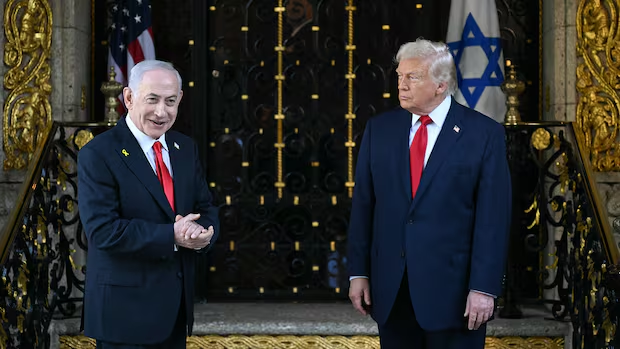
President Donald Trump confirmed during an interview with the New York Post’s “Pod Force One” podcast that a phone call with Israeli Prime Minister Benjamin Netanyahu became heated as Trump pressed his ally to pull back from planned strikes on Beirut. Trump acknowledged telling Netanyahu, “you’re f—ing crazy,” framing the outburst as the candid exchange of two wartime partners who nonetheless “work very well together.” Trump described himself as “a little bit perturbed at his constantly fighting with Lebanon.”
The rupture came after Netanyahu described imminent Israeli strikes on Beirut as unavoidable, only for Israel to ultimately hold off following U.S. pressure. Israeli Defense Minister Israel Katz stated that the IDF continued to operate in an expanding security zone in southern Lebanon but refrained from powerful strikes on the Lebanese capital following the American request — except for what Katz described as “targeted assassinations.” Netanyahu himself said Israeli forces would keep striking southern Lebanon “as planned,” even as he tacitly acknowledged the Beirut ceasefire.
Netanyahu, speaking to CNBC from Jerusalem on Wednesday, acknowledged there are “tactical disagreements” between himself and Trump while insisting the two leaders agree on the broader strategic objective of preventing Iran from reconstituting its capabilities. He sought to project confidence, touting Israel’s economic resilience — citing projected GDP growth of 3.8 percent in 2026 — and encouraging investors to “buy anything in Israel” as markets and the shekel strengthen.
Meanwhile, Secretary of State Marco Rubio appeared before the Senate Foreign Relations Committee on Tuesday and stated that Iran “could negotiate aspects of their nuclear program,” the clearest signal yet that the Trump administration is seeking a diplomatic resolution to the conflict rather than escalating toward regime change or territorial outcome. Rubio has additional congressional appearances scheduled this week.
The war, which began with large-scale U.S.-Israel strikes against Iranian nuclear and military infrastructure in February 2026, has evolved into a prolonged conflict that has rattled global energy markets, stretched U.S. strategic reserves, and drawn intense domestic political scrutiny as midterm elections approach.
Why It Matters
The Trump-Netanyahu rift matters because the two countries entered this conflict with what both sides described as an unprecedented level of coordination. The erosion of that unity — even if managed carefully — creates operational uncertainty. Military actions taken by one partner without the other’s full blessing can have strategic consequences that undermine shared objectives, particularly in Lebanon, where Hezbollah’s posture directly affects the security of northern Israel and the stability of any broader ceasefire architecture.
Domestically, Trump faces a squeeze from multiple directions. His base contains a strong non-interventionist strain that never wanted U.S. involvement in the Iran war; Trump’s high-profile feud with conservative media personality Tucker Carlson stems directly from that tension. At the same time, pro-Israel donors and defense hawks within the Republican coalition have pushed for sustained pressure on Tehran. Managing both factions while a shooting war continues is an extraordinary political challenge.
Rubio’s testimony that Iran could negotiate on its nuclear program suggests the administration is beginning to prioritize an exit strategy over maximizing military gains. That shift aligns with Trump’s transactional style but may frustrate Netanyahu, who has spent decades warning of Iran’s existential threat and may see a negotiated settlement as leaving the core danger unresolved.
The public nature of the disagreement also carries reputational costs for both leaders. Netanyahu faces criticism at home from political opponents who viewed his decision to hold back from Beirut under American pressure as a sign of weakness. Trump, having invested significant political capital in the war’s launch, needs the conflict to conclude on terms he can present as a victory before November.
Economic and Global Context
The Iran war has created significant disruption in global energy markets. The Trump administration has released approximately 58 million barrels of oil — roughly 14 percent of total reserves — from the Strategic Petroleum Reserve to ease supply constraints caused by the conflict. The SPR now holds approximately 357 million barrels, its lowest level since January 2024. Continued drawdowns risk depleting the emergency cushion available to respond to future supply shocks.
Iran’s retaliatory strikes have extended to Gulf neighbors. Iran launched missiles and drones at Kuwait and Bahrain in recent days, forcing the closure of Kuwait’s airport and signaling Tehran’s willingness to expand the conflict’s geographic footprint. These strikes threaten the stability of critical energy infrastructure and logistics corridors that global commodity markets depend upon.
Oil prices remain elevated relative to pre-war levels, imposing a persistent inflationary drag on the U.S. economy. With the Federal Reserve already navigating a complicated rate environment and Trump’s tariff policies adding additional cost pressures, sustained energy price inflation represents one of the administration’s most significant economic vulnerabilities heading into midterm season.
Implications
For U.S. foreign policy, the public disagreement with Israel accelerates the pressure to define endgame conditions. Rubio’s congressional testimony about Iranian nuclear negotiations points toward a diplomatic track, but any deal acceptable to Washington must also be acceptable — or at least tolerable — to Jerusalem, a constraint that significantly complicates negotiations.
For Netanyahu, the path forward involves managing both Washington’s impatience and his domestic political survival. His opponents at home have already attacked him for backing down on the Beirut threat under U.S. pressure. Going further toward a ceasefire or negotiated settlement will intensify that pressure; resisting American calls for restraint risks the U.S. support that makes the campaign militarily viable.
For American voters, the war’s duration and cost are becoming campaign issues. Republicans defending House seats in November must be prepared to address what the war has cost in treasure, energy prices, and strategic reserves — and to explain what America has gained. Democrats are already shaping a midterm argument around executive overreach and the absence of congressional authorization for the conflict.
For global allies, the visible strain between Washington and Tel Aviv — the two anchor partners of the military campaign — raises questions about Western cohesion. European governments that have been quietly managing the diplomatic fallout are watching closely to determine how much daylight is genuinely growing between the two leaders and what it means for the conflict’s eventual resolution.
Sources
“Netanyahu says he and Trump have ‘tactical disagreements’ but agree overall amid Iran war”

