Story Highlights
- The ruling restores a map giving Republicans six of seven Alabama congressional districts, up from five under the court-ordered map used in 2024
- Democratic Representative Shomari Figures, who holds Alabama’s Second District, is expected to lose his seat as a result
- The three liberal justices publicly dissented; Justice Sonia Sotomayor wrote the majority had “doubled down on chaos”
What Happened
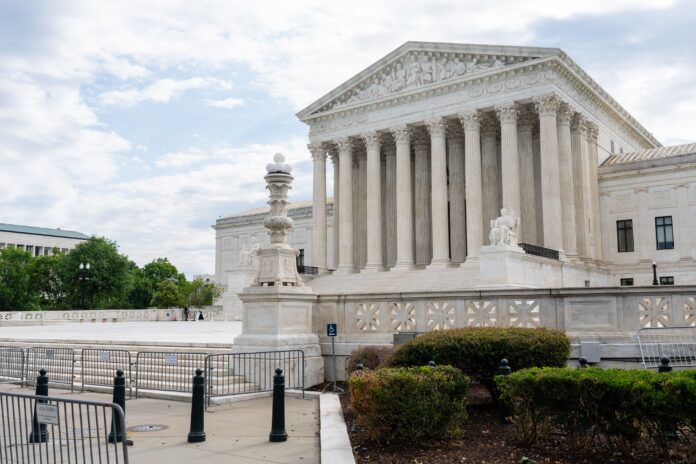
The Supreme Court issued an unsigned emergency order on Tuesday allowing the state of Alabama to use a congressional redistricting map it originally adopted in 2021, rejecting a three-judge district court panel’s ruling that the plan was “tainted by intentional race-based discrimination.” The high court granted Alabama’s emergency appeal just one day before a deadline set by Republican Governor Kay Ivey, who had already extended the state’s filing window in anticipation of a favorable ruling.
The dispute traces back to the 2020 census, after which Alabama drew a congressional map featuring only one majority-Black district among its seven seats, despite Black residents comprising more than one-quarter of the state’s population. Voters and civil rights organizations immediately challenged the map under the Voting Rights Act, arguing it illegally diluted minority voting power. Lower courts initially agreed, ordering the state to produce a second district in which Black voters had a realistic opportunity to elect their candidate of choice.
That court-drawn map was used in the 2024 elections and produced two Black Democratic representatives, including Shomari Figures, who now holds the Second District. Alabama’s Republican leadership rejected the court-ordered configuration and returned to the Supreme Court last week after the district court again refused to accept the state’s preferred map. Attorney General Steve Marshall argued before the court that Alabama did not intentionally discriminate and that lawmakers, not federal judges, should draw the state’s electoral boundaries.
The Supreme Court agreed, issuing its order in an unsigned per curiam ruling. The decision aligns with a broader pattern this term in which the court has curtailed enforcement mechanisms under the Voting Rights Act and given states more latitude to draw maps favoring the majority party. Justice Sonia Sotomayor, writing for the dissenting liberal bloc, stated the court had “doubled down on chaos” and provided cover for states to “deliberately and openly discriminate against Black voters without fear of any consequence.”
The order is immediately effective, meaning Alabama’s August special primaries and the November general elections will proceed under the Republican-drawn configuration. The ruling came despite the fact that Alabama had already held congressional primaries earlier this cycle under a different map — an unusual procedural complication the court majority did not directly address.
Why It Matters
Republicans currently hold a slim House majority, and every seat has strategic significance heading into November’s midterms. Alabama’s seven congressional seats had been configured, under the 2024 court-drawn map, to include two Black-majority or Black-plurality districts that leaned Democratic. Returning to a single such district removes one nearly certain Democratic seat from the board and replaces it with a Republican-leaning one — a net two-seat swing in terms of practical partisan impact.
The decision also functions as a signal to other states engaged in similar redistricting battles. The Supreme Court has now weighed in on congressional maps in Alabama, Louisiana, Texas, Virginia, and California in the current cycle. In most of those instances, the rulings have favored Republican configurations. The cumulative effect could be several additional Republican seats in the House, enough to offset Democratic gains in swing districts and potentially preserve the majority.
For the Voting Rights Act, the ruling accelerates an already significant erosion. The VRA was passed in 1965 to protect minority voters from discriminatory electoral practices. The court’s recent decisions have weakened the statute’s enforcement mechanisms considerably, making it harder for plaintiffs to challenge maps on racial grounds even when demographic evidence is clear. Civil rights organizations are signaling they will continue pursuing these cases, but the legal landscape has shifted substantially against them.
The direct human impact falls on Representative Figures, who won election in 2024 under a map courts ruled was necessary to give Black voters a fair opportunity. Under the restored Republican map, his district is reconfigured to reduce Black voting concentration, making his reelection prospects in November extremely difficult.
Economic and Global Context
Congressional redistricting does not have a direct economic effect, but the composition of Congress shapes every major fiscal and economic decision the federal government makes, from appropriations to tax policy to trade authority. A Republican House majority preserved through favorable redistricting is more capable of advancing Trump administration economic priorities — including tariff regimes, tax cuts, and deregulation — than one that falls below functional majority threshold.
The Supreme Court’s redistricting activity this term represents the clearest operational application of the conservative judicial majority that has been assembled over the past decade. Five of the nine current justices were appointed by Republican presidents, three of them by Trump. The court’s willingness to intervene in redistricting disputes — consistently in ways that benefit Republicans — reflects how judicial appointments translate into electoral outcomes.
Internationally, decisions about U.S. electoral maps are watched carefully by governments and democratic institutions that look to the United States as a model. Rulings that permit maps found by lower courts to intentionally dilute minority voting power invite criticism from allied democracies and provide rhetorical ammunition to adversaries who challenge American democratic credibility.
Implications
For Alabama Democrats and civil rights organizations, the ruling requires a rapid strategic reassessment. The NAACP Legal Defense Fund has pledged to continue fighting the map, but with August primaries approaching under the reinstated configuration, the window for further legal intervention before the election is narrow. Longer-term constitutional challenges may proceed, but they will not alter the 2026 electoral outcome.
For the Republican Party’s House strategy, the Alabama ruling provides a meaningful cushion. Party leadership has been working aggressively across states to maximize favorable redistricting outcomes ahead of November, and the court’s willingness to enforce those maps through emergency orders gives the effort significant late-cycle momentum.
For Congress more broadly, the Alabama outcome reinforces the pattern in which incumbent protection and partisan advantage drive redistricting decisions more than representation principles. Reform advocates who have pushed for independent redistricting commissions are likely to use this ruling as evidence for why such commissions are necessary, creating a future policy battleground.
For voters in Alabama’s Second District specifically, the ruling creates immediate electoral uncertainty. Figures now faces a November contest on terrain redesigned to disadvantage him. His ability to hold his seat will depend on turnout, crossover appeal, and whether the legal challenges his opponents to the ruling produce any further court intervention before November 3.
Sources
“Supreme Court reinstates Republican-favored Alabama congressional districts”

