Story Highlights
- Trump signed the Secure America Act on June 10, providing approximately $70 billion for ICE and CBP through 2029
- The House passed the bill 214-212 and the Senate approved it 52-47, both along party lines using the budget reconciliation process
- The law caps a 100-plus-day funding fight after Democrats blocked DHS immigration agency funding following the deaths of two U.S. citizens during enforcement operations
What Happened
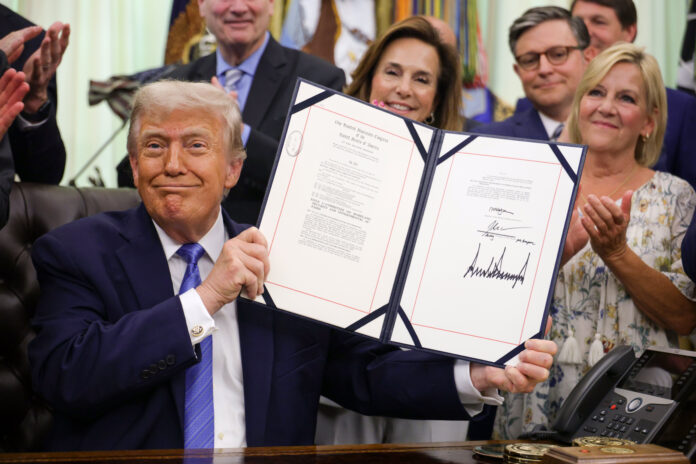
President Donald Trump signed the Secure America Act in the Oval Office on June 10, flanked by House Speaker Mike Johnson, senior members of Congress, and Cabinet officials. The signing capped a prolonged legislative battle that began in January after Democrats refused to fund ICE and Border Patrol without major reforms to immigration enforcement policy — a standoff triggered in part by the deaths of two American citizens, Renee Good and Alex Pretti, during federal enforcement operations in Minnesota.
The House passed the final version of the bill 214 to 212 on June 9, after the Senate approved it 52 to 47 the previous week following an 18-hour marathon vote-a-rama. Congressional Republicans deployed the budget reconciliation process, which allowed them to pass the legislation with a simple majority in the Senate, bypassing the 60-vote threshold that would have enabled a Democratic filibuster.
At the signing ceremony, Trump declared the legislation would give the heroes of ICE and Border Patrol the support and resources they need to defend America’s borders, protect the homeland, and keep the country safe. He credited Johnson and Republican congressional leaders for persevering through months of delay, including a controversy over a proposed $1.8 billion anti-weaponization fund for the Justice Department that drew pushback from both parties before being abandoned.
The law allocates approximately $38.5 billion to ICE for personnel hiring, pay, and training; $22.6 billion to CBP for Border Patrol agents and support personnel; $7.5 billion to ICE’s Homeland Security Investigations unit; and $5 billion in discretionary general funds for DHS Secretary Markwayne Mullin. Unlike annual appropriations bills, the Secure America Act funds these agencies through a single multi-year allocation covering three fiscal years through 2029.
Why It Matters
The Secure America Act is the second major legislative win for Trump on immigration in less than a year, following last July’s One Big Beautiful Bill Act, which provided $75 billion in immigration enforcement funding and made ICE the most heavily funded law enforcement agency in the federal government. Together, the two laws have now channeled over $140 billion into immigration enforcement, a level of investment with no historical precedent in American law enforcement funding.
The practical effect is to insulate ICE and CBP from future congressional leverage during the remainder of Trump’s term. Because the Secure America Act covers spending through fiscal year 2029, Democrats cannot use the annual appropriations process to threaten another shutdown or extract concessions on enforcement policy. Speaker Johnson called the vote an end to the Democratic DHS shutdown once and for all, declaring Republicans had permanently removed the ability to hold immigration funding hostage.
The law also arrives at a pivotal political moment. Republican polling has been uneven amid the Iran war, economic pressures, and other controversies. A concrete legislative win on border security — one of the top issues for Republican base voters — offers a compelling message heading into November’s midterms, particularly in competitive districts where immigration remains a defining issue.
The bill’s passage required Republicans to navigate significant internal disagreements. The proposed $1.8 billion anti-weaponization fund, intended to compensate those who claimed to be victims of politicized prosecution, drew bipartisan opposition before being shelved. Senate parliamentarian rulings also stripped out $1.5 billion in Justice Department funding and $1 billion for Secret Service upgrades tied to the White House ballroom project.
Economic and Global Context
Immigration enforcement spending at this scale has direct economic implications across several sectors. The construction and logistics industries tied to border infrastructure and detention facility expansion are set to benefit from significant new capital inflows. ICE’s $38.5 billion personnel allocation is expected to drive hiring across law enforcement, intelligence, and support fields throughout the agency’s national operational footprint.
The broader economic backdrop against which the bill passed reflects the Trump administration’s ongoing battle with inflation. Economic data released around the signing showed inflation surging to its highest level since early 2023, driven in part by tariff costs and the economic disruptions of the Iran conflict. Trump pushed back against concerns at the signing ceremony, calling the economic numbers great and pointing to areas he viewed as positive indicators for American workers and businesses.
Internationally, the Secure America Act strengthens the enforcement infrastructure underpinning Trump’s mass deportation campaign. ICE street arrests increased elevenfold during the first nine months of Trump’s second term compared with the final months of the Biden presidency, according to Legal Defense Fund data. The new funding removes a financial ceiling on that operational tempo through 2029, ensuring enforcement activity can be sustained regardless of annual congressional negotiations or Democratic opposition.
Implications
For Republican candidates running in November, the Secure America Act provides a concrete deliverable on the party’s signature immigration agenda. Incumbents in competitive districts can point to a $70 billion investment in border security as proof that Republican governance produces results on one of the top voter concerns in the country.
For immigrant communities and civil liberties advocates, the law raises serious questions about accountability. The Congressional Budget Office noted considerable uncertainty about the pace of spending given the limited guardrails in the bill text. Critics warn that giving DHS nearly unlimited discretionary authority, on top of agency-specific allocations, further reduces congressional oversight of how enforcement dollars are spent and where enforcement priorities are directed.
The law also sets up a potential third reconciliation package before Trump’s term ends. Speaker Johnson has indicated Republicans plan additional reconciliation efforts to address items not included in either the One Big Beautiful Bill Act or the Secure America Act. The scope of that effort and what spending offsets may be required will shape the next major fiscal negotiation between the White House and the Republican congressional leadership before the midterm elections arrive.
Sources
“Trump signs $70 billion immigration bill, capping lengthy fight over ICE funding”

