Story Highlights
- The Supreme Court ruled 6-3 that the administration can end TPS protections for approximately 350,000 Haitians and 6,100 Syrians, with implications for 1.3 million people across 17 countries
- The court held that decisions to terminate or extend TPS designations are not subject to judicial review, shielding future executive action from legal challenge
- A second ruling reinstated the “metering” policy, allowing border officials to turn away asylum seekers who have not yet set foot on U.S. soil
What Happened
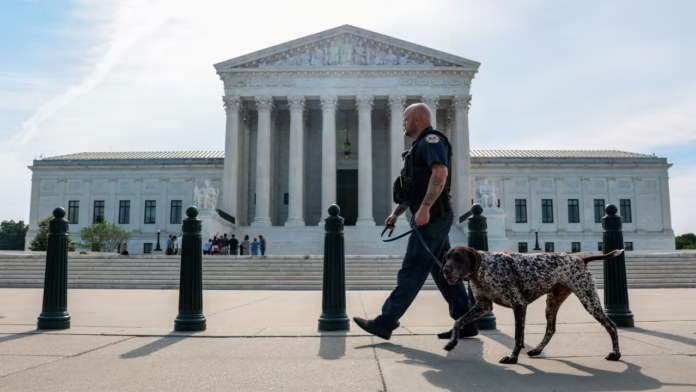
The United States Supreme Court handed President Donald Trump a pair of sweeping legal victories on Thursday in two immigration cases that together clear the way for mass deportations and tighter border controls. In the first case, Mullin v. Doe, the court’s conservative majority ruled that federal courts cannot review the government’s decisions to terminate Temporary Protected Status, a humanitarian program created by Congress in 1990 to shield migrants from countries experiencing natural disasters, armed conflict, or other extraordinary conditions.
Justice Samuel Alito authored both majority opinions over sharp dissents from the court’s three liberal justices. Writing in Mullin v. Doe, Alito stated that decisions by the Department of Homeland Security secretary on TPS designations are entirely insulated from judicial scrutiny. The practical effect is immediate: the administration can now move forward with ending protections that had been stalled for months by lower court injunctions. The case centered specifically on Haitian and Syrian TPS holders, but the ruling’s logic applies broadly to all 17 countries currently designated.
The White House reacted swiftly. Spokeswoman Abigail Jackson called the ruling a “tremendous win” and said it affirmed that temporary protected status was never intended as a pathway to permanent legal residency. James Percival, General Counsel for the Department of Homeland Security, said the ruling was a victory for the rule of law and noted that the “T in TPS stands for TEMPORARY.” The administration has already ended TPS for roughly one million people from 13 countries, including 650,000 Venezuelans and 50,000 Hondurans, since Trump returned to office.
In the second ruling, Mullin v. Al Otro Lado, the court upheld the practice known as “metering,” under which U.S. border officials can turn away migrants on the Mexican side of the border from applying for asylum. This policy had previously been struck down by lower courts, and its reinstatement gives border agents substantial new discretion to limit access to the formal asylum process before individuals even enter the country. Together, the two rulings represent the most consequential legal expansion of presidential immigration authority in years.
Not all Republicans celebrated. Ohio Governor Mike DeWine, a Republican who had strongly supported Haitian TPS holders, called the ruling “a mistake” and warned that more than 10,000 Haitians working legally in his state, many in healthcare, would now be subject to immediate deportation and could no longer be legally employed.
Why It Matters
These rulings matter because they fundamentally shift the balance of power in immigration policy from the courts and Congress toward the executive branch. For decades, the judiciary served as a check on abrupt changes to humanitarian protections, frequently halting administration actions through preliminary injunctions. The Supreme Court has now declared that this oversight mechanism does not apply to TPS decisions. Future presidents — of either party — will be able to terminate or extend TPS designations without fear of judicial reversal.
The decision carries particular weight given the scale of the population affected. Roughly 1.3 million people from 17 countries currently hold TPS protections in the United States. Many have lived and worked legally in this country for years, and in some cases decades. The ruling opens the door to a cascade of further terminations, with decisions looming for approximately 200,000 Salvadorans and 100,000 Ukrainians whose protections are set to expire in the near future.
Healthcare and other industries dependent on immigrant labor could face significant disruptions. According to Krish O’Mara Vignarajah, president and CEO of Global Refuge, roughly a third of Haitian TPS holders in the United States work in the healthcare sector as caregivers, doctors, and medical professionals. The bipartisan concern about losing that workforce was enough to push a House bill extending Haitian TPS through Congress, though Trump is expected to veto any such measure.
The metering ruling also has major implications for how the United States processes asylum claims going forward. By allowing officials to turn away migrants before they reach American soil, the administration has effectively narrowed one of the foundational legal pathways through which people seek refuge in the country. Immigration advocates warn this could expose vulnerable individuals to serious harm while their cases go unheard.
Economic and Global Context
The economic consequences of rapid large-scale deportations are difficult to overstate. TPS holders are deeply embedded in the labor market across sectors including construction, agriculture, healthcare, food service, and manufacturing. States with large TPS populations — including Florida, Texas, New York, California, and Ohio — stand to see significant workforce disruptions as protections expire and individuals become subject to removal. Economists have consistently found that immigrant labor, including that of humanitarian migrants, contributes positively to GDP growth, tax revenues, and consumer spending.
From an international perspective, returning hundreds of thousands of migrants to countries like Haiti and Syria raises serious concerns. The State Department currently advises U.S. citizens not to travel to either country. Haiti has seen more than 2,300 people killed in gang attacks this year alone, with 1.5 million internally displaced. Syria, while no longer in active civil war, remains fragile years after a devastating conflict. Sending large numbers of people back to these environments carries both humanitarian and diplomatic risks.
The ruling also signals to foreign governments and international organizations that U.S. immigration policy will be driven primarily by executive discretion rather than legislatively mandated protections or court-enforced standards. Countries that rely on the TPS program as a safety valve for their own displaced populations may increasingly need to seek other diplomatic arrangements or bilateral agreements to protect their nationals in the United States.
Implications
In the short term, the Trump administration is expected to move quickly to formalize the termination of TPS for affected populations, particularly Haitians and Syrians. Legal advocates have pledged further challenges on narrower constitutional grounds, though the Supreme Court’s language in the majority opinion significantly limits available avenues for litigation. The window for legal relief has narrowed considerably, and the timeline for deportation proceedings could accelerate through the summer and fall.
For Congress, the ruling places new pressure on legislators who want to preserve protections for specific groups. A House-passed bill extending Haitian TPS already exists, but faces long odds in the Senate and a near-certain presidential veto. Republicans in states with large TPS populations, particularly those facing competitive midterm races in November, will be forced to navigate between loyalty to Trump’s agenda and the economic and constituency concerns raised by their governors and local officials.
For the broader American electorate, the decisions reinforce that the 2026 immigration policy landscape is being shaped by the courts as much as by Congress or the White House. The Supreme Court’s conservative supermajority has now demonstrated a willingness to grant sweeping deference to executive immigration authority, a posture that could define the legal environment for immigration enforcement throughout the remainder of Trump’s second term.

