Story Highlights
- Supreme Court ruled 6-3 that Trump’s executive order ending birthright citizenship for certain groups was unconstitutional
- Chief Justice John Roberts wrote the majority opinion; Justices Thomas, Gorsuch, and Alito dissented
- The order, signed January 20, 2025, was blocked by lower courts and never took effect anywhere in the country
What Happened
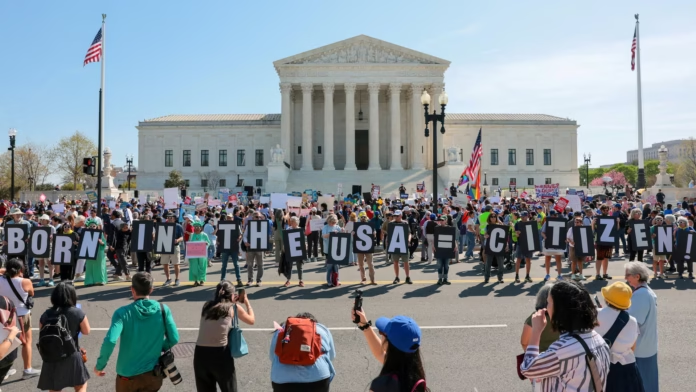
The Supreme Court issued its ruling Tuesday morning as part of a series of final decisions closing out its term. Chief Justice John Roberts wrote the 6-3 majority opinion, concluding that the executive order President Donald Trump signed on his first day back in office in January 2025 violated the 14th Amendment’s guarantee of citizenship to those born in the United States. The order had sought to deny automatic citizenship to children born to parents who entered the country illegally or who were in the U.S. legally but temporarily, such as on work or student visas.
Roberts, invoking the historical weight of the citizenship clause, wrote that the framers of the 14th Amendment extended the promise of citizenship to “every free-born person in this land,” and that the court was bound to uphold that promise. The ruling relied heavily on the 1898 precedent United States v. Wong Kim Ark, in which the court held that a man born in San Francisco to Chinese immigrant parents was a U.S. citizen, a decision that has anchored the modern understanding of birthright citizenship for more than 125 years.
Justice Brett Kavanaugh issued a separate opinion concluding that the order violated federal statute rather than the Constitution itself, while Justices Clarence Thomas, Neil Gorsuch, and Samuel Alito dissented. In a 91-page dissent, Thomas argued the 14th Amendment was historically intended primarily to secure citizenship for formerly enslaved Black Americans rather than to broadly guarantee citizenship to children of foreign nationals, writing that the majority’s reasoning “devalues” the meaning of American citizenship.
The executive order had been challenged immediately after Trump signed it, with multiple federal courts, including ones handling a case originating in New Hampshire brought by the American Civil Liberties Union on behalf of affected families, blocking it before it ever took effect. According to estimates from the Migration Policy Institute and Penn State’s Population Research Institute, roughly 255,000 children per year would have been denied citizenship had the order been allowed to stand.
Trump reacted angrily in the lead-up to the ruling, writing on Truth Social earlier this month that the United States “cannot live with the shackles of Birthright Citizenship,” calling it economically unsustainable. Following the ruling, civil rights attorneys and immigrant advocacy groups celebrated the decision as a reaffirmation of a core constitutional protection that has defined American identity for over a century.
Why It Matters
Tuesday’s ruling preserves one of the most fundamental and long-settled interpretations of American citizenship, affecting hundreds of thousands of families nationwide. Had the order been upheld, it would have created a new bureaucratic system requiring parents to prove citizenship or immigration status at the time of a child’s birth, a logistical and legal burden that civil rights groups warned could have created widespread confusion, delayed citizenship determinations, and disproportionately affected immigrant communities, including those here entirely legally.
The decision also represents a broader statement about the limits of executive power. Trump’s attempt to alter birthright citizenship through executive order, rather than through a constitutional amendment or new legislation, was widely viewed by legal scholars as testing how far a president could stretch unilateral authority to reinterpret constitutional text. The court’s rejection reinforces that fundamental constitutional rights cannot be altered through executive action alone.
For immigrant families, including legal visa holders such as students and green card applicants who would also have been affected, the ruling provides certainty that children born in the U.S. retain citizenship regardless of their parents’ immigration status. This removes a significant source of anxiety that had lingered since the order was first signed, even though it was never actually enforced due to early court intervention.
The ruling additionally reinforces the judiciary’s role as a check on executive immigration policy, a theme that has repeatedly defined Trump’s second term. It marks the third major Supreme Court defeat for Trump in recent months, following the February ruling striking down his global tariffs and Monday’s ruling on E. Jean Carroll’s defamation case, suggesting the court’s conservative majority is not uniformly aligned with the administration on every front.
Economic and Global Context
The birthright citizenship case carries broader economic implications tied to immigration and labor policy. Business groups, particularly in agriculture, hospitality, and technology sectors that rely heavily on immigrant labor and skilled visa holders, had expressed concern that uncertainty around citizenship status for U.S.-born children of temporary visa workers could complicate recruitment and retention of international talent. The ruling removes that uncertainty, preserving an element of stability that many companies view as important for attracting global workers to the United States.
Internationally, the ruling reaffirms the United States’ historical position as a country offering unconditional birthright citizenship, a practice shared by dozens of nations including Canada and most of Latin America, but one that sets the U.S. apart from much of Europe and Asia, where citizenship is typically tied to parental nationality. Foreign governments and immigrant-sending countries had been closely watching the case, given the potential implications for dual citizenship arrangements and diplomatic relations involving their citizens residing in the U.S.
The decision also lands amid Trump’s broader immigration enforcement agenda, which has included expanded deportation operations, restrictions on asylum processing, and tightened visa rules. While birthright citizenship was the first major immigration policy from this term to reach the Supreme Court for a final ruling, several other immigration-related legal challenges remain pending in lower courts, meaning Tuesday’s decision is unlikely to be the last major immigration ruling of Trump’s presidency.
Economically, immigration policy remains tightly linked to broader labor market conditions, with demographic and workforce experts noting that birthright citizenship has historically supported long-term population growth and labor force expansion, factors increasingly relevant as the U.S. faces slowing native-born population growth and rising retirement rates among the Baby Boomer generation.
Implications
In the immediate term, the ruling closes the legal chapter on Trump’s specific birthright citizenship order, though the administration retains the option of pursuing a constitutional amendment, an exceptionally difficult path requiring two-thirds approval in both chambers of Congress and ratification by three-quarters of state legislatures. Given the current political composition of Congress and the states, such an amendment is widely viewed as unlikely in the near future.
For Trump, the defeat is unlikely to end his rhetorical campaign against birthright citizenship, which he has pursued publicly since at least 2015. He may continue to use the issue as a political rallying point heading into the 2026 midterms, even without a viable legal path to implement the policy change.
For immigrant families and advocacy organizations, the ruling provides a sense of legal finality, though continued vigilance is expected given the administration’s pattern of testing executive authority on immigration matters through alternative regulatory or enforcement mechanisms not directly addressed by this ruling.
Looking ahead, legal observers expect the broader fight over presidential immigration authority to continue playing out across other pending cases, with this ruling now serving as a key precedent reinforcing that constitutional citizenship protections remain outside the reach of unilateral executive action.
Sources
Supreme Court rejects Trump’s attempt to limit birthright citizenship

