
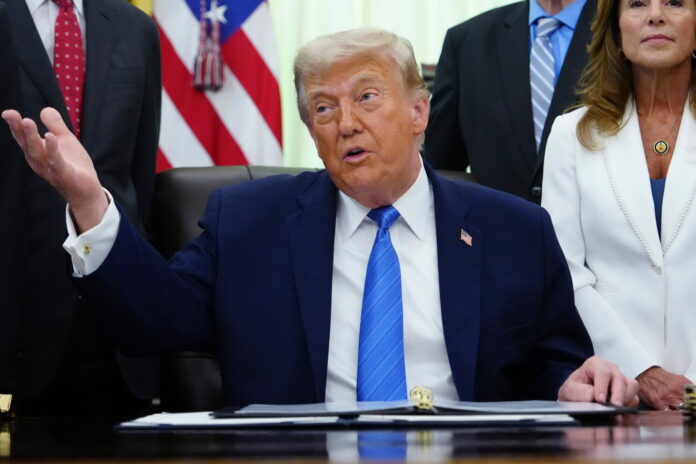
The 21st Century ROAD to Housing Act, the most significant federal housing legislation in more than three decades, became law at midnight Saturday after President Trump declined to sign it in protest over the Senate’s failure to pass his separate voter identification bill. Despite overwhelming bipartisan support in both chambers of Congress, Trump withheld his signature entirely, allowing the constitutional 10-day window to lapse and the bill to take effect automatically. The law is designed to expand housing supply and restrict large institutional investors from purchasing single-family homes.
Story Highlights
- The bill passed the Senate 85-5 and the House 396-13, reflecting rare bipartisan consensus
- Trump refused to sign the bill in protest over the Senate’s inaction on his SAVE America Act voter ID legislation
- The law automatically took effect at midnight Saturday under the Constitution’s 10-day sign-or-veto provision
- The measure restricts large investors from purchasing new single-family homes and streamlines zoning and environmental review processes
What Happened
President Trump was originally scheduled to sign the 21st Century ROAD to Housing Act at a Capitol Hill ceremony last month, following its passage through both the House and Senate by wide bipartisan margins. He abruptly canceled that signing event hours before it was set to occur, announcing instead that he would withhold his signature until Congress passed the SAVE America Act, separate legislation that would require proof of citizenship for voter registration and photo identification at polling places. That bill has remained stalled in the Senate, lacking the 60 votes needed to overcome procedural hurdles.
On Friday morning, Trump reiterated his position in a Truth Social post, writing that he would not sign the housing bill “in PROTEST over the fact that the United States Senate is not capable of passing THE SAVE AMERICA ACT.” Under Article I, Section 7 of the Constitution, a president has 10 days, excluding Sundays, to sign or veto legislation once it is formally presented; if neither action is taken, the bill becomes law automatically. House Speaker Mike Johnson delivered the bill to Trump’s desk on June 29, setting the deadline for midnight Friday into Saturday.
Trump took no action, and the legislation became law at the stroke of midnight without his signature, a rare occurrence that has happened only a handful of times in modern history, including former President Barack Obama’s similar decision in 2016 regarding a renewal of the Iran Sanctions Act. Johnson had publicly encouraged Trump to sign the bill, joking that he hoped the president would use “the fattest black marker you have,” while acknowledging that regardless of Trump’s decision, the legislation would take effect and Republicans would “still celebrate it.”
The bill itself represents the culmination of nearly a year of negotiations, incorporating provisions from more than 60 separate pieces of legislation introduced across both chambers, 36 of which had bipartisan sponsorship. Its lead negotiators included Democratic Senator Elizabeth Warren of Massachusetts and Republican Senator Tim Scott of South Carolina, along with House counterparts Democratic Representative Maxine Waters and a Republican co-sponsor. Warren was among the bill’s most vocal critics of Trump’s delay, stating that the president may have withheld his signature because “there was nothing in it for him personally.”
Why It Matters
The law arrives amid a nationwide housing affordability crisis that has become a top concern for voters heading into the 2026 midterm elections. According to Redfin data cited in national reporting, a typical American family now needs to earn approximately 117,000 dollars annually to afford a median-priced home, roughly 30,000 dollars more than the average household currently earns. The median new home price has risen to approximately 403,000 dollars, up 77 percent from around 227,000 dollars in 2011, according to Federal Reserve Bank of St. Louis figures.
For homebuyers, particularly first-time buyers, the law’s restrictions on institutional investors purchasing new single-family homes could meaningfully affect competition in certain markets, though economists remain divided on how large that effect will be. Researchers at Freddie Mac have suggested that private equity firms are only a modest driver of the broader housing shortage, since they typically purchase older homes requiring substantial renovation rather than competing directly for new construction.
Politically, Trump’s decision to withhold his signature, despite having previously called the bill “the most comprehensive and consequential housing legislation in the history of our country” in an earlier proclamation, created an unusual dynamic in which Republican leadership actively celebrated a law the president himself refused to formally endorse. This dynamic reflects growing tension within the party over prioritization between voter identification measures, long a priority for the conservative base, and pocketbook issues like housing affordability that polling suggests are of more immediate concern to a broader swath of voters.
The episode also illustrates the practical limits of presidential leverage over legislation that enjoys deep bipartisan support. Despite Trump’s explicit protest, neither his own party’s congressional leadership nor Senate Democrats were willing to hold the broadly popular housing measure hostage to his separate demands regarding election law changes.
Economic and Global Context
The new law includes more than 45 individual provisions aimed at increasing housing supply nationwide. Among its most significant measures, Title 10 prohibits large institutional investors, defined as entities controlling at least 350 single-family homes, from purchasing new single-family properties, with limited exceptions carved out for build-to-rent developments, which must sell homes to individual buyers within seven years. The law also establishes a HUD renter outreach resource for tenants in institutionally owned properties and creates civil penalties for violations.
Other provisions focus on streamlining regulatory barriers to construction, including allowing developers to bypass environmental review requirements for infill housing built between two previously reviewed structures, and creating a federal grant program to help communities adopt preapproved “pattern book” housing designs that require fewer approvals. The law also raises FHA multifamily loan limits and establishes a small-dollar mortgage pilot program intended to help lower-income buyers access financing for modest homes.
Recent polling from the American Property Owners Alliance found that 89 percent of voters support the law’s core objectives, reflecting the breadth of public concern over housing costs. Industry reaction has been largely positive, with the National Association of Home Builders, the Mortgage Bankers Association, AARP, and the Bipartisan Policy Center all issuing statements praising the bill’s passage as a milestone for housing policy, even as some groups urged further legislative action to address remaining affordability gaps.
The build-to-rent industry had already begun adjusting to the anticipated changes before the law took effect, with developer TerraLane Communities reportedly pausing construction on housing projects in Arizona and Texas in response to the bill’s advancement through Congress, illustrating how quickly market participants moved to account for the new regulatory landscape.
Implications
For homebuilders and developers, the law’s streamlined environmental review and zoning provisions are expected to accelerate certain categories of construction projects, potentially increasing housing supply over the medium term, though the scale and timeline of that impact will depend heavily on implementation by HUD and other federal agencies tasked with writing supporting regulations.
For institutional real estate investors, the law introduces significant new compliance obligations and restrictions on future single-family home acquisitions, which could reshape investment strategies across the sector and prompt some firms to pivot more heavily toward build-to-rent development, one of the narrow exceptions preserved under the law.
For congressional Republicans heading into the midterms, the law offers a bipartisan achievement to tout on the campaign trail regarding cost-of-living concerns, even as the unusual manner of its enactment, without presidential endorsement, may complicate messaging around the administration’s broader economic record.
For the Trump administration, attention now shifts back to the SAVE America Act, which remains stalled in the Senate absent the 60 votes needed for passage, leaving open the question of whether the president’s protest achieved any practical leverage toward his stated legislative priority.
Sources

