

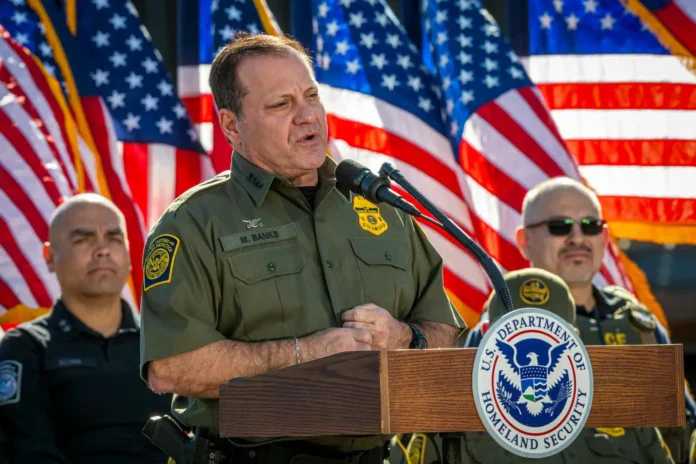
Story Highlights
- Banks announced his resignation in a Fox News interview on Thursday, May 14, describing it as voluntary after 37 years of public service.
- His departure is the third senior DHS leadership exit in two months, following the resignation of former Secretary Kristi Noem and the announced departure of acting ICE Director Todd Lyons.
- It remains unclear who will succeed Banks; CBP Commissioner Rodney Scott praised his service but no replacement has been named.
What Happened
Michael Banks announced his resignation as chief of U.S. Customs and Border Protection’s Border Patrol division in a Fox News interview Thursday afternoon, with the decision taking effect immediately. In the interview and in subsequent statements confirmed by the Department of Homeland Security, Banks framed his departure as a personal decision made from a position of accomplishment rather than conflict. “It’s just time,” he said, adding that he felt the agency had been transformed from what he described as the disorder of the Biden years into the most secure border operation in the nation’s recorded history.
Banks had a long and unconventional career trajectory that brought him back to the Border Patrol after years in state-level service. He rose to prominence as border czar for Texas Governor Greg Abbott during a period when illegal crossings reached record highs under the Biden administration, and the state launched a multibillion-dollar enforcement surge that frequently put Texas officials in direct conflict with federal authorities. His national profile elevated, Banks returned to federal service and eventually assumed the chief role.
Rodney Scott, the Customs and Border Protection commissioner whose agency encompasses Border Patrol, issued a statement thanking Banks for decades of service “during one of the most challenging periods for border security.” Scott noted that under Banks, the border had been transformed into “the most secure border ever recorded” — language that aligned with the administration’s continued emphasis on framing Trump’s immigration agenda as a historic success.
The resignation adds to a pattern of DHS leadership turnover that has drawn attention over the past several months. Former Secretary Kristi Noem left her post, replaced by former Republican Senator Markwayne Mullin of Oklahoma, who assumed the DHS secretary role roughly two months ago. Acting ICE Director Todd Lyons has also announced his departure, with his last day set for May 31. David Venturella, a longtime immigration official and former private prison industry executive, has been named to replace Lyons at ICE.
No successor to Banks had been named as of Friday. Border Patrol is the frontline enforcement arm of CBP and has played a central and sometimes controversial role in implementing Trump’s immigration crackdown, including participation in enforcement operations conducted in Democrat-led cities across the country.
Why It Matters
The leadership churn at DHS comes at a moment when the Trump administration’s immigration enforcement agenda is simultaneously at its most ambitious and most legally contested. Border Patrol, ICE, and CBP together form the operational backbone of a deportation and enforcement effort that the White House has consistently described as one of its defining policy achievements. Sustained turnover at the top of those agencies introduces the possibility of disruption in the execution of that agenda, even if the administration’s stated policies and priorities remain unchanged.
Banks’s departure follows a period in which several of the administration’s immigration enforcement operations have attracted intense scrutiny. Fatal shootings of two U.S. citizens — Renee Good and Alex Pretti — by federal officers earlier this year triggered a prolonged standoff in Congress, with Senate Democrats refusing to fund ICE and CBP through the regular appropriations process in the absence of oversight reforms. That standoff contributed to a record-length partial DHS shutdown that lasted 75 days and ultimately ended through a separate legislative path.
For Republican voters and members of Congress who have made border security a defining issue, the departure of a chief who publicly declared victory on border security carries a mixed message. On one hand, the framing of Banks’s exit as mission accomplished aligns with the administration’s preferred narrative. On the other, three significant leadership departures within two months inevitably raises questions about organizational stability and morale within the agencies charged with carrying out that mission.
The timing also intersects with a $72 billion Senate reconciliation package currently advancing through committee that would provide tens of billions in new funding for ICE and CBP — a legislative fight in which leadership continuity at the agencies themselves is relevant to effective implementation.
Economic and Global Context
The functioning of U.S. border enforcement has direct economic implications that extend well beyond immigration policy. CBP plays a central role in processing the roughly $3 trillion in annual trade that crosses U.S. land and sea ports, collecting tariffs and managing customs compliance for importers across every sector of the American economy. Disruptions in the agency’s senior leadership can create downstream effects in processing efficiency and regulatory enforcement consistency.
The broader cost of the administration’s immigration enforcement effort has also grown substantially. ICE and CBP are already among the most heavily funded federal law enforcement agencies, and the pending $72 billion reconciliation package would add significantly to their operational budgets through fiscal year 2029. Leadership transitions at the top of both agencies coincide with this period of expanded resourcing and expanded operational scope.
The DHS partial shutdown that preceded the current leadership reshuffling also had economic consequences, temporarily disrupting agency operations and creating uncertainty for businesses and individuals whose dealings with DHS — from visa processing to customs clearance — are time-sensitive.
Implications
For the Trump immigration enforcement apparatus, the key near-term question is who assumes leadership of Border Patrol and with what operational priorities. The agency has been actively involved not just in traditional border enforcement but in interior operations in major American cities — a significant expansion of its historic mission that has been both politically celebrated and legally challenged.
For Congress, the leadership transition adds complexity to ongoing negotiations over the $72 billion immigration reconciliation bill. Oversight of how new funding is allocated and managed depends in part on having stable, confirmed leadership in place at CBP and ICE. Committee markups for that bill are scheduled for the week of May 19.
For DHS Secretary Mullin, now in the role for only two months, the wave of departures represents an immediate management challenge. Rebuilding senior leadership across multiple DHS components simultaneously while advancing an aggressive enforcement agenda is a significant institutional undertaking.
For the American public, the departure of the Border Patrol chief amid the administration’s most active enforcement period serves as a reminder that the human and organizational infrastructure behind immigration policy is as consequential as the policy itself — and that high-profile declarations of success do not always translate into durable institutional stability.
Sources

