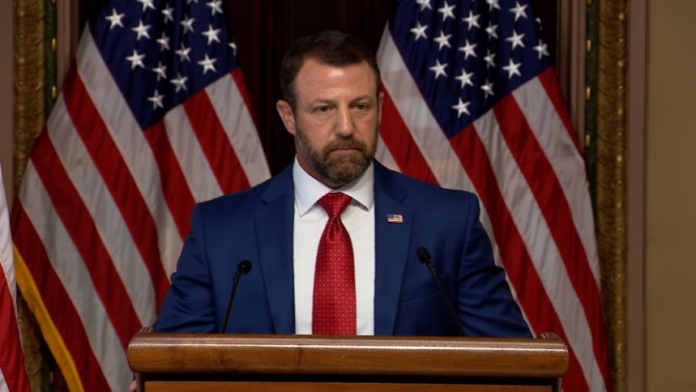
The Department of Homeland Security has identified more than 250,000 potential noncitizens registered to vote across California, New Jersey, Pennsylvania, and Nevada, findings unveiled alongside President Trump’s primetime address on election security. DHS Secretary Markwayne Mullin sent formal letters to election officials in the four states demanding cooperation with federal verification efforts, while fact-checkers have urged caution about the preliminary nature of the numbers. The disclosure adds fuel to an already intense national debate over election integrity heading into the 2026 midterms.
Story Highlights
- DHS identified an estimated 190,832 potential noncitizens registered in California, 35,152 in New Jersey, 15,903 in Nevada, and 14,576 in Pennsylvania
- The findings were released alongside President Trump’s primetime address on election vulnerabilities, which also cited Chinese compromise of over 200 million voter records
- All four states had declined to use the federal SAVE citizenship verification system, prompting DHS to conduct an independent public-records review
What Happened
The Department of Homeland Security released preliminary findings Thursday indicating that more than 250,000 potential noncitizens are registered to vote across four states that declined to cooperate with the federal government’s citizenship verification system. The disclosure came in conjunction with President Donald Trump’s nearly 26-minute primetime address on election integrity, during which he also revealed declassified intelligence findings alleging that the People’s Republic of China had “compromised” more than 200 million voter records across at least 18 states.
According to a DHS memo titled “Preventing Alien Voting,” the agency’s review found an estimated 190,832 potential noncitizens registered in California, 35,152 in New Jersey, 15,903 in Nevada, and 14,576 in Pennsylvania. DHS Secretary Markwayne Mullin said the finding stemmed from a preliminary review of public voter records after all four states, each led by Democratic governors, declined to participate in the SAVE system, a federal citizenship verification database that cross-references Social Security records. “There is an undeniable pattern emerging as DHS begins to unravel the horrific damage done by the open border policies of the Biden administration,” the agency stated in its memo, adding that states adopting what it termed “alien-first policies” showed a disproportionate number of noncitizens on their voter rolls.
Mullin sent formal letters to the secretaries of state in all four jurisdictions, calling on them to respond within two weeks and confirm their willingness to collaborate with DHS to verify voter identities. “Election security is national security,” Mullin said in a Friday press release. “As President Trump announced last night, DHS has identified over 250,000 potential non-citizens illegally registered to vote in just 4 U.S. states. Only Americans should be electing American leaders.” Separately, DHS disclosed that as of June 22, a total of 25 states had processed more than 68 million voter registration records through the SAVE system, identifying over 400,000 deceased registrants still on the rolls and more than 28,000 confirmed noncitizens who had illegally registered nationwide.
Mullin also used a Friday press conference to criticize major broadcast networks for declining to air Trump’s primetime address, calling the decision “shameful” and questioning why outlets like ABC and NBC would not broadcast a speech centered on election security after having extensively covered assessments describing the 2020 election as secure. The address and accompanying document release also touched on other alleged vulnerabilities, including weaknesses in electronic voting and ballot-counting systems and a Michigan election fraud investigation that Trump’s team says was slow-walked by the Biden Justice Department. The administration’s broader push has run into legal resistance as well: U.S. District Judge Sparkle Sooknanan, a Biden appointee, recently issued an order blocking the administration from using a streamlined version of the SAVE system.
Why It Matters
The DHS findings represent one of the most significant flashpoints in the administration’s ongoing campaign to tighten federal oversight of state election systems ahead of the 2026 midterms, a campaign that has already produced multiple executive orders, court battles, and confrontations with state election officials. For Republican voters and lawmakers who have long expressed concern about noncitizen voting, the disclosure offers concrete, if preliminary, federal data supporting calls for stricter voter roll verification nationwide.
The political stakes are considerable given that all four flagged states, California, New Jersey, Pennsylvania, and Nevada, play significant roles in national elections, with Pennsylvania and Nevada in particular considered perennial battlegrounds. Any credible evidence of irregularities in these states’ voter rolls carries outsized political weight regardless of whether the underlying numbers withstand full verification, making the framing and public reception of this data especially consequential heading into a competitive midterm cycle.
At the same time, election experts and independent fact-checkers have cautioned that preliminary noncitizen voter counts have historically been reduced substantially once individually verified, and that DHS has not yet demonstrated the number of individuals on this list who actually cast ballots, a distinction PolitiFact and other outlets emphasized in their initial assessments of the claim. This tension between the administration’s public framing and the underlying data’s preliminary status is likely to remain a central point of political and legal contention in the weeks ahead.
For the states in question, the letters from Mullin create both a political and administrative challenge: comply with federal demands and risk validating the administration’s broader push for centralized voter roll oversight, or decline and face continued public pressure and potential legal action from a Justice Department that has already sued numerous states over voter registration data requests.
Economic and Global Context
The dispute over noncitizen voter registration data intersects with a broader and costly legal battle already underway between the Trump administration and numerous state governments. Thirty states and the District of Columbia have faced federal lawsuits from the Department of Justice over refusing to hand over full, unredacted voter registration lists, though federal courts have already dismissed cases against fifteen states, including California, Michigan, New York, and Wisconsin, ruling that federal law does not require such disclosures.
The Chinese voter record compromise allegations introduce a distinct national security dimension to the controversy, tying the domestic election integrity debate to broader concerns about foreign interference in American democratic institutions. If substantiated, claims of foreign compromise of voter data at the scale described, more than 200 million records across 18 states, would represent one of the largest alleged breaches of American electoral infrastructure ever disclosed, though independent verification of this claim has not yet been widely reported.
Implementing the SAVE system nationwide and reconciling it against state voter rolls represents a substantial administrative and technical undertaking, with the 25 states that have already processed more than 68 million records through the system representing only a partial national rollout. Full implementation across all fifty states would require significant additional federal and state resources.
Internationally, the allegations of Chinese interference in American voter data add to a growing list of documented and alleged foreign efforts to influence democratic processes worldwide, a trend that has prompted increased scrutiny of digital election infrastructure security across numerous democracies in recent years.
Implications
In the near term, the four flagged states have two weeks to respond to Mullin’s letters, and their decisions on whether to cooperate with DHS verification efforts will likely determine whether the dispute escalates into formal legal action or moves toward a negotiated data-sharing arrangement. Given that all four states previously declined to use the SAVE system, continued resistance appears likely, setting up further confrontation.
For congressional Republicans, the findings are likely to bolster renewed pushes for federal legislation requiring documentary proof of citizenship for voter registration nationwide, a measure supporters argue would close the gaps DHS has identified, while critics warn could disenfranchise eligible voters lacking ready access to such documents.
For Democratic state officials in the affected jurisdictions, expect continued public pushback against both the accuracy of the DHS figures and the underlying legal authority for federal demands on state voter data, a dispute likely to play out simultaneously in the court of public opinion and in ongoing federal litigation.
For voters in California, New Jersey, Pennsylvania, and Nevada, the controversy is likely to generate continued uncertainty about voter roll accuracy heading into the midterms, even as election experts caution that the ultimate number of confirmed, verified noncitizen registrants is likely to be substantially smaller than the preliminary figures released this week.
Sources
“Homeland Security found over 250,000 illegal aliens registered to vote in just four states”

