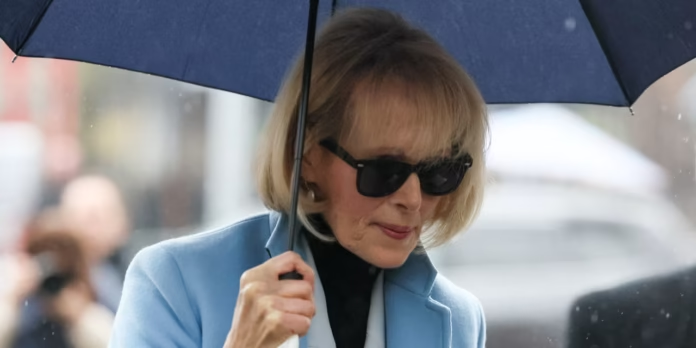
The Justice Department has launched a criminal investigation into E. Jean Carroll, the former magazine columnist whose two civil lawsuits against President Donald Trump produced combined jury verdicts totaling more than $88 million. Prosecutors are examining whether Carroll committed perjury in a 2022 deposition when she stated that no outside party was funding her legal fees. The probe, assigned to federal prosecutors in Chicago, marks one of the most significant legal counteroffensives taken by the Trump administration against a figure the president has long characterized as a political adversary.
Story Highlights
- The DOJ investigation centers on Carroll’s 2022 deposition claim that no outside party was covering her litigation costs — a statement later contradicted by Trump’s attorneys, who revealed that philanthropist Reid Hoffman funded her cases.
- Acting Attorney General Todd Blanche has recused himself from the matter due to his prior role as one of Trump’s personal lawyers during Carroll’s civil appeals.
- Carroll won two landmark civil verdicts against Trump — $5 million in 2023 for sexual abuse and defamation, and $83.3 million in 2024 for defamation.
What Happened
The Justice Department has opened a criminal investigation into E. Jean Carroll, the 82-year-old former Elle magazine advice columnist whose civil lawsuits against President Donald Trump resulted in two landmark jury verdicts. The probe was first reported by CNN and subsequently confirmed by CBS News, NPR, and ABC News, each citing multiple sources familiar with the matter. It is being led out of the U.S. Attorney’s Office for the Northern District of Illinois in Chicago.
According to sources, the investigation focuses on whether Carroll committed perjury during a 2022 deposition when she stated under oath that no outside party was paying her legal fees. That claim later came under scrutiny after Trump’s attorneys revealed that Reid Hoffman, a Silicon Valley entrepreneur, Democratic megadonor, and philanthropist, had helped fund her litigation. Hoffman’s nonprofit organization is based in Chicago, which accounts for why the investigation was routed to the Northern District of Illinois rather than to New York prosecutors, where the deposition was originally taken.
Acting Attorney General Todd Blanche has recused himself from all aspects of the matter. Before joining the administration, Blanche served as one of Trump’s personal attorneys during the appeal process related to Carroll’s lawsuits. According to Reuters and The New York Times, Blanche has attended no meetings and played no role in discussions about the probe. Oversight has been assumed by other officials in the deputy attorney general’s office. U.S. Attorney Andrew Boutros, a Trump appointee confirmed to lead the Northern District of Illinois in 2025, is reported to have personally opened the federal investigation.
Carroll’s attorney, Roberta Kaplan, declined to comment when contacted by multiple outlets. Carroll first publicly accused Trump of sexually assaulting her in a Manhattan department store dressing room in the mid-1990s, a story she detailed in a 2019 New York Magazine piece. She subsequently filed two civil lawsuits — one alleging sexual abuse and defamation, and a second for defamation stemming from Trump’s repeated denials in 2019. In May 2023, a Manhattan jury found Trump liable for sexual abuse and defamation, awarding Carroll $5 million. A second jury in January 2024 found Trump liable for a separate defamation claim and ordered him to pay $83.3 million in additional damages.
The 2nd U.S. Circuit Court of Appeals had already examined the underlying perjury question as part of Trump’s appellate challenge. The court found Carroll had plausibly represented in her deposition that she had simply forgotten about the outside funding, and determined she was not personally involved in managing who paid her litigation costs. Both verdicts survived that appeal. Trump has asked the Supreme Court to overturn the $5 million judgment; the court deferred consideration of that petition for the twelfth time as recently as Wednesday morning.
Why It Matters
The opening of a criminal perjury probe into Carroll has intensified longstanding debate about whether the Trump Justice Department is operating as an independent law enforcement institution or as a vehicle for political retaliation. Critics point to the fact that the 2nd Circuit already examined Carroll’s deposition statement and found no basis to conclude she intentionally lied. Opening a federal criminal investigation on the same factual basis — and assigning it to a Trump-appointed U.S. attorney in a different jurisdiction — appears to many legal observers as an end run around a court ruling that already resolved the question.
The investigation is the latest in a series of DOJ actions targeting individuals perceived by Trump as adversaries, including media figures, former officials, and civil plaintiffs. Carroll’s case is particularly significant because the underlying civil judgments against Trump are still working their way toward the Supreme Court. A federal criminal investigation into the opposing party in active litigation creates an unusual and ethically fraught environment around those proceedings.
Acting Attorney General Blanche’s recusal is a meaningful procedural step, but it does not fully resolve concerns about the department’s independence. Blanche’s dual role — first as Trump’s personal attorney, then as the nation’s chief law enforcement officer — has been a persistent source of criticism since his appointment. His removal from this specific matter addresses a conflict of interest but leaves intact broader questions about the department’s direction.
It is also important to note that investigations do not always lead to charges. Federal prosecutors routinely open and close preliminary inquiries without indictment. However, the public knowledge that an investigation exists carries its own legal and reputational weight — a reality that critics argue is itself the point.
Economic and Global Context
While the Carroll investigation is primarily a legal story, it exists within a broader context that has international resonance. America’s allies and global institutions that monitor the rule of law track the Trump administration’s deployment of federal legal powers with close attention. The credibility of U.S. institutions — courts, the DOJ, the independent bar — matters for ongoing diplomatic negotiations, trade agreements, and multilateral commitments that depend on foreign governments trusting the consistency of American governance.
Domestically, public confidence in the Justice Department has been in measurable decline across multiple polls. Trust in federal institutions correlates with economic investment behavior — both domestic and foreign. Businesses and investors prefer legal predictability; when the rule of law appears to bend toward political objectives, that introduces systemic risk premiums into economic planning and capital allocation decisions.
The Carroll case also arrives at a particularly sensitive political moment. Democrats are polling ahead of Republicans by double digits on the 2026 generic congressional ballot. A Justice Department perceived as wielding criminal law as a political instrument energizes Democratic voters and motivates independent ones who care about institutional integrity — both of which represent headwinds for Republican House candidates in competitive districts.
Implications
For Carroll personally, even a criminal investigation that never results in charges is a severe burden. At 82 years old, after years of emotionally and logistically demanding civil litigation, a federal criminal probe introduces new legal costs, stress, and public exposure. The investigation effectively reshuffles her legal situation at a moment when the civil judgments she won were on the cusp of reaching the Supreme Court.
For Republicans, the probe offers a political gift: the narrative that a financially backed, politically motivated legal assault on the president is now facing scrutiny. That framing will be amplified across conservative media and will serve as a fundraising and base-mobilization asset in the months ahead. Trump’s allies will frame the DOJ action as accountability overdue, not as retaliation manufactured.
For voters in the political center, the investigation will function as another data point in the broader question they are already weighing: whether the Trump administration uses government power for the public interest or for personal and political ends. That question will be the defining issue of the 2026 midterm campaign, and the Carroll investigation adds significant fuel to both sides of that debate.
Source
DOJ opens investigation into Trump accuser E. Jean Carroll for perjury

