Story Highlights
- The DOJ said it will abide by a court order temporarily blocking the $1.8 billion fund, signaling a retreat from the plan.
- Senate Republicans blocked Trump’s June 1 deadline for ICE and Border Patrol funding legislation over the fund controversy.
- Senators including Chuck Grassley said the DOJ’s statement is insufficient and they need a firmer commitment to kill the fund entirely.
What Happened
The Trump administration signaled Monday it is backing off on creating a $1.8 billion fund announced by the Justice Department that could send money to allies of President Donald Trump deemed to be “victims of lawfare and weaponization.” The announcement came after a fierce and rare backlash from Senate Republicans, who threatened to team up with Democrats to block the fund. About half the Republican conference appeared ready to vote with Democrats to restrict or kill it, according to Sen. Ted Cruz, R-Texas.
In a statement, the Justice Department cited a federal judge’s ruling on Friday that blocked the fund on a temporary basis, saying it “disagrees strongly” but “will abide by the Court’s ruling.” The judge had issued an order that only temporarily blocked the DOJ from taking further action on the fund until the court more fully assessed both parties’ arguments; it did not permanently block the fund. A hearing was set for June 12.
The announcement was aimed at restarting the party-line “reconciliation” bill Republicans were trying to push through Congress to fund ICE and the Border Patrol through the end of Trump’s term in office. Those two agencies were left out of the Department of Homeland Security appropriations bill this year. That push stalled two weeks ago before the Memorial Day recess because of the anti-weaponization fund.
Sen. Chuck Grassley, R-Iowa, chair of the Senate Judiciary Committee, said the DOJ statement was not enough. “The only thing that’s going to solve this problem, to get immigration funded and law enforced, is for the president to do away with the weaponization fund,” Grassley said. Asked if the DOJ statement was enough, Grassley replied: “The answer is no.”
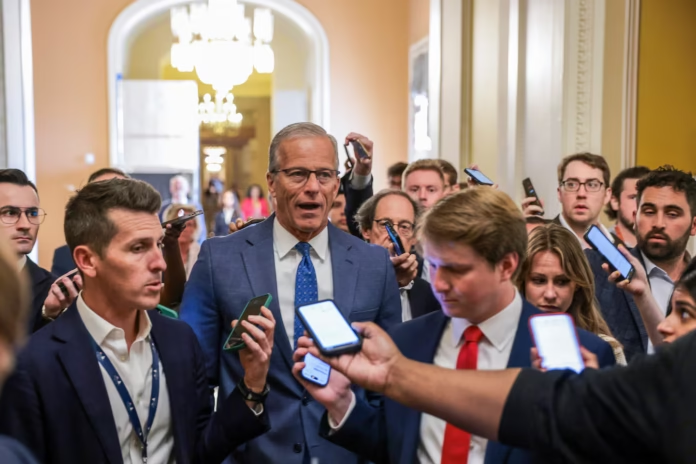
Sen. John Thune, R-S.D., the Senate Majority Leader, said: “I don’t know, but I do think that the best way to handle it is if the administration decides to shut it down themselves.” Trump himself has not made any public commitment to permanently abandoning the fund.
Why It Matters
The episode is significant for several reasons that extend well beyond the fate of a single funding mechanism. First, it illustrates the limits of presidential authority to push controversial executive actions through a Congress in which even a loyal Senate majority has a breaking point. The GOP’s $70 billion immigration enforcement funding agenda is stalled over concerns about the fund, and Senate Republicans’ anger has eroded their bond with the White House. Democrats plan to force vulnerable Republicans on the record over the fund ahead of November elections.
Second, the substance of the fund itself has generated extraordinary concern. Senate Minority Leader Chuck Schumer of New York took to the floor to warn that the fund, as proposed, could funnel taxpayer money to “MAGA billionaires, cop-beating Jan. 6 insurrectionists and Trump’s own family.” The concern that a federal fund could be used for political patronage rather than legitimate legal remediation has united Democrats and a substantial faction of Senate Republicans in opposition.
Third, the timing matters enormously. Trump had pressed for a June 1 deadline to pass ICE and Border Patrol funding. Missing that deadline weakens the administration’s negotiating position on the broader immigration enforcement agenda and raises questions about whether the reconciliation bill — a centerpiece of Trump’s second-term domestic agenda — can be passed before Congress heads toward the midterm election cycle.
Economic and Global Context
The stalling of ICE and Border Patrol funding has real operational consequences. Both agencies were excluded from the Department of Homeland Security’s regular appropriations bill this fiscal year, meaning the reconciliation legislation is the primary vehicle for ensuring continued funding for the administration’s immigration enforcement priorities. A prolonged delay directly affects staffing, detention capacity, and operational continuity for these agencies.
Republicans control a 53-47 majority in the Senate and an even narrower 217-212 margin in the House, meaning the administration can afford almost no defections if it wants to pass the reconciliation package on a party-line basis. The depth of Republican opposition to the anti-weaponization fund — with Cruz estimating that at least half the Senate GOP conference was ready to vote against the administration — reveals just how thin those margins actually are in practice.
The legal situation adds another layer of complexity. At least four lawsuits had been filed challenging the fund, including one brought by a January 6 prosecutor who was fired by the Trump administration and another by two officers who protected the Capitol on January 6. Federal courts have already moved quickly, with one judge granting a temporary block within weeks of the fund’s announcement.
Implications
The most direct implication is that the reconciliation bill’s path remains uncertain. Even if the White House formally abandons the anti-weaponization fund, Senate Republicans have made clear they want that commitment in law — not just in statements from the DOJ. Democrats have pledged to force votes on amendments to block the money and have introduced stand-alone legislation to permanently prohibit such funds.
For the Trump White House, the episode represents a rare but significant instance of the administration being compelled to retreat from a policy initiative by its own party. The management of the rollout — specifically, the DOJ announcing the fund without notifying Senate Majority Leader Thune — inflicted unnecessary political damage and underscored ongoing coordination problems between the executive branch and Capitol Hill.
For Republican senators facing competitive races in November, the anti-weaponization fund has become a liability they are eager to move past. The fund’s potential to divert taxpayer money to political allies made it a gift for Democratic opponents and an uncomfortable burden for incumbents trying to maintain credibility with general election voters.
For Americans watching the immigration debate, the episode highlights how internal Republican disagreements can block enforcement priorities as effectively as Democratic opposition — a dynamic that could feature prominently in the fall campaign.
Sources

