Story Highlights
- Senate Republicans released a $72 billion reconciliation package funding ICE, CBP, and other immigration enforcement operations through Trump’s presidency
- The bill includes $1 billion for Secret Service security upgrades related to Trump’s White House East Wing ballroom project
- Senate Republican leaders aim to bring the bill to a floor vote the week of May 18, with Trump’s June 1 deadline as the target
What Happened
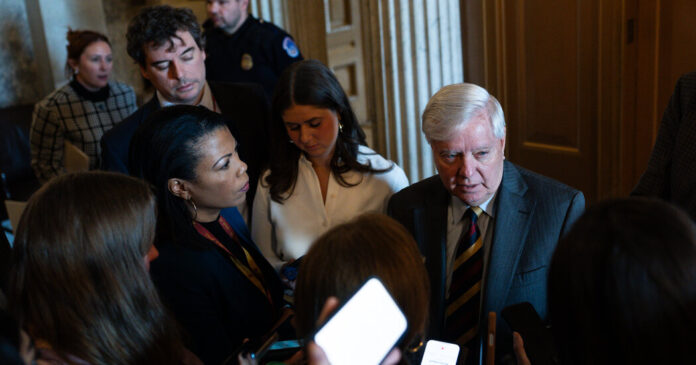
Senate Republicans are moving aggressively to lock in long-term funding for President Donald Trump’s immigration enforcement agencies, releasing the text of a $72 billion reconciliation bill late Monday night through the Senate Judiciary and Homeland Security and Governmental Affairs committees. The package covers Immigration and Customs Enforcement and Customs and Border Protection, two agencies at the center of the administration’s mass deportation agenda, providing funding that stretches through the end of Trump’s current term.
The reconciliation process was deliberately chosen to bypass the Senate filibuster, which requires 60 votes to overcome. Republicans do not have that threshold, but reconciliation allows passage with a simple majority. Senate Budget Committee Democrat Jeff Merkley of Oregon immediately vowed that his party would “review this bill line by line and vigorously challenge any provision that violates the Byrd Rule” — the procedural guideline that limits what can be included in reconciliation legislation.
The funding breakdown is substantial. The bill allocates $38.2 billion for ICE, $26 billion for CBP, and a $5 billion discretionary fund for the Secretary of Homeland Security. An additional $1.5 billion is earmarked for Department of Justice operations, including terrorism prosecutions, DEA operations, and FBI work. Within the ICE allocation, $30.725 billion is specifically designated for personnel, attorney costs, transportation, and expenses related to removing individuals in the country illegally.
Notably, the bill includes $1 billion directed to the Secret Service for “security adjustments and upgrades” tied to Trump’s White House East Wing modernization — the controversial ballroom project currently under construction on the grounds of the White House. The administration has consistently maintained the ballroom itself is being funded through private donations, and the bill text specifies these funds may not be used for “non-security elements” of the project. A White House spokesman said the administration “applauds Congress’s latest proposal” and its inclusion of funding for “long overdue” security infrastructure upgrades. Critics, however, argue the distinction between security and construction costs is difficult to enforce.
Why It Matters
The scale of this funding package signals the Republican Party’s commitment to making Trump’s immigration enforcement posture durable and difficult for any future administration to reverse. By securing multi-year, lump-sum appropriations through reconciliation, Congress would effectively shield ICE and CBP from the kind of annual appropriations battles that Democrats used earlier this year to apply pressure on the agencies following the fatal shootings of two U.S. citizens by federal agents in Minneapolis.
That standoff — which resulted in the longest government shutdown in U.S. history, lasting 75 days — demonstrated both the vulnerability of annual appropriations as a funding mechanism and the political cost of protracted government shutdowns. Trump himself set a June 1 deadline for the bill’s passage, and Senate Majority Leader John Thune and Speaker Mike Johnson have largely complied, designing a legislative timeline that puts the bill on the floor with days to spare.
The ballroom provision has become a flashpoint in the broader debate. Democrats have argued that the project has evolved from a privately funded renovation into a significant taxpayer expenditure, with Democratic lawmakers pointing out that $1 billion in Secret Service funding represents nearly one-third of the agency’s entire annual budget of $3.3 billion. The administration counters that separating security infrastructure from the construction project itself is both legally sound and operationally necessary given the post-Correspondents’ Dinner shooting security review.
The bill comes on top of the roughly $170 billion in immigration enforcement funding already approved as part of Trump’s One Big Beautiful Bill Act last year, cementing what critics have described as a historic transformation of the federal immigration enforcement apparatus into one of the most well-funded operations in the executive branch.
Economic and Global Context
The financial architecture of Trump’s immigration enforcement agenda is unprecedented in scope. ICE’s detention budget alone has grown by approximately 400 percent compared to pre-Trump levels, and the agency now has sufficient funding to detain potentially more than 100,000 individuals per year. This expansion has created a significant and growing industry around detention facilities, transportation contracts, and security services — a complex that has both economic and governance implications.
The bill’s passage would also have downstream effects on federal labor markets. The ICE allocation includes funding to hire 10,000 new officers, while CBP expansion plans would similarly require large-scale recruiting and training operations. During the 75-day DHS shutdown, agencies relying on appropriated funds found themselves financially stretched, with TSA workers and others depending on emergency executive action to receive paychecks. The new legislation is designed to eliminate that vulnerability.
At the same time, the fiscal environment in which this spending is occurring is strained. The Iran war has cost $29 billion to date and is contributing to elevated inflation, rising oil prices, and growing federal debt service costs. Directing an additional $72 billion toward immigration enforcement at this juncture — on top of existing allocations — will intensify debates about federal spending priorities and the administration’s economic management.
Implications
Senate Republican leaders plan the floor vote the week of May 18. If the bill passes the Senate with 51 votes, it will move to the House, where leadership will need to reconcile any differences before sending a final package to Trump’s desk. The June 1 deadline creates urgency, but House-Senate dynamics on immigration funding have historically proven complicated, with hard-line Republicans like Rep. Chip Roy of Texas already expressing frustration that immigration enforcement funding was separated from the broader DHS appropriations bill in the first place.
If enacted, the legislation would represent one of the most consequential immigration policy victories of Trump’s second term. It would also become a central issue in the November midterm elections. Democrats plan to campaign on accountability for federal agents and the cost of the administration’s enforcement apparatus. Republicans will argue they fulfilled their core mandate on border security and gave the agencies the stability they need to do their jobs.
The ballroom provision, meanwhile, is likely to remain a target for Democratic messaging — a symbol, in their framing, of a Republican Congress that funded armed federal enforcement agencies and a presidential luxury project simultaneously while ordinary Americans contend with $4.50 gasoline.
Sources
“Republicans want to add $1 billion for Trump’s ballroom security to ICE funding plan”

