Story Highlights
- The $72 billion reconciliation bill would fund ICE through 2029 with over $38 billion, and CBP with $26 billion
- An additional $1 billion is included for Secret Service security upgrades related to Trump’s White House ballroom project
- Senate committees plan markup the week of May 19, with a goal of reaching Trump’s desk by June 1
What Happened
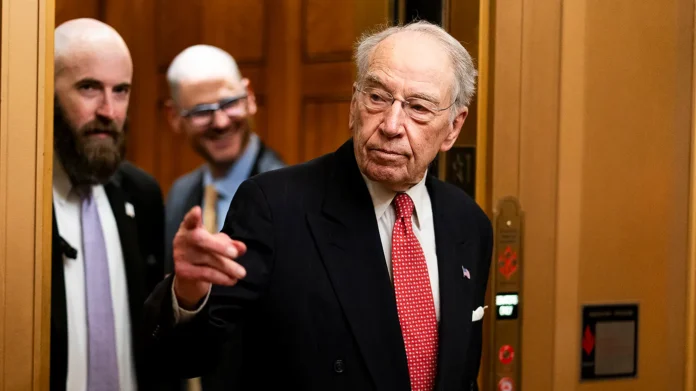
Two Republican-led Senate committees — the Judiciary Committee under Chairman Charles Grassley of Iowa and the Homeland Security and Governmental Affairs Committee — released legislative text Monday night for a nearly $72 billion reconciliation package aimed at fully funding the Trump administration’s immigration enforcement apparatus. The package was made possible after both chambers adopted a budget resolution in late April, passing the Senate 50 to 48 with only Senators Lisa Murkowski of Alaska and Rand Paul of Kentucky voting against it.
Under the Judiciary Committee’s portion of the bill, ICE would receive $30.73 billion to hire, train, pay, and equip personnel — including officers, agents, investigators, attorneys, and support staff — through fiscal year 2029, extending one year past the end of Trump’s current term. CBP would receive $22.57 billion for similar personnel-related expenses under the same timeline. The Homeland Security Committee’s separate title adds $32.5 billion in additional funding, including $3.5 billion for border security technology and screening infrastructure. The combined total of $71.7 billion in new spending would be partially offset by existing unobligated funds.
The bill also provides $2.5 billion to Homeland Security Secretary Markwayne Mullin for general immigration enforcement operations and $1 billion to the U.S. Secret Service for security upgrades to the White House complex related to the ongoing construction of a new ballroom to replace the historic East Wing. According to the bill text, those funds may only be used for security-related elements of the project — including “above-ground and below-ground security features” — and cannot be used for non-security construction. The White House praised the inclusion, citing a recent assassination attempt on Trump at the White House Correspondents’ Dinner as justification for hardening the compound.
The reconciliation process allows the bill to pass the Senate with a simple majority of 51 votes, bypassing the 60-vote threshold needed to overcome a Democratic filibuster. Democrats had blocked immigration enforcement funding in the broader DHS appropriations bill for 75 days, refusing to approve ICE and CBP funding without reforms to agency practices following the fatal shootings of two American citizens — Renee Good and Alex Pretti — by federal officers in January. After that impasse ended last week through a bipartisan spending bill, Republicans moved immediately to advance the reconciliation package to provide the immigration funding Democrats had refused to support.
Grassley argued the legislation would deliver certainty for federal law enforcement. “We will work to ensure this critical funding gets signed into law without unnecessary delay,” he said in a statement. Paul, despite his earlier opposition to the budget resolution, chose to participate in drafting his committee’s portion of the bill, announcing plans for a markup later in May. Senate committees plan to hold markups the week of May 19, with the goal of sending a final bill to Trump’s desk by June 1.
Why It Matters
The reconciliation bill represents a foundational investment in the infrastructure of immigration enforcement that will extend well beyond Trump’s current term. Funding ICE and CBP through fiscal year 2029 would insulate those agencies from future congressional budget battles and Democratic legislative leverage, effectively locking in current enforcement capacity regardless of who controls Congress after November’s midterms. That durability is a strategic priority for the administration, which views a reduction in immigration enforcement as one of the primary risks of a Democratic congressional takeover.
The ballroom funding provision has generated significant political controversy, providing Democrats with a potent messaging opportunity at a time when gas prices and the cost of living are already dominant voter concerns. Senate Democratic Leader Chuck Schumer said Republicans were “on a different planet than American families,” while Sen. Elizabeth Warren called the provision hypocrisy, noting the project’s cost had grown from $200 million in private donations to $1 billion in taxpayer funds. The White House’s defense — citing an assassination attempt at the Correspondents’ Dinner as justification for White House hardening — offers a substantive rationale, but Democrats will continue to press the political contrast.
The broader reconciliation strategy also carries internal Republican risks. Senate Majority Leader John Thune has warned that opening up tax code provisions in any new reconciliation bill could reignite fights over the One Big Beautiful Bill Act — the landmark July 2025 legislation that extended Trump’s 2017 tax cuts and cut over $1 trillion from Medicaid and SNAP. Some conservatives are already calling for a third reconciliation bill to include defense spending and additional safety net cuts, which would further complicate the legislative calendar.
Economic and Global Context
The $72 billion reconciliation package comes at a moment of significant fiscal constraint and economic anxiety. The One Big Beautiful Bill Act, signed by Trump on July 4, 2025, is projected by the Congressional Budget Office to increase the federal deficit by $3.4 trillion over 10 years under a current law baseline. That deficit expansion has already triggered a Medicare sequester order that, according to May 2026 CBO analysis, would reduce Medicare spending by $45 billion in fiscal year 2026 — an automatic cut that Congress has historically moved to nullify but that would require additional legislative action.
The immigration enforcement agencies at the center of this bill — ICE and CBP — already have over $100 billion in unspent funds according to Democrats’ accounting, a claim Republicans dispute but which raises questions about whether additional appropriations are immediately necessary. Democrats have argued that the administration’s pressing priorities are misaligned with public needs during a period of high gas prices and inflation driven by the Iran war.
For American businesses, particularly in sectors that rely on migrant labor — agriculture, construction, hospitality, and food service — the prospect of sustained, multi-year aggressive immigration enforcement carries real economic implications. Agricultural producers in particular have expressed concern about labor supply disruptions at a time when input costs are already elevated due to the Iran war’s effect on diesel and fertilizer prices.
Implications
The reconciliation timeline is ambitious but achievable if Republican unity holds. The most significant internal risk comes from Paul and other fiscal conservatives who may attempt to use the markup process to trim spending, and from Murkowski, whose continued independence on immigration-related votes creates some uncertainty. However, with a June 1 target and strong White House pressure behind the effort, Republican leaders are likely to find the votes needed for passage.
Once enacted, the bill would secure Trump’s immigration enforcement infrastructure for years to come, creating a durable policy legacy even if Democrats recapture one or both chambers in November. It would also provide administration officials with a ready response to criticism that the Republican majority failed to act on immigration — a core voter priority that helped elect Trump in both 2016 and 2024.
For Democratic messaging ahead of the midterms, the combination of the ballroom funding provision and the broader ICE and CBP investment will feature prominently in their argument that Republicans are out of touch with ordinary Americans. Whether that argument resonates with the persuadable voters who will decide competitive congressional races in the fall will depend heavily on whether the economic environment improves or worsens between now and November.
Sources
“Republicans unveil budget reconciliation bill to fund ICE, Border Patrol through 2029”

