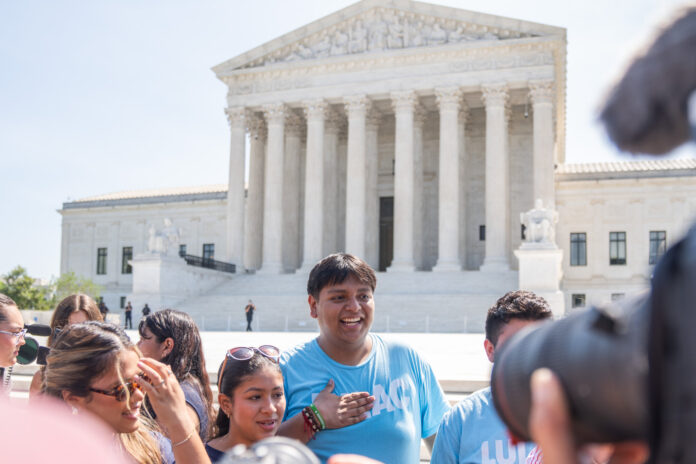
The Supreme Court struck down President Trump’s executive order seeking to end birthright citizenship for children of undocumented and temporary immigrants, ruling 6-3 that the Fourteenth Amendment guarantees citizenship to nearly all children born on American soil. The decision, Trump’s third major Supreme Court defeat this year, has split Republican lawmakers between those calling for new legislation and others urging the party to move on.
Story Highlights
- The Supreme Court ruled 6-3 in Trump v. Barbara that Trump’s January 2025 executive order restricting birthright citizenship is unconstitutional.
- Chief Justice John Roberts wrote the majority opinion, joined by Justices Kagan, Sotomayor, Barrett, and Jackson, with Kavanaugh concurring on narrower statutory grounds.
- Justices Thomas, Gorsuch, and Alito dissented, with Alito warning the ruling fails to address “birth tourism” concerns.
What Happened
President Trump signed the executive order on his first day back in office in January 2025, directing federal agencies to stop recognizing citizenship for children born in the United States to parents who were in the country illegally or on temporary visas. The order was immediately challenged in multiple courts by civil rights organizations, including the American Civil Liberties Union and the NAACP Legal Defense Fund, and was blocked before it ever took effect anywhere in the country.
The case that reached the Supreme Court, Trump v. Barbara, originated in New Hampshire, where a federal court certified a nationwide class of plaintiffs, including infants who would have been denied citizenship under the order. The justices heard oral arguments on April 1, 2026, with Trump making an unprecedented personal appearance in the courtroom. In its 194-page ruling issued June 30, the Court’s majority, led by Chief Justice John Roberts, held that children born in the United States to parents who are unlawfully or temporarily present remain “subject to the jurisdiction” of the United States and are citizens at birth under the Fourteenth Amendment’s Citizenship Clause.
Roberts grounded the decision heavily in the Court’s 1898 ruling in United States v. Wong Kim Ark, which established that the Fourteenth Amendment codified the common-law principle of birthright citizenship, with narrow exceptions for children of accredited diplomats, children of hostile occupying forces, and a few other limited categories. Justice Brett Kavanaugh concurred in the outcome but on narrower grounds, finding the order violated federal statute rather than the Constitution itself. Justices Clarence Thomas, Neil Gorsuch, and Samuel Alito dissented, with Alito specifically citing concerns about “birth tourism” and arguing the ruling failed to grapple with modern immigration realities.
Reaction on Capitol Hill broke sharply along ideological lines. Republican Representative Byron Donalds of Florida called the decision “a terrible decision,” while Democratic Representative Ro Khanna of California argued for stronger regulation of the immigration process without altering birthright citizenship itself. Some Republicans have since introduced legislation aimed at restricting citizenship for children of certain visa holders, though such a bill would face the same constitutional hurdles the executive order failed to clear.
Why It Matters
The ruling represents a significant defeat for one of the centerpiece immigration policies of Trump’s second term, following closely on the heels of the Supreme Court’s February decision striking down his sweeping tariff program. It marks the third major Supreme Court setback for the administration in recent months, a pattern that has visibly frustrated the president, who has previously criticized the justices in personal terms following unfavorable rulings.
For Republican lawmakers, the decision forces a strategic reckoning. Some, including those who introduced new restrictive legislation, appear determined to continue pursuing the policy goal through Congress rather than executive action, even though any statute attempting to narrow the Fourteenth Amendment’s citizenship guarantee would likely face identical constitutional challenges. Other Republicans have suggested the party should redirect its energy toward border security and interior enforcement measures that do not require reinterpreting constitutional text.
The ruling also reinforces the limits of executive authority over constitutional provisions, a theme that has recurred throughout Trump’s efforts to reshape immigration and trade policy through unilateral executive action. For legal scholars and immigration policymakers, the decision cements more than a century of precedent and forecloses, for now, any administrative pathway to narrowing citizenship eligibility.
Economic and Global Context
The ruling arrives as the administration simultaneously pursues an aggressive interior immigration enforcement campaign, including a sharp increase in arrests by Immigration and Customs Enforcement. While birthright citizenship itself carries no direct market impact, the broader immigration enforcement posture has implications for labor markets in agriculture, construction, and hospitality industries that rely heavily on immigrant labor, sectors already reporting workforce disruptions tied to increased enforcement activity.
Internationally, the decision has drawn attention from countries whose citizens are affected by U.S. immigration policy, and it reinforces the United States’ continued adherence to jus soli citizenship principles at a time when several other nations have moved toward more restrictive, descent-based citizenship models. The ruling may also influence ongoing litigation and legislative debates in other countries considering similar restrictions.
Domestically, the decision provides legal certainty for hospitals, schools, and state agencies that had been preparing contingency plans in case the executive order had been upheld, avoiding what immigration attorneys had warned could have been significant administrative chaos in verifying citizenship status for newborns nationwide.
Implications
For the Trump administration, the ruling likely shifts focus toward legislative and enforcement-based approaches to immigration policy, including continued support for the stalled SAVE America Act and expanded ICE enforcement operations, rather than further executive actions on citizenship itself.
For congressional Republicans, the coming months will test whether party leadership pursues new legislation attempting to narrow birthright citizenship, a path most constitutional scholars view as futile absent a formal constitutional amendment, or pivots entirely toward other immigration priorities where legislative consensus is more achievable.
For families and advocacy organizations who challenged the order, the ruling provides lasting legal certainty, though continued enforcement actions elsewhere in immigration policy suggest the broader political fight over immigration will remain a defining issue heading into the midterm elections.
Sources
Supreme Court strikes down Trump’s birthright citizenship executive order in landmark decision

