Story Highlights
- Supreme Court struck down federal limits on coordinated spending between political parties and candidates in a 6-3 ruling
- The case, National Republican Senatorial Committee v. FEC, originated from JD Vance’s 2022 Senate campaign
- The decision overturns a 2001 precedent and allows party committees to spend unlimited funds in coordination with candidates
What Happened
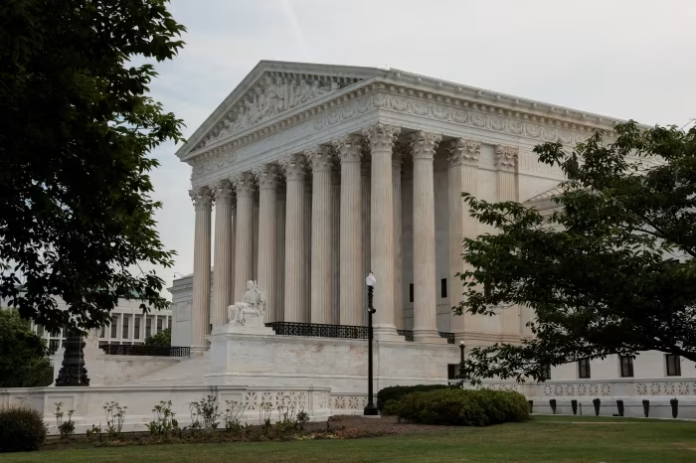
The Supreme Court ruled Tuesday in National Republican Senatorial Committee v. Federal Election Commission, striking down decades-old limits on how much political parties may spend in direct coordination with their own candidates. Justice Brett Kavanaugh wrote the majority opinion in the 6-3 decision, concluding that the spending caps imposed under the Federal Election Campaign Act violated the First Amendment’s protection of political speech. “More speech is generally better than less speech,” Kavanaugh wrote in explaining the court’s reasoning.
The case traces back to 2022, when then-Senate candidate JD Vance, running in Ohio, joined former Congressman Steve Chabot and two Republican party committees in challenging the constitutionality of federal coordinated spending limits. Under the prior rules, party committees were restricted to spending between roughly $65,300 and $130,600 in coordination with House candidates, and between $130,600 and $4 million with Senate candidates, depending on state population, according to Federal Election Commission figures for the current election cycle. The plaintiffs argued these limits unconstitutionally restricted a political party’s ability to support its own candidates.
A federal appeals court had previously upheld the limits, citing a 2001 Supreme Court precedent that found similar restrictions constitutional. Tuesday’s ruling explicitly overturns that 25-year-old decision, marking the latest in a long series of Supreme Court rulings since 2010’s Citizens United v. FEC that have steadily dismantled campaign finance regulations originally designed to limit the influence of money in politics.
Although Vance and Chabot are no longer active candidates, and the Trump Justice Department had already indicated it would not enforce the coordinated spending limits, the court proceeded with a ruling on the merits. During oral arguments in December, justices suggested a definitive ruling would provide candidates and parties with legal certainty in the event a future administration sought to reinstate enforcement of the limits.
Justice Elena Kagan authored the dissent, joined by the court’s other liberal justices, warning that the decision “ushers back in the same opportunities for quid pro quo corruption that the contribution limits were meant to check.” Attorneys representing the Democratic Party, who had intervened in the case to defend the existing limits, argued the ruling would “fundamentally reshape the campaign finance regime” and create obvious risks of corruption.
Why It Matters
The ruling represents a significant structural shift in how American political campaigns are financed, granting party committees substantially more power and flexibility heading into the 2026 midterm elections and beyond. Freed from spending caps, national party organizations like the National Republican Senatorial Committee and its Democratic counterparts can now coordinate directly and without limit with individual candidates, a change that strengthens the role of formal party infrastructure relative to outside spending groups.
For decades, campaign finance law has drawn a critical distinction between coordinated spending, which was tightly regulated due to corruption concerns, and independent expenditures by super PACs, which have faced few restrictions since Citizens United. This ruling effectively narrows that distinction for party committees specifically, allowing parties to combine the fundraising power of unlimited donations with direct coordination authority over how that money is spent alongside candidates.
Critics warn the decision removes one of the last meaningful guardrails in federal campaign finance law, potentially making party committees more attractive vehicles for large donors seeking influence, since money funneled through parties can now be spent in direct coordination with candidates rather than independently. This raises renewed concerns about the potential for donors to gain outsized access and influence over elected officials through party channels.
Supporters counter that the change strengthens political parties relative to outside groups and wealthy individual donors who have increasingly dominated campaign spending through super PACs since 2010. They argue that empowering parties, which are subject to more transparency and accountability requirements than many outside spending vehicles, is preferable to the current system’s reliance on loosely regulated independent expenditure groups.
Economic and Global Context
The ruling arrives amid record levels of political spending in recent U.S. election cycles, with the 2024 presidential and congressional elections combined exceeding an estimated 15 billion dollars in total spending across all federal races, according to Federal Election Commission and OpenSecrets tracking data. Removing coordination limits is expected to further increase the flow of money through official party channels heading into the 2026 midterms, particularly in competitive Senate and House races where both parties are expected to pour significant resources.
Political fundraising experts anticipate that national party committees will move quickly to capitalize on the ruling, restructuring fundraising appeals to emphasize their newly expanded ability to coordinate directly with candidates. This could shift donor strategy industry-wide, as major donors and political action committees reassess whether contributing through party committees now offers greater strategic value compared to traditional super PAC vehicles.
The decision also fits within a broader two-decade trend of U.S. campaign finance law moving toward deregulation, a trajectory that stands in contrast to many other democracies, including Canada, the United Kingdom, and most European Union nations, which maintain considerably stricter limits on coordinated political spending and overall campaign expenditures. This divergence continues to set the United States apart internationally in terms of the scale and structure of political fundraising.
Economically, the ruling is expected to benefit industries closely tied to political consulting, advertising, and media buying, sectors that have already seen substantial growth tied to the post-Citizens United campaign finance landscape and are likely to see continued expansion as party committees gain greater spending flexibility.
Implications
In the immediate term, both major parties are expected to begin restructuring their fundraising and spending strategies ahead of the 2026 midterms to take full advantage of the newly unlimited coordination authority, particularly in competitive Senate and swing-district House races where outside spending has traditionally played an outsized role.
For Republican candidates, the ruling provides immediate strategic benefits given that the case was brought specifically by GOP plaintiffs and committees, potentially giving Republican party infrastructure an early operational advantage in adapting to the new legal landscape compared to Democratic counterparts.
For campaign finance reform advocates, the decision represents another significant setback in a long string of judicial losses dating back to Citizens United, and is likely to renew calls for legislative action, though any meaningful reform effort would face substantial obstacles given current congressional dynamics and the Supreme Court’s clear directional stance on these issues.
Looking ahead, expect continued legal and political battles over campaign finance regulation, with this ruling likely serving as a foundational precedent for future challenges to remaining restrictions, including individual contribution limits and disclosure requirements that have so far survived judicial scrutiny.
Sources
Supreme Court strikes down limits on political party spending

