Story Highlights
- The U.S. Court of International Trade ruled 2-1 against Trump’s 10 percent global replacement tariff
- The ruling follows a February Supreme Court decision that struck down the administration’s original sweeping import levies
- The government expects to refund more than $166 billion collected under the earlier, invalidated tariffs
What Happened
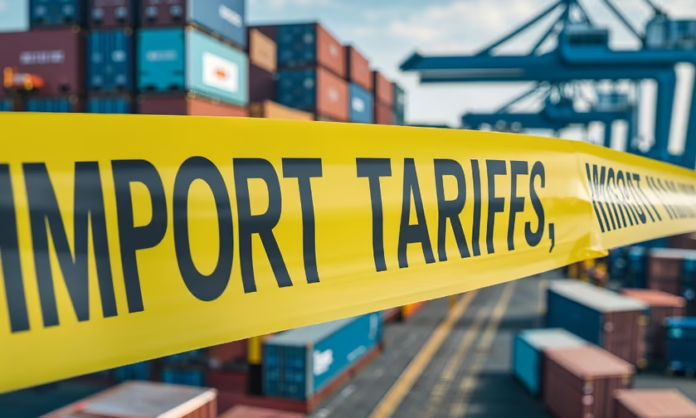
In a victory for importers and a setback for the Trump administration, the Court of International Trade struck down a second round of worldwide tariffs that the president ordered to replace import levies that were outlawed by the U.S. Supreme Court. The court’s decision was limited to two importers who challenged the tariffs, along with the state of Washington. It was not immediately clear whether other importers would have to keep paying the levies.
President Donald Trump imposed the temporary 10% duty in February, shortly after the Supreme Court struck down many of his global tariffs. The new tariff was meant to deal with balance of payments deficits, citing Section 122 of the Trade Act of 1974. The 2-1 ruling by the U.S. Court of International Trade, for now, blocks the tariffs from being implemented against just two companies and the state of Washington — but it could open doors to further such outcomes.
After the Supreme Court ruled in February that President Trump had exceeded his authority in ordering double-digit tariffs on virtually everything the U.S. imports, Trump sought to replace the import taxes using a different law. But that law only authorizes tariffs in response to large and persistent balance-of-payments deficits. The trade court ruled that condition does not currently exist, so the replacement tariffs are not warranted.
Jeffrey Schwab, senior counsel at the Liberty Justice Center, said after the ruling: “Section 122 was passed in response to a specific historical crisis that resulted in the U.S.’s currency and gold reserves being depleted. The U.S. has a trade deficit, not a balance-of-payments deficit, and does not have an international payments problem.”
The White House did not immediately respond to a request for comment. The new tariffs were time limited and set to expire in July. The administration continues to explore other options to impose tariffs using different statutes.
Why It Matters
This ruling represents the second consecutive legal rebuke of the Trump administration’s signature trade policy within months, creating a pattern that raises serious questions about the legal durability of any future tariff framework the White House might attempt. The courts have now twice found that the administration overstepped its statutory authority in imposing broad import taxes.
The administration has in the meantime been pursuing more lasting means to rebuild its trade agenda. U.S. officials have opened new investigations into dozens of trading partners over forced labor and overcapacity concerns — which could lead to fresh tariffs or other action. Whether those investigations will produce tariff authority that survives judicial scrutiny remains an open question.
The initial, emergency tariffs cost importers tens of billions of dollars. The government now plans to refund more than $166 billion, with the first payments expected next week. For businesses that have spent months planning around elevated import costs, the reversal creates enormous operational uncertainty — a different kind of burden than the tariffs themselves.
The ruling also has downstream implications for the administration’s ability to use trade policy as a negotiating lever with foreign countries. Without a credible and legally enforceable tariff structure, the White House’s leverage in bilateral trade talks is weakened, potentially complicating ongoing negotiations with major trading partners.
Economic and Global Context
Jay Foreman, whose Basic Fun! company imports toys such as Lincoln Logs and Tonka Trucks, expects to collect some $7 million in refunds for the earlier tariffs. Stories like his are replicated across hundreds of thousands of import-dependent businesses, many of which had already passed elevated costs on to consumers.
U.S. Customs and Border Protection estimated in March that more than 330,000 importers could be eligible for refunds after the Supreme Court’s decision. The tariffs that were earlier struck down, imposed under the International Emergency Economic Powers Act, collected approximately $166 billion in duties and estimated deposits.
The tariff saga has contributed to significant market volatility throughout 2026. Importers, retailers, and manufacturers have struggled to set prices and plan supply chains amid constant legal and policy uncertainty. The prospect of partial refunds offers some relief, but the administrative complexity of processing refunds for hundreds of thousands of claimants adds further disruption.
Global trading partners have been monitoring these legal proceedings closely. Countries subject to Trump’s tariffs had mounted diplomatic and legal challenges of their own, and the repeated court reversals validate the position of those who argued the tariffs lacked sound legal footing.
Implications
The administration faces a narrowing set of options for building a durable tariff policy. The court of international trade ruling ordered defendants to implement the decision within five days, and for the importers who sued in this case to receive refunds. The Trump administration could appeal the trade court’s decision. An appeal to the Federal Circuit would extend the legal battle but would not guarantee relief.
Meanwhile, congressional Republicans have been broadly supportive of the president’s trade agenda in principle, but have provided little legislative help to establish tariff authority on more solid statutory footing. Unless Congress acts to explicitly authorize the kind of sweeping global tariffs Trump has pursued, the administration will continue to face judicial headwinds.
For consumers and businesses, the trajectory of Trump’s trade policy remains uncertain. Higher import costs have contributed to inflationary pressure, and while a refund program offers partial remediation, the broader disruption to international trade relationships and supply chains cannot easily be reversed in the short term.
The two successive court defeats also carry political weight heading into the November midterms. Trade policy was a cornerstone of Trump’s 2024 campaign, and the failure to establish a legally sustainable tariff regime represents one of the administration’s most visible second-term policy setbacks.
Sources

