Story Highlights
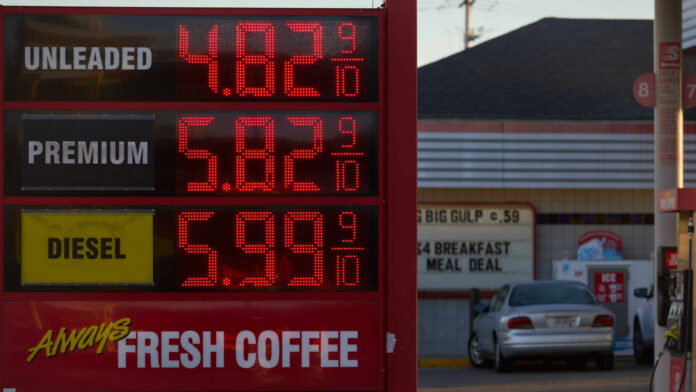
- Average U.S. gasoline prices reached $4.52 per gallon as of mid-May 2026, up from just under $3.00 per gallon when the United States launched military strikes against Iran on February 28 — a jump of more than 50 percent in under three months.
- Trump announced his support for a gas tax holiday in a CBS News interview and Oval Office remarks, saying “we’re going to take off the gas tax for a period of time, and when gas goes down, we’ll let it phase back in,” while acknowledging Congress must act.
- Republican Senator Josh Hawley announced he would introduce legislation to suspend the federal gas tax, and GOP Rep. Anna Paulina Luna of Florida said she would introduce a companion bill in the House.
What Happened
President Donald Trump announced this week that he wants to suspend the federal gasoline tax — an 18.4-cent-per-gallon excise tax that has been in place since 1993 — as a direct response to surging fuel prices caused by Iran’s blockade of the Strait of Hormuz. In an interview with CBS News and separate remarks in the Oval Office, Trump said the proposal was aimed at providing relief to American consumers who have seen gasoline prices climb from approximately $2.98 per gallon before the Iran war began in late February to $4.52 per gallon as of mid-May — an increase of more than 50 percent in under three months.
“I think it’s a great idea,” Trump told CBS. “Yup, we’re going to take off the gas tax for a period of time, and when gas goes down, we’ll let it phase back in.” The administration has framed the proposal as a tangible, immediate step to ease economic pain for working Americans while diplomacy and military pressure continue to be applied to reopen the Strait of Hormuz. Energy Secretary Chris Wright told NBC’s Meet the Press that the White House is “open to all ideas” to lower consumer costs, calling the proposal under active consideration.
The political urgency is significant. A poll conducted by NPR, PBS NewsHour, and Marist found that eight in ten Americans say gas prices are straining their household budgets — a concern that crosses partisan lines, with overwhelming majorities of Democrats, independents, and Republicans alike expressing financial pressure. In Los Angeles, gas prices exceeded $6 per gallon at some stations in early May. Budget airline Spirit Airlines shut down operations this month, citing jet fuel costs that have more than doubled since the Iran war began, and analysts predict airline ticket prices will rise substantially through the summer.
Republican Senator Josh Hawley of Missouri moved quickly to translate Trump’s remarks into legislation, announcing he would introduce a bill to suspend the federal gas tax. GOP Representative Anna Paulina Luna of Florida announced a companion House bill. Several Democratic lawmakers had already introduced similar legislation — an unusual moment of potential bipartisan overlap on a high-visibility consumer issue in a deeply polarized Congress. However, the legislative path remains uncertain. The gas tax is the primary funding mechanism for the Highway Trust Fund, which supports road, bridge, and transit construction across the country. A full suspension would cost the federal government approximately $500 million per week, according to budget analysts.
The administration has already taken several steps to try to ease gas prices that have not fully succeeded. The White House has tapped the Strategic Petroleum Reserve and waived the Jones Act — which restricts coastal shipping to American-flagged vessels — to ease fuel supply at domestic ports. But energy analysts have consistently noted that neither measure can offset the structural supply disruption caused by Iran’s near-closure of the Strait of Hormuz, through which approximately one-fifth of the world’s crude oil normally flows.
Why It Matters
The federal gas tax holiday debate matters for several distinct reasons. First, it is a rare instance where a Republican president is proposing a direct, immediate consumer subsidy — effectively using the tax code to transfer cost relief to American drivers at a time when fiscal conservatism would normally counsel against reducing revenue. The proposal reflects the administration’s recognition that gas prices above $4.50 per gallon create political risk that must be actively managed, particularly with November midterm elections approaching.
Second, the proposal tests the limits of executive economic authority in a domain where Congress holds clear constitutional power. Trump cannot suspend the gas tax unilaterally — unlike tariffs, which he has attempted to impose via emergency authority — because excise taxes are explicitly statutory. Any holiday requires legislation, which means Republican majorities in both chambers must act, likely in an accelerated legislative timeline to produce results visible to consumers before Election Day.
Third, the gas tax holiday debate forces Republicans to navigate a genuine fiscal dilemma. The Highway Trust Fund is already chronically underfunded relative to the nation’s infrastructure needs — a problem that predates the Iran war. Suspending its primary revenue source for any extended period would either require offsetting appropriations from other accounts or result in delayed or cancelled infrastructure projects across the country, a politically uncomfortable outcome for legislators who campaigned on rebuilding American infrastructure.
Economic and Global Context
The economic context for the gas tax proposal is framed almost entirely by the Iran war. Iran’s near-closure of the Strait of Hormuz — through which 17 to 21 million barrels of oil flow daily under normal conditions — has removed a substantial portion of global oil supply from markets. The disruption has pushed Brent crude above $100 per barrel, driving domestic pump prices to their highest level since July 2022. Diesel fuel, a critical input for agriculture, trucking, and freight rail, is approaching its all-time high.
A full suspension of the 18.4-cent federal gas tax and 24.3-cent diesel tax would provide only partial and indirect relief. The Bipartisan Policy Center estimates a full suspension would reduce pump prices by 10 to 16 cents per gallon — meaningful but far short of the $1.50-per-gallon price increase consumers have absorbed since late February. A persistent challenge with gas tax holidays is that the savings are not reliably passed on to consumers; energy economists have documented that previous gas tax holidays have often been partially or fully absorbed by retailers and refiners rather than reducing prices at the pump. Congress would have limited enforcement mechanisms to guarantee full pass-through to consumers.
The Spirit Airlines closure this month illustrates the cascading economic effects of sustained high fuel prices. The carrier, which served price-sensitive leisure travelers and anchored competition on many domestic routes, cited jet fuel costs as a primary factor in its shutdown. Higher ticket prices across all carriers are expected to become visible to consumers by the summer travel season.
Implications
For Congress, the gas tax holiday proposal is both a political opportunity and a legislative challenge. On the opportunity side, it allows Republicans to demonstrate direct, tangible responsiveness to a cost-of-living crisis that is damaging the party’s electoral standing. A gas tax holiday passed before the summer driving season would produce visible, immediate relief — the kind of concrete benefit that voters notice and credit to their elected officials. On the challenge side, the fiscal cost, the Highway Trust Fund implications, and the enforcement problem create substantive policy concerns that fiscally conservative Republicans will need to work through before the proposal can advance.
For energy markets, the gas tax debate is a symptom rather than a cure. The fundamental supply constraint is the Strait of Hormuz disruption, which can only be resolved through diplomatic or military means. No domestic tax policy can meaningfully offset a global oil supply shock of this magnitude, and markets will price that reality regardless of what Congress does with the gas tax. Analysts project that prices will remain elevated through summer absent a ceasefire agreement that includes a verifiable Hormuz reopening.
For Republican candidates running in competitive House and Senate districts, the gas tax holiday provides a campaign-season talking point that directly engages voters’ top economic concern. Candidates can credibly say they are taking concrete action on pump prices — even if the legislative outcome is uncertain — while also positioning against Democrats who may oppose the proposal on Highway Trust Fund or fiscal grounds.
Sources

