Story Highlights
- China agreed to purchase 200 Boeing jets, which would be its first significant U.S. commercial aircraft buy in nearly a decade, though Beijing has not officially confirmed the deal.
- Xi and Trump agreed to a “strategic stability” framework intended to guide bilateral relations over the next three years, according to Chinese state media.
- Taiwan remained a central point of friction, with Xi warning that mishandling the island’s status could lead to conflict; Trump said he has not yet decided on a proposed $14 billion arms sale.
What Happened
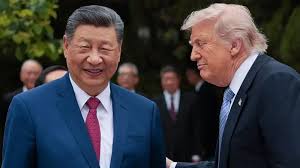
President Donald Trump arrived in Beijing earlier this week for his first state visit to China since his return to the White House, meeting with Chinese President Xi Jinping across two days of talks at the Zhongnanhai compound — a historic government complex dating to China’s imperial era. The summit, framed by both sides as an effort to stabilize a relationship that has been battered by tariffs, technology disputes, and geopolitical tensions, featured ceremonial elements including a tea ceremony, a state dinner, and flag-waving crowds organized for the occasion.
Trump departed Friday aboard Air Force One without any formal joint communiqué or enumerated list of agreements. Speaking to reporters en route to Alaska, Trump said the meetings had been productive, telling journalists that “a lot of different problems” had been settled, without specifying details. He described the atmosphere with Xi as warm and praised what he characterized as significant economic concessions.
In an interview with Fox News conducted during the trip, Trump stated that China had agreed to purchase 200 commercial airplanes from Boeing, which would represent a meaningful reversal of Beijing’s informal boycott of U.S. aircraft since trade tensions escalated. However, the figure fell short of the approximately 500 purchases some market analysts had projected heading into the summit. Chinese officials had not publicly confirmed the aircraft order as of Friday.
On the geopolitical front, Xi used the summit’s first day to deliver a pointed warning about Taiwan, cautioning that mismanaging China’s sovereignty claims over the island could produce “clashes and even conflicts.” Trump acknowledged that Taiwan was discussed extensively and said he does not believe a military confrontation over the island is imminent. He told reporters he has not yet made a determination on whether to proceed with a $14 billion arms sale to Taipei, adding that he would consult with Taiwan’s president, Lai Ching-te, before finalizing any decision.
The question of Iran also surfaced during the talks. Xi offered what U.S. officials characterized as agreement to keep the Strait of Hormuz open and a statement that Iran should not acquire nuclear weapons — positions analysts described as low-cost rhetorical commitments that impose little real pressure on Tehran. Craig Singleton, a senior fellow at the Foundation for Defense of Democracies, noted that the harder test would be whether Beijing would actually pressure Iran, restrict Chinese oil purchases from Tehran, or translate general language into verifiable outcomes.
Why It Matters
The Trump-Xi summit carries significance well beyond its immediate outcomes. The U.S.-China relationship shapes global trade flows, technology supply chains, financial markets, and regional security across the Indo-Pacific and beyond. Any stabilization — even rhetorical — reduces the risk of the kind of abrupt escalation that could rattle markets or trigger a military confrontation in contested waters near Taiwan or in the South China Sea.
For American businesses, particularly in aviation and energy, the commitments made in Beijing — however unconfirmed — signal a potential thaw in commercial dealings that have been constrained for years. Boeing, which has faced a painful combination of manufacturing crises and diminished Chinese orders, would benefit enormously from even a partial resumption of sales to Chinese carriers. The broader trade relationship, shaped heavily by tariffs that both governments have treated as leverage, may be entering a phase of managed de-escalation.
For Republican policymakers and voters, the summit represents Trump’s continued assertion that personal diplomacy at the highest level can unlock progress that traditional diplomatic channels cannot. The president framed the visit as a success rooted in his direct relationship with Xi, consistent with his broader foreign policy approach of bilateral leader-to-leader engagement over multilateral frameworks.
At the same time, the absence of concrete deliverables on the most contentious issues — Taiwan arms sales, fentanyl precursor flows, Chinese military activity in the Pacific — means that the structural tensions defining the relationship remain intact. Analysts noted that the real measure of the summit’s success will emerge over the months ahead, particularly as both sides attempt to operationalize whatever informal understandings were reached.
Economic and Global Context
The Boeing deal, if confirmed, would be economically significant. Boeing has seen its standing in the Chinese aviation market erode sharply over the past several years, with Chinese carriers shifting purchases heavily toward Airbus and domestically produced COMAC aircraft. A 200-plane order from Chinese carriers would represent billions of dollars in revenue and support thousands of American manufacturing jobs, particularly in Washington State and South Carolina.
On energy, Trump indicated that China had also agreed to purchase U.S. oil, a commitment that would provide incremental support for American producers at a time when energy markets remain sensitive to geopolitical developments in the Middle East. Broader trade volumes between the two countries have been distorted by the tariff regime both governments have maintained, and any movement toward normalization in goods trade would have ripple effects across global supply chains.
The summit also touched on Iran’s nuclear program in the context of ongoing U.S. military operations in the region. Chinese state media indicated that Xi had expressed support for de-escalation. However, China has continued purchasing Iranian oil despite U.S. sanctions, and experts cautioned that verbal commitments made in a summit setting have historically not translated reliably into behavioral changes in Beijing’s energy purchasing patterns.
Looking further ahead, Xi’s visit to the United States is tentatively expected in September, with observers suggesting it could be timed around the United Nations General Assembly in New York. Hai Zhao, a director of international political studies at the Chinese Academy of Social Sciences, described the anticipated September meeting as a return state visit that would carry significant diplomatic weight.
Implications
For the Trump administration, the summit provides a political narrative of diplomatic engagement and deal-making that can be presented to American voters as a tangible product of the president’s approach to foreign policy. The Boeing announcement, in particular, translates into a concrete economic story involving American jobs — regardless of whether a formal agreement is yet in place.
For Taiwan, the summit’s outcome is more ambiguous. Xi’s explicit warning about the island’s status, delivered directly to Trump, signals that Beijing intends to keep Taiwan central to any discussion of U.S.-China relations. Trump’s decision to delay the $14 billion arms sale determination means that Taipei faces continued uncertainty about the level of American military commitment it can count on.
For U.S. businesses operating across the Indo-Pacific region, the summit signals neither a full normalization nor a continuation of peak tensions. The strategic stability framework agreed upon by both leaders suggests that both Washington and Beijing are prepared to manage the relationship as a structured rivalry rather than allow it to drift toward open confrontation.
For markets and policymakers globally, the most consequential near-term question is whether the informal commitments made in Beijing — on Boeing, oil, Iran, and Taiwan — harden into formal, verifiable agreements or dissolve as subsequent events impose competing pressures on both governments.
Sources
“Live updates: Trump concludes warm China trip with few clear wins”

