Story Highlights
- Trump arrived in Beijing on May 13 for a two-day summit with President Xi Jinping focused on trade, Iran, and AI oversight
- The Iran ceasefire is described by Trump as on “massive life support” after he rejected Tehran’s latest counterproposal
- Trump’s delegation includes Secretary of State Marco Rubio, Defense Secretary Pete Hegseth, and tech CEOs Elon Musk, Tim Cook, and Jensen Huang
What Happened
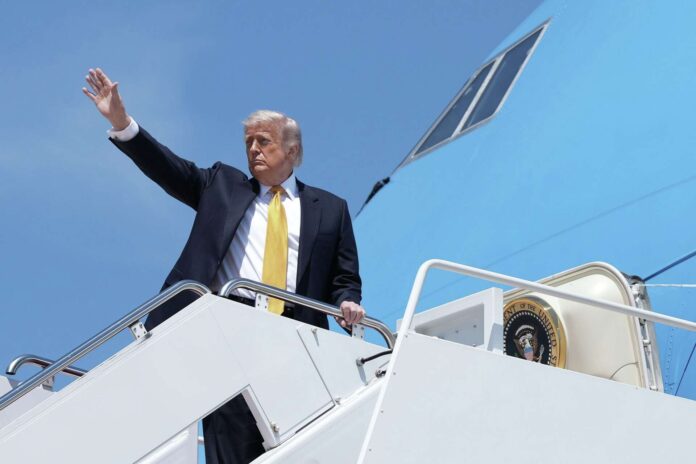
President Donald Trump landed at Beijing Capital International Airport on the morning of May 13, greeted by senior Chinese officials including Chinese Executive Vice Minister of Foreign Affairs Ma Zhaoxu and Vice President Han Zheng. The state visit, which had originally been delayed by the outbreak of the U.S. war with Iran earlier this year, was rescheduled after Trump and Xi last met on the sidelines of a South Korean summit in the fall of 2025 — a meeting Trump described on Air Force One as “a 12 out of 10.”
Joining Trump on the trip is a high-profile delegation that reflects both the diplomatic and economic dimensions of the visit. Secretary of State Marco Rubio and Defense Secretary Pete Hegseth represent the national security arm of the administration, while prominent technology executives — including Elon Musk of Tesla and SpaceX, Tim Cook of Apple, and Nvidia CEO Jensen Huang — signal the administration’s desire to use business ties as a diplomatic tool. Huang’s participation came as a last-minute addition, with the Nvidia chief joining the delegation during a refueling stop in Alaska.
Trump told reporters before departing Washington that the summit would “largely focus on trade,” though he also indicated plans to have a “long talk” with Xi about the ongoing war with Iran. The two leaders are expected to discuss the possibility of creating a formal U.S.-China Board of Trade to institutionalize management of the bilateral economic relationship. Discussions around artificial intelligence are also planned, with officials describing the goal as establishing “channels of deconfliction” on the issue between the world’s two largest economies.
The backdrop of the visit is anything but stable. The ceasefire between the U.S. and Iran, which took effect in early April, has been under severe strain. After rejecting Tehran’s latest counterproposal — which Trump called “a piece of garbage” — the president declared the truce was on “massive life support.” Some senior Trump aides are now reportedly considering a resumption of major combat operations. Regional sources told CNN that peace talks are unlikely to make meaningful progress until Trump’s Beijing summit concludes, underscoring just how much weight is riding on this diplomatic trip.
Why It Matters
The Beijing summit carries enormous stakes for the United States at a uniquely turbulent moment. Trump is simultaneously trying to manage an active military conflict with Iran, stabilize an unsettled global economy rattled by war-driven energy price spikes, and maintain his administration’s posture on trade with the world’s second-largest economy. The fact that all three of these threads converge in a single two-day meeting in Beijing illustrates both the complexity of the current geopolitical environment and the outsized role this particular bilateral relationship plays in it.
For American businesses, the summit offers the prospect of renewed clarity on the U.S.-China trade relationship. Following the dramatic tariff escalations and subsequent truce of 2025, American companies — particularly in the technology sector — have been eager for greater predictability. The inclusion of Musk, Cook, and Huang in the delegation sends a clear signal that the administration intends to use private-sector leverage to push for concessions and opportunities in China’s market.
For the Republican Party, the summit represents a critical test of Trump’s foreign policy brand. His supporters have long valued his willingness to engage directly with adversaries and peers alike, and a successful outcome in Beijing could provide a political boost at a moment when the administration’s approval ratings are under significant pressure. Conversely, a failed or inconclusive summit would add to growing domestic concerns about the administration’s handling of multiple simultaneous crises.
The diplomatic optics matter as well. Beijing residents interviewed ahead of the visit expressed skepticism, with one describing Trump as “not trustworthy.” Chinese state media will be watching closely how Xi manages the meeting, with domestic audiences on both sides evaluating the encounter through their own political lenses.
Economic and Global Context
The U.S.-China economic relationship remains one of the defining structural features of the global economy. When Trump and Xi last met in South Korea in 2025, the two sides agreed to dial back an escalating trade war that had been disrupting global supply chains and rattling financial markets. Since then, tensions have been managed cautiously, but underlying disagreements over technology transfer, tariffs, and market access remain unresolved.
The Iran conflict has introduced a new and compounding variable into the global economic picture. Oil prices have remained above $100 per barrel, and the U.S. Department of Energy has warned they are likely to stay there in the coming weeks. National average gasoline prices have climbed to $4.52 per gallon, up from $2.98 when the war began. Inflation accelerated in April to an annual rate of 3.8 percent — the highest since May 2023 — with energy costs accounting for roughly 40 percent of that increase.
China has particular economic exposure to instability in the Middle East. The country is the world’s largest importer of crude oil, much of which flows through the Strait of Hormuz — the same waterway that has been at the center of the U.S.-Iran standoff. Beijing has a strong interest in seeing hostilities de-escalate, giving Xi genuine leverage at the negotiating table. China was also involved in mediating earlier stages of the ceasefire, with officials confirming Chinese participation in truce negotiations.
Implications
The outcome of the Beijing summit will send signals across multiple fronts simultaneously. If Trump and Xi can agree on a framework for managing trade disputes and establish formal coordination mechanisms on AI, it would represent a meaningful stabilization of the most consequential bilateral relationship in the world. That kind of outcome could provide a modest boost to financial markets and offer relief to multinationals caught between the two economic superpowers.
On Iran, the summit may prove pivotal. A resumption of major combat operations would be a seismic event with enormous economic and humanitarian consequences. If Beijing’s influence can be brought to bear on Tehran — whether directly or indirectly — Trump may be able to negotiate a more durable ceasefire that addresses core U.S. demands on nuclear nonproliferation.
For Republican lawmakers heading into the November midterms, a diplomatic victory in Beijing would offer badly needed good news. With Trump’s approval rating sitting at just 37 percent according to the latest NPR/PBS/Marist poll, and with over 80 percent of Americans saying gas prices are straining their household budgets, a visible foreign policy achievement could shift the political conversation. Republicans are acutely aware that the path to holding the House in 2026 runs partly through demonstrating that the administration’s foreign engagements are producing results.

