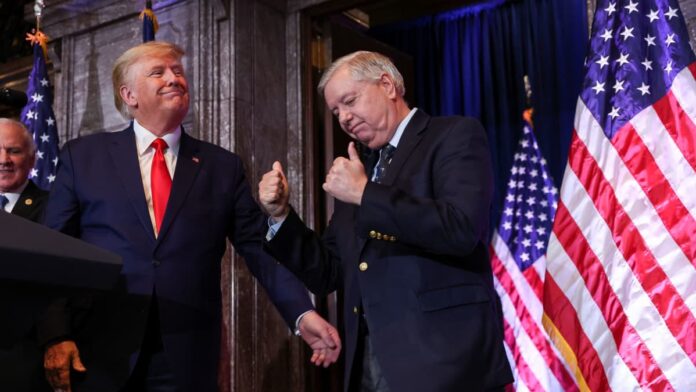
President Trump on Monday urged the Senate to pass the Clarity Act, a major cryptocurrency regulation bill, framing swift passage as a tribute to the late Sen. Lindsey Graham just days after the South Carolina Republican’s sudden death. The push adds digital asset regulation to a growing list of legislative priorities now tied to Graham’s legacy, as Senate Republicans work through a crowded summer agenda. Trump’s appeal signals renewed White House pressure on Congress to finalize a regulatory framework the crypto industry has sought for years.
Story Highlights
- Trump called on the Senate to pass the Clarity Act “in honor of Senator Lindsey Graham,” a supporter of the legislation
- The bill aims to establish a comprehensive federal regulatory framework for digital assets
- The push comes amid a broader wave of legislative priorities Trump has tied to Graham’s death, including sanctions and election bills
What Happened
President Trump posted on Truth Social Monday calling on the Senate to pass the Clarity Act, a comprehensive cryptocurrency regulatory framework, as a tribute to Sen. Lindsey Graham, who died unexpectedly over the weekend. “In honor of Senator Lindsey Graham, a big supporter, the U.S. Senate should pass the Clarity Act,” Trump wrote, linking the bill’s passage directly to Graham’s legacy just two days after his death from an aortic dissection.
The Clarity Act is designed to establish clear jurisdictional boundaries between federal regulators overseeing digital assets, an issue that has created years of uncertainty for cryptocurrency companies operating in the United States. The legislation has been a top priority for the crypto industry, which has pushed for years to resolve ambiguity over which federal agencies, primarily the Securities and Exchange Commission and the Commodity Futures Trading Commission, hold jurisdiction over different types of digital tokens and trading platforms. Supporters argue that a clear framework would allow American companies to compete more effectively in the global digital asset market without fear of shifting regulatory interpretations.
Trump’s appeal to pass the bill “in honor” of Graham is notable given that cryptocurrency regulation was not among the causes most closely associated with Graham’s decades-long Senate career, which focused primarily on national security, foreign policy and judicial nominations. The framing appears to reflect a broader White House strategy of leveraging the emotional aftermath of Graham’s death to build momentum for a range of pending legislative priorities, including the Clarity Act, the Sanctioning Russia Act targeting Moscow’s oil revenue, and the SAVE America Act, Trump’s election overhaul legislation that Graham had also supported.
The push comes as the Senate faces a crowded legislative calendar heading into the August recess, with lawmakers simultaneously navigating the aftermath of Graham’s death, the appointment of his interim successor, ongoing appropriations negotiations, and the escalating conflict with Iran. Senate Majority Leader John Thune has not indicated a specific timeline for bringing the Clarity Act to the floor, though the bill has previously drawn bipartisan interest as part of a broader push to modernize digital asset regulation following years of industry lobbying.
Why It Matters
The Clarity Act’s advancement would represent a significant milestone for the cryptocurrency industry, which has spent years seeking regulatory certainty from Washington. A clear federal framework could unlock greater institutional investment in digital assets and provide American companies with a more stable operating environment compared to the current patchwork of enforcement actions and shifting agency interpretations that have characterized crypto regulation in recent years.
For everyday investors, clearer rules could offer greater protection by establishing consistent standards for how digital asset platforms must operate, disclose risks, and safeguard customer funds, potentially reducing the kind of regulatory gray areas that have contributed to high-profile industry collapses in the past. At the same time, critics of light-touch crypto regulation have warned that industry-favored legislation could prioritize innovation and competitiveness over robust consumer protections.
Trump’s decision to tie the bill to Graham’s memory also illustrates a broader pattern in how the administration is managing the aftermath of an influential senator’s sudden death, using the moment to build momentum across multiple unrelated legislative priorities. Whether that strategy proves effective will likely depend on how genuinely persuasive colleagues find the emotional appeal versus the underlying merits of each individual bill.
For the broader digital asset industry, the renewed presidential attention signals that crypto regulation remains a live priority for the administration even amid a packed agenda dominated by foreign policy crises and domestic political transitions, suggesting industry advocates may find a more receptive audience in Washington in the coming weeks.
Economic and Global Context
The cryptocurrency industry has grown into a multi-trillion dollar global market, with the United States competing against jurisdictions such as the European Union, which has already implemented its Markets in Crypto-Assets regulation, and various Asian financial hubs that have moved more quickly to establish clear digital asset rules. Industry advocates argue that continued regulatory ambiguity in the U.S. risks pushing innovation and investment offshore to jurisdictions with more settled legal frameworks.
Passage of the Clarity Act could also have implications for how traditional financial institutions engage with digital assets, potentially accelerating the integration of cryptocurrency products into mainstream banking and investment services now that federal regulators would have clearer statutory guidance on jurisdiction and compliance requirements.
The push for crypto regulation also intersects with the administration’s broader economic agenda, which has included efforts to position the United States as a leader in emerging financial technology. A comprehensive regulatory framework would align with those broader ambitions, potentially reinforcing Washington’s competitive position in global fintech markets.
Implications
In the near term, the Senate will need to weigh the Clarity Act against a packed legislative calendar that includes appropriations bills, the Russia sanctions legislation, and the ongoing fallout from Graham’s death, all competing for limited floor time before the August recess. Whether Trump’s appeal accelerates the bill’s timeline remains uncertain given the competing priorities.
For the cryptocurrency industry, continued advocacy and lobbying efforts are likely to intensify in the coming weeks as companies seek to capitalize on the renewed presidential attention and push lawmakers toward a floor vote. Industry groups will likely frame the bill’s passage as both an economic opportunity and a matter of maintaining American competitiveness in financial technology.
For Senate Republicans and Democrats alike, the coming weeks will test how effectively Graham’s legacy can be marshaled to move multiple pieces of legislation simultaneously, and whether that momentum can survive the practical realities of a crowded summer session focused heavily on foreign policy and appropriations fights.
Source
Trump says Graham’s death is ‘big blow to the SAVE America Act’

