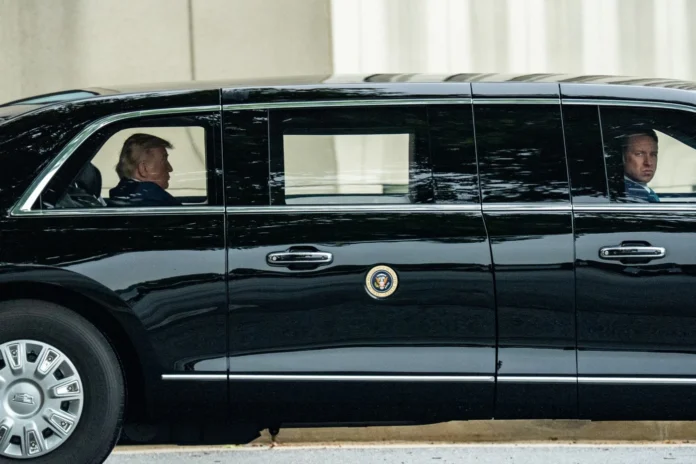
President Donald Trump gathered his full Cabinet at the White House on Wednesday as negotiations to end the ongoing U.S.-Iran war entered a delicate and uncertain stretch. Trump is projecting confidence that he’s closing in on a deal that will reopen the Strait of Hormuz and provide him a credible argument that Iran’s nuclear capability has been diminished enough to declare victory, winding down a conflict that’s been politically unpopular for Republicans. The session comes amid a tangle of disputed reports, continued military activity, and growing pressure from lawmakers and the public for a clear path to resolution.
Story Highlights
- Iranian state television reported a draft memorandum of understanding that would require U.S. military forces to withdraw from Iran’s vicinity and lift a blockade of Iranian ports in exchange for the reopening of the Strait of Hormuz; the White House called the report “not true.”
- The Pentagon is struggling financially to carry out routine training and maintenance amid ongoing operations, with military leaders pressing Congress for additional funding.
- Talks were further complicated after U.S. forces carried out what the Pentagon called “defensive” strikes on missile launch sites and mine-laying boats in southern Iran, which Iran decried as a sign of bad faith.
What Happened
President Donald Trump convened his Cabinet on Wednesday morning at the White House in what administration officials described as a high-stakes strategy session on the status of negotiations to end the U.S.-Iran war. The meeting, originally planned to take place at Camp David, was moved to the White House due to what Trump cited as possible bad weather. All Cabinet members were expected to attend, and the session was open to the press.
Trump arrived at the meeting just days after insisting his administration and Tehran had “largely negotiated” a settlement, with negotiations still in a state of flux. The competing narratives around what has or has not been agreed to have created confusion in Washington and abroad, with Iranian state media and the White House issuing contradictory accounts of the proposed terms.
Secretary of State Marco Rubio acknowledged the complexity of the situation, stating Tuesday that talks on reopening the Strait of Hormuz and extending the ceasefire would take several more days. Rubio told reporters, “He’s either going to make a good deal or no deal,” signaling that the administration is not willing to commit to terms it views as insufficiently favorable, even under growing political pressure.
The military backdrop to the diplomatic activity remains tense. U.S. forces conducted strikes on Iranian positions as recently as Monday, which the Pentagon described as defensive actions targeting missile launch sites and mine-laying equipment. Following the announcement of a two-week ceasefire, initial U.S.-Iran talks in Pakistan in April failed to reach a peace deal, after which Trump announced an open-ended extension of the ceasefire and the continuation of a U.S. blockade until negotiations are concluded.
Vice President J.D. Vance expressed optimism ahead of the Cabinet meeting, saying he is “extremely hopeful” that Tehran will formally disavow nuclear weapons as part of any final agreement. The administration has consistently maintained that a verifiable end to Iran’s nuclear ambitions is a non-negotiable condition of any peace settlement.
Why It Matters
The outcome of the Iran negotiations will define a large portion of Trump’s second-term legacy. The conflict, now in its third month following the joint U.S.-Israeli strikes launched on February 28, has become a significant political liability for the administration. Multiple polls show Americans increasingly do not believe Trump can end the Iran war with a clear-cut victory for the U.S., and a majority of polled voters want to end military operations in Iran even without a peace deal.
For Republican lawmakers facing competitive midterm elections, the Iran war’s resolution — or lack thereof — is a central concern. A prolonged conflict with no clear endgame threatens to become an albatross for GOP candidates across the country, particularly in suburban districts where voter anxiety over military entanglement and economic disruption tends to be most pronounced.
The stakes of the current negotiations extend well beyond electoral politics. A deal that critics view as insufficiently tough on Iran’s nuclear program could generate blowback from hawkish members of both parties, as well as from key allies in the Middle East. Conversely, a failure to reach any agreement would leave the administration managing an open-ended military operation with growing financial and strategic costs.
The emerging deal puts off many critical issues to be resolved later and has already exposed the Republican president to fierce criticism — even from some of his own supporters — that Iran’s hard-line leaders will interpret concessions as weakness. Managing those perceptions while securing a deal substantive enough to declare victory is the central diplomatic challenge Trump now faces.
Economic and Global Context
The economic consequences of the ongoing conflict are substantial and cumulative. The Strait of Hormuz — a focal point of the current ceasefire terms — is one of the world’s most critical chokepoints for global energy trade. Restrictions on its use have contributed to elevated oil prices and shipping insurance costs since the conflict began, with effects rippling through global supply chains and consumer prices in the United States and abroad.
The Navy’s top officer, Admiral Daryl Caudle, told House Armed Services Committee lawmakers that his 2026 budget did not account for Operation Epic Fury, and that the Navy faces impacts on routine operations as a result, including limits on training exercises, flight training hours, and training for new recruits. The financial strain on the military is translating directly into readiness concerns that extend beyond the Iran theater.
Global markets have been watching the negotiations closely. Energy sector volatility tied to the conflict has created uncertainty for businesses and governments dependent on Middle Eastern oil flows. Any credible deal that reopens the Strait of Hormuz to pre-war levels would likely produce an immediate and measurable reduction in global energy prices, providing a potential economic dividend for Trump at a politically sensitive time.
The broader geopolitical picture is complicated by Iran’s internet blackout, reported military restrictions, and the role of Pakistan as a diplomatic intermediary. Other regional actors — including Gulf states and NATO members — are monitoring the negotiations, with concerns about what a perceived U.S. concession to Iran might signal about American resolve in future conflicts.
Implications
If Wednesday’s Cabinet meeting produces a clear directive to pursue a specific negotiated framework, it could accelerate talks toward a resolution in the coming days. The White House has strong incentives to reach a deal quickly given declining approval ratings and the approaching midterm campaign season, in which every week of continued conflict represents additional political risk.
For Congressional Republicans, the Cabinet meeting outcome will be closely watched. Lawmakers who have quietly pushed for a resolution will need to decide whether any emerging deal provides adequate political cover — particularly on the question of Iran’s nuclear status. A deal that leaves Iran’s nuclear infrastructure partially intact is likely to face intense scrutiny from hawkish members, regardless of how it is framed by the administration.
The Iranian government’s posture remains an unpredictable variable. Tehran’s decision to broadcast details of the proposed memorandum of understanding — which the White House immediately denied — suggests that Iranian negotiators are managing their own domestic political pressures and may be attempting to shape international perceptions of the deal’s terms before any agreement is finalized.
Ultimately, the Cabinet meeting represents a moment of decision for an administration that has been publicly projecting confidence while privately managing a complex and evolving diplomatic situation. Whether that confidence translates into a durable agreement will determine not only the trajectory of the war, but the political fortunes of the Republican Party heading into November.

